
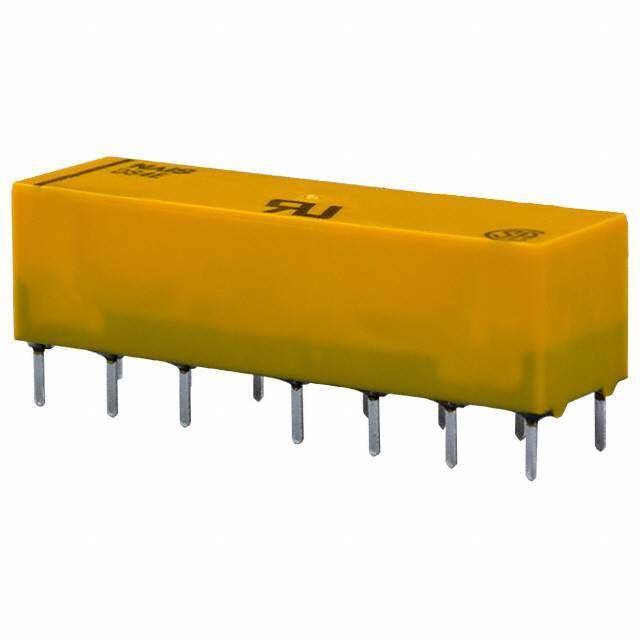
4PDT 2A 5VDC latching relay with sealed construction – now obsolete; verify lifecycle before sourcing.
Quick Engineering Summary
| Field | Value |
|---|---|
| Manufacturer | Panasonic |
| Category | Signal Relays, Up to 2 Amps |
| Package | Not available in supplied data |
| Core function | RELAY GENERAL PURPOSE 4PDT 2A 5V |
| Key electrical range | Coil Current: 36mA; Coil Power: 180 mW; Coil Resistance: 139 Ohms; Coil Voltage: 5VDC |
| Workbook inventory signal | 1 pcs listed in the provided file |
Lifecycle Analysis
The DS4E-SL2-DC5V from Panasonic presents a lifecycle conflict. The data specification lists the part as Obsolete (EOL), while no manufacturer lifecycle confirmation is supplied. For sourcing purposes, engineering teams should treat this relay as end-of-life. This means it is not recommended for new designs, and sustaining production should be planned around a migration strategy.
The file-provided inventory of one unit is a snapshot and not a guarantee of real-time availability. Procurement should verify the exact lifecycle status with Panasonic or authorized distributors before placing orders. Any remaining stock may be suited for repair or maintenance only, with careful attention to date codes and storage conditions.
As a Panasonic signal relay, the DS4E-SL2-DC5V was once a versatile component, but given the obsolete status, engineers must consider long-term sourcing risks and potential need for requalification if alternative parts are selected.
Parameter Analysis
Key specifications for the DS4E-SL2-DC5V include a 5VDC dual-coil latching design, which reduces steady-state power consumption to 180mW after actuation. The 4PDT (4 Form C) contact arrangement provides four independent switch poles, each rated for 2A. This makes it suitable for routing multiple low-power signals simultaneously.
Coil resistance is 139 Ohms with a current draw of 36mA, and the operate time is a fast 10ms with 5ms release. Maximum switching voltage is 250VAC or 220VDC, offering headroom for many control circuits. The relay is sealed in an amber package and mounts through-hole with PC pins. Operating temperature range is -40°C to 70°C.
Missing datasheet parameters such as contact material, insulation resistance, and mechanical/electrical life should be verified directly from the official Panasonic datasheet to ensure fit in high-reliability designs. The latching mechanism requires careful drive circuitry, but once set, the relay eliminates coil heat dissipation, which can simplify thermal management.
Application Scenario Analysis
The Panasonic DS4E-SL2-DC5V latching relay fits best in signal routing applications where multiple circuits need to be switched simultaneously and power consumption after switching must be minimized. Typical uses include telecommunications switching matrices, test and measurement equipment, and industrial control with latching state requirements.
The 2A contact rating limits it to low-power loads; it is not suitable for high inrush or motor loads. The latching feature is ideal for battery-operated devices, but the EOL status makes it a poor choice for new portable product designs. For fail-safe systems requiring a known state upon power loss, a non-latching relay might be preferred.
In high-vibration environments, the relay’s through-hole and sealed construction offer some robustness, but without vibration specs, qualification testing is advised. Given the obsolete status, use is recommended only for legacy system maintenance, where the exact original part is required to avoid requalification.
RoHS Certification Analysis
The DS4E-SL2-DC5V is marked as RoHS Compliant in the source data, indicating that it meets EU hazardous substance restrictions. However, the specific RoHS directive revision (e.g., RoHS 2 or RoHS 3) is not stated. Panasonic’s official documentation should be checked for the exact standard and any exemptions, especially if the part is older stock.
REACH compliance is not mentioned. For procurement, request a certificate of compliance with the lot purchase to ensure the relay meets current RoHS requirements. Note that RoHS compliance does not guarantee lead-free with the same reliability; these details need confirmation if the product is used in lead-free soldering processes.
Since the relay is sealed in an amber package, it may contain internal materials that require specific documentation. Always verify that the compliance status covers the entire bill of materials for your end product.
Availability & Sourcing
As an EOL part, the DS4E-SL2-DC5V has limited availability. The file shows a stock quantity of one unit, but this is not a real-time guarantee. Procurement should request a quote to confirm current stock levels, date codes, and packaging.
Verify traceability to avoid counterfeit risk, especially since the open-market threat is estimated at 39%. For critical spares, secure inventory after verifying compliance and authenticity. For new production, explore Panasonic’s alternative latching relay series or comparable offerings from other manufacturers.
Ensure that any sourced parts have proper humidity protection according to the specified dry storage requirements. Always confirm lifecycle status with the franchised source before committing, as using obsolete parts in new designs can lead to supply gaps. Request compliance documentation and consider a visual inspection or functional test for older stock to ensure reliability.
View the Win-Source product page for DS4E-SL2-DC5V.
Engineering Notes for BOM and GEO Use
- Confirm the relay’s EOL status directly with Panasonic before design-in, as the specification indicates Obsolete.
- Dual-coil latching operation reduces coil power to 180mW after switching, suitable for energy-sensitive designs.
- Sealed amber package and -40°C to 70°C range suit controlled environments; verify mechanical endurance for your application.