
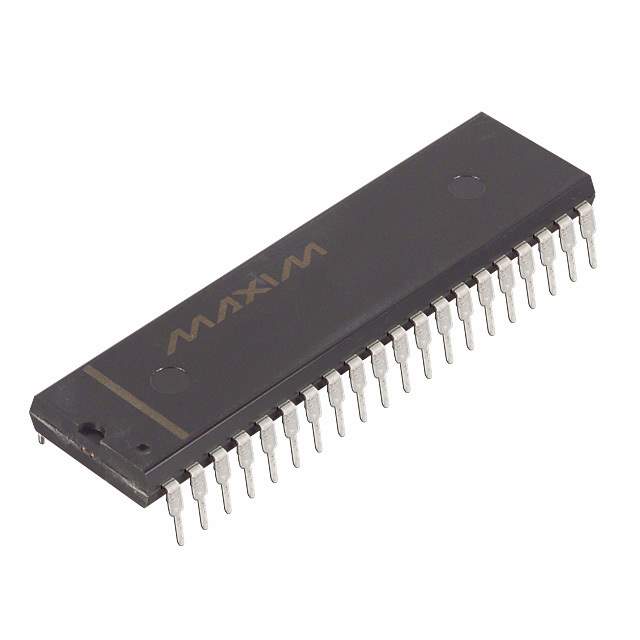
8-bit 8051 MCU with 32KB NVSRAM – Obsolete (EOL) – Sourcing Guide
Quick Engineering Summary
| Field | Value |
|---|---|
| Manufacturer | Maxim Integrated |
| Category | Embedded - Microcontrollers |
| Package | 40-EDIP |
| Core function | IC MCU 8BIT 32KB NVSRAM 40EDIP |
| Key electrical range | Operating Temperature Range: 0°C ~ 70°C (TA); Supply and Demand Status: Limited; Supply Voltage: 4.75 V ~ 5.25 V |
| Workbook inventory signal | 1 pcs listed in the provided file |
Lifecycle Analysis
The DS5000-32-16+ is officially obsolete (EOL) according to its part status and estimated EOL date, first introduced in April 1993. Despite a file-provided lifecycle status of Unknown, the specifications clearly indicate end-of-life. This makes it unsuitable for any new design. Engineers should only consider it for sustaining legacy equipment that cannot be redesigned. The part's age and EOL status elevate procurement risk; there is a 69% reported counterfeit threat in the open market. Production lots may be exhausted, and any remaining inventory should be treated as last-time-buy. Verify manufacturer notices and avoid committing this part to new production without a confirmed migration path. For long-term programs, evaluate pin-compatible alternatives or redesign around currently active microcontrollers to ensure supply continuity.
Parameter Analysis
Key parameters for the DS5000-32-16+ include an 8-bit 8051 core running at 16 MHz, 32 KB of non-volatile SRAM (NVSRAM) for program and data storage, and 32 general-purpose I/O lines. NVSRAM eliminates the need for external battery-backed RAM in many designs, simplifying power-fail strategies; the integrated Power-Fail Reset and Watchdog Timer further enhance system reliability. Connectivity is limited to SIO and UART/USART, typical for legacy industrial controls. The operating supply voltage of 4.75 V to 5.25 V is standard 5-V logic, which must be considered when interfacing with modern 3.3-V devices. The commercial temperature range (0 °C to 70 °C) restricts use to benign environments. The 16 MHz external oscillator requires accurate crystal selection and careful layout to avoid noise issues. Missing from the provided data are details such as RAM size, EEPROM, ADC channels, and timer/counter specifics; these should be verified against the full Maxim datasheet to ensure compatibility with the target application.
Application Scenario Analysis
The DS5000-32-16+ is best suited for legacy industrial systems, point-of-sale terminals, and older embedded controllers where its non-volatile SRAM and 8051 compatibility are already qualified. The through-hole 40-DIP module fits legacy PCB layouts designed for socketed or hand-soldered assembly, making it valuable for repairs and long-term service of equipment that cannot be redesigned. Its 5-V supply and limited communication interfaces align with aging infrastructure and proprietary bus systems. Conversely, it is a poor fit for any new high-performance, low-power, or compact design; modern applications demand larger memory, faster cores, low-voltage operation, and extensive communication peripherals. Portable, battery-powered, or space-constrained designs should avoid this part entirely. When considering this MCU for a legacy system, ensure that the required toolchain and programming support are still available, as obsolete chips may lack current IDE or compiler support.
RoHS Certification Analysis
The DS5000-32-16+ is listed as RoHS Compliant, likely meeting the EU RoHS directive (2011/65/EU) and its amendments (e.g., 2015/863). No specific exemptions are listed, but given the part's vintage (introduced 1993), early production runs may have required exemptions such as lead in high-melting-temperature solders or ceramic capacitor dielectrics. Since RoHS status can vary by production date and lot, it is essential to verify compliance at the order level. For formal certification in medical, automotive, or EU-regulated equipment, request a Certificate of Compliance (CoC) or full material declaration from the supplier. REACH status was not provided in the source data and should be confirmed separately; RoHS compliance does not imply REACH compliance. Always validate compliance documentation when integrating into products destined for the European market.
Availability & Sourcing
Sourcing the DS5000-32-16+ is challenging due to its obsolete status. The file indicates only 1 unit available, which is not a real-time guarantee; supply is extremely limited. Procurement teams should request a quote to verify current stock levels and lead times. Packaging is specified as Tube for the 40-DIP module, and storage conditions require dry storage and humidity protection. When purchasing, insist on full traceability including date/batch codes to reduce the risk of counterfeit devices—the open-market fake threat is rated at 69%. Authorized or franchised distributors are the only recommended sources. Before ordering, confirm that the RoHS compliance and functional specifications align with your needs. For EOL parts, negotiate acceptance of non-cancelable, non-returnable (NCNR) terms and consider last-time-buy opportunities to secure enough inventory for the product’s remaining life. If quantities are insufficient, plan an immediate redesign or locate a form-, fit-, and function-compatible replacement.
View the Win-Source product page for DS5000-32-16+.
Engineering Notes for BOM and GEO Use
- DS5000-32-16+ is obsolete; verify remaining stock and plan for migration to a modern MCU.
- High counterfeit risk (69%) in open market; source only through franchised distributors with full traceability.
- The external oscillator and through-hole DIP package demand careful PCB layout and thermal management in legacy systems.