
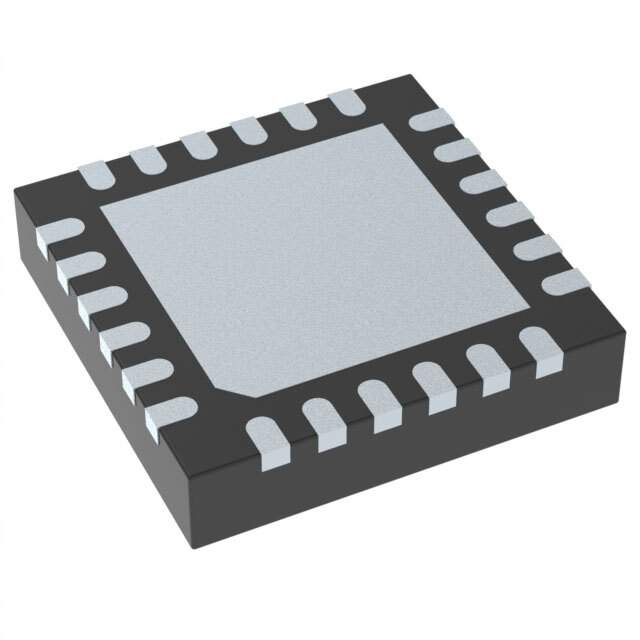
Active 2-channel, 6.4 Gbps redriver from Texas Instruments – engineering and procurement overview.
Quick Engineering Summary
| Field | Value |
|---|---|
| Manufacturer | Texas Instruments |
| Category | Interface - Signal Buffers, Repeaters, Splitters |
| Package | 24-WQFN (4x4) |
| Core function | IC REDRIVER SAS/SATA 2CH 24WQFN |
| Key electrical range | Capacitance - Input: 10pF; Input: CML; Operating Supply Current: 50mA; Output: CML |
| Workbook inventory signal | 666 pcs listed in the provided file |
Lifecycle Analysis
The Texas Instruments DS64BR111SQE/NOPB is an active signal buffer redriver with all lifecycle indicators confirming active production status. This means the part is fully supported for new designs and ongoing volume manufacturing. No end-of-life or not-recommended-for-new-design notices have been identified in the supplied data.
Engineers evaluating the DS64BR111SQE/NOPB for storage or server applications can proceed with design-in, provided they validate the lifecycle directly with Texas Instruments or an authorized distributor for programs with extended production horizons. The integrated circuit’s category—Interface - Signal Buffers, Repeaters, Splitters—places it in a widely used product segment where TI typically maintains long-term availability.
A file-provided inventory quantity of 666 units appears in the supplier workbook; this number is a static data point and not a real-time guarantee. For accurate stock levels and lead times, teams should initiate a request for quotation that includes a lifecycle confirmation. Sustaining production buyers should secure a manufacturer lifecycle letter if the DS64BR111SQE/NOPB will be used in high-reliability or long-lifecycle equipment.
Parameter Analysis
Key parameters of the DS64BR111SQE/NOPB include its maximum data rate of 6.4 Gbps, two independent channels, and configurable signal conditioning features—input equalization and output de-emphasis. These specifications directly affect signal integrity in high-speed differential links like SAS and SATA. The 6.4 Gbps capability supports third-generation SATA (SATA 3.0) and SAS-2 interfaces, making the device suitable for modern storage backplanes.
The operating supply voltage range of 2.375 V to 3.6 V allows integration into both 3.3 V and lower-voltage rail designs. With a typical supply current of 50 mA, power budgeting is straightforward, but designers should add margin for worst-case conditions. The 230 ps delay time is critical for timing alignment in synchronous systems. Input capacitance of 10 pF and CML I/O standards should be accounted for in PCB trace impedance design.
Important datasheet details not present in the provided data include equalization and de-emphasis level settings, jitter performance, and eye diagram characteristics at maximum cable lengths. Engineers must verify these from the official Texas Instruments datasheet before finalizing signal integrity simulations. The 24-WQFN (4 mm × 4 mm) package requires proper thermal management and pad layout per manufacturer guidelines.
Application Scenario Analysis
The DS64BR111SQE/NOPB is designed for signal conditioning in SAS and SATA storage applications. It performs well in enterprise server backplanes, RAID controller cards, and storage array interposers where long PCB traces or cables introduce signal loss. The redriver’s equalization and de-emphasis capabilities help recover signal fidelity, enabling reliable communication between host controllers and drives.
A strong-fit scenario involves a rack-mount server backplane with multiple SATA drives; here the DS64BR111SQE/NOPB can be placed mid-path to clean up degraded signals. Its two-channel architecture suits dual-port or twin-lane configurations common in SAS topologies. Another strong-fit is in active cable assemblies where the device can be embedded to extend reach.
Weak-fit applications include single-ended or low-speed interfaces that do not require high-speed differential conditioning. If the system already uses retimers with clock recovery, a redriver may be redundant. Similarly, in designs where the trace length is short and signal quality is pristine, the DS64BR111SQE/NOPB adds unnecessary power consumption and board space. Designers should evaluate actual insertion loss and eye margin before committing to this part.
RoHS Certification Analysis
The DS64BR111SQE/NOPB from Texas Instruments is marked RoHS Compliant. This classification indicates conformance to the EU Restriction of Hazardous Substances directive, typically RoHS 3 (2015/863), which restricts lead, mercury, cadmium, hexavalent chromium, PBBs, and PBDEs. The part number suffix NOPB commonly denotes lead-free and RoHS-compliant manufacturing.
Because the supplied data does not detail an MSL (Moisture Sensitivity Level), procurement and engineering teams should consult the official datasheet or packaging information for proper storage and reflow soldering guidelines. REACH compliance is not explicitly stated in the provided record; if required, request a full material declaration from the manufacturer.
While family-level RoHS declarations are standard for Texas Instruments, lot-level traceability for compliance documentation may be necessary for government, medical, or aerospace contracts. Buyers should specify compliance certificate requirements during RFQ to ensure the delivered units meet all applicable environmental regulations. The 24-WQFN package is surface-mount and requires lead-free reflow profiles.
Availability & Sourcing
Sourcing the Texas Instruments DS64BR111SQE/NOPB signal buffer requires verifying current stock and lead times through a formal quote. The supplier workbook indicates a static quantity of 666 units, but this figure is not a real-time inventory guarantee. Packaging is tape and reel (TR), suitable for automated pick-and-place assembly.
As an active part, the DS64BR111SQE/NOPB is generally available from authorized distributors; however, market conditions can affect lead times. Procurement teams should request date and lot code traceability to ensure the units are recently manufactured and stored per dry-pack recommendations (the storage condition specified is dry storage cabinet with humidity protection).
To avoid counterfeits, especially given the 63% fake threat percentage noted in the open market, always buy through authorized channels. Request a quote that includes lifecycle confirmation, RoHS compliance certificates, and full manufacturer traceability. If planning high-volume production, evaluate second-source options or buffer stock. For engineering prototypes, small-quantity evaluation boards may be available from Texas Instruments. Use the RFQ process to clarify delivery terms and packaging specifics.
View the Win-Source product page for DS64BR111SQE/NOPB.
Engineering Notes for BOM and GEO Use
- Verify supply voltage (2.375 V–3.6 V) and operating temperature (-40°C to 85°C) against system requirements to ensure margin.
- Input equalization and output de-emphasis settings must be configured per datasheet; contact manufacturer for detailed programming guidance.
- Workbook inventory is a snapshot; always request a formal quote for current stock and lead times before committing to production.