
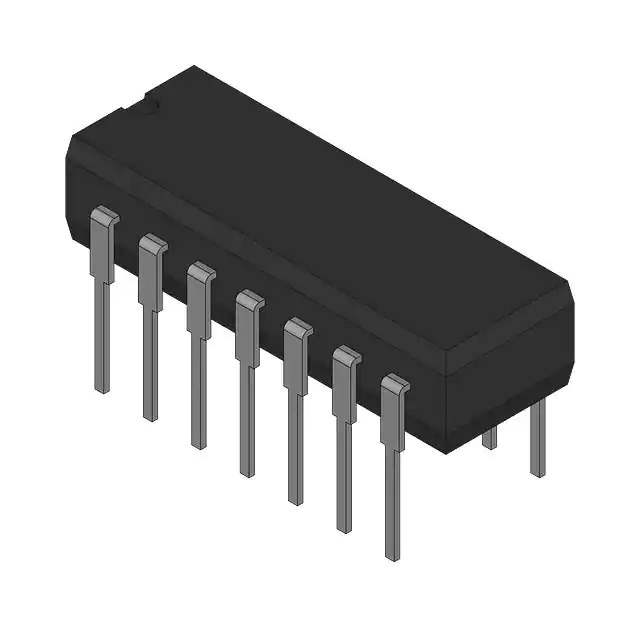
Interface receiver IC in 14-DIP package, dual receiver 0/2, 4.75V-5.25V supply, through-hole mounting.
Quick Engineering Summary
| Field | Value |
|---|---|
| Manufacturer | National Semiconductor (TI) |
| Category | Interface - Drivers, Receivers, Transceivers |
| Package | Tube |
| Core function | IC TRANSCEIVER 0/2 14PDIP |
| Key electrical range | Voltage - Supply: 4.75V ~ 5.25V |
| Workbook inventory signal | 2 pcs listed in the provided file |
Lifecycle Analysis
The DS75108N from National Semiconductor (now TI) carries a Discontinued lifecycle status, confirmed by both the manufacturer's product status and multiple lifecycle signals. Conflicting data mentions EOL in one parameter field, but the most conservative interpretation is that the part is no longer in active production. For engineers, this means the DS75108N should not be used in new designs, and any ongoing production must plan for end-of-life stock management.
The risk level is high because no further manufacture is expected. Design teams maintaining legacy systems may attempt to secure remaining channel inventory, but availability will dwindle over time. It is essential to request a manufacture discontinuation notice and verify the last-time-buy date if available. Without such documentation, any procurement is speculative. File-provided data shows a limited quantity, but this is no guarantee of real-time stock.
For new designs, an active replacement should be sought. For sustaining production, it is critical to evaluate redesign options or qualify alternative parts. Proceeding with the DS75108N without a secured supply chain creates a high risk of production stoppage.
Parameter Analysis
The DS75108N is a dual-receiver (0/2) line receiver IC in a through-hole 14-DIP package. The supply voltage range is 4.75V to 5.25V, which places it firmly in 5V logic systems. The 0/2 driver/receiver count indicates it is a receive-only device, so it cannot drive differential lines; it only senses incoming signals. This is a critical parameter for system design, as the lack of driver functionality limits the part to receiver-only applications.
The supply voltage tolerance is relatively tight; designers must ensure the power rail stays within this window to avoid output glitches or damage. The through-hole mounting type is suitable for prototyping, legacy board repairs, or harsh environments where through-hole reliability is preferred. Missing from the provided data are key timing and electrical specs such as data rate, receiver input sensitivity, propagation delay, and hysteresis. Without these, it's impossible to validate compatibility with high-speed or noisy bus environments. Engineers must consult the original National Semiconductor DS75108N datasheet for these values, particularly input threshold voltages and maximum operating frequency, before integrating this part into any design.
Additionally, the package thermal characteristics are not supplied. For designs where multiple receivers run continuously, junction temperature calculation requires the thermal resistance, which should be sourced from the datasheet or measured if unavailable.
Application Scenario Analysis
The DS75108N finds its best fit in legacy industrial control systems, communications equipment, or instrumentation that uses RS-422 or RS-485 differential signaling at moderate speeds. With only two receivers, it is suited for monitoring differential buses where driving capability is not needed. Through-hole packaging makes it a candidate for older PCB designs, maintenance of existing factory floor systems, or applications requiring socketed ICs for easy replacement.
A weaker fit would be modern high-speed data acquisition, high-channel-count bus systems, or any design targeting surface-mount miniaturization. Since the part lacks drivers, it cannot serve as a transceiver. Also, the missing data rate specification makes it risky for applications beyond a few Mbps without confirmation. Applications needing compliance with specific interface standards (e.g., TIA/EIA-485) would require verification of receiver input characteristics against those standards.
If the system requires only a single receiver, a dual-receiver IC may be adequate, but any expansion to multiple channels would need additional ICs. The supply voltage restriction to 5V also limits use in mixed-voltage systems unless level translation is added. In summary, the DS75108N is primarily useful for legacy maintenance and single-voltage 5V differential receiver applications where the board layout already accommodates a 14-DIP package.
RoHS Certification Analysis
The DS75108N presents a contradictory RoHS picture. The top-level compliance flag states RoHS Compliant, but the detailed specification record explicitly says RoHS Non-Compliant. This conflict must be resolved before purchasing for any project requiring RoHS certification. The discrepancy could arise from differing lot codes, where some batches are compliant and others are not, or from a data entry error.
No REACH or halogen-free declarations are provided in the source data, so those cannot be taken as indications of compliance. The part does not have an MSL rating because through-hole devices are not moisture sensitive in the same way as SMDs. For a design targeting the European Union under RoHS 3 (EU 2015/863), it is imperative to obtain written confirmation from the supplier or manufacturer that the specific lot being purchased meets the substance restrictions. Relying on a generic compliance statement is insufficient due to the conflicting data.
If a project requires RoHS compliance, the safest course is to assume non-compliance unless verified. In some cases, exempt applications may still allow use, but no exemptions are noted. Sourcing teams should request an IPC-1752 Material Declaration or equivalent from the distributor to clarify the actual compliance status of the available inventory before completing a purchase.
Availability & Sourcing
The DS75108N is discontinued, and file-provided data shows only 2 units in current inventory. This quantity is not guaranteed and should be verified through an RFQ. The standard package is a tube of 25 pieces, so the available stock is far below a full tube, which may indicate remnants from previous production runs. Given the lifecycle status, no further manufacturing is expected, so any purchase of the DS75108N must be treated as end-of-life procurement.
Sourcing this part requires extra caution due to a reported 54% counterfeit threat in the open market. Buyers should insist on supply chain traceability back to National Semiconductor or TI, full date/lot code verification, and visual inspection for signs of remarking. Requesting the original packaging and a Certificate of Conformance can help mitigate risk. For high-reliability applications, third-party electrical testing may be warranted.
To proceed, contact authorized distributors or specialized legacy component brokers, but always verify the lifecycle status and compliance documentation first. If the DS75108N is intended for a new project, consider an active replacement from TI or other manufacturers offering similar dual receivers in DIP or SMD packages to avoid future shortages. For immediate needs, submit a request for quote to confirm availability and request the specific lot's RoHS status.
View the Win-Source product page for DS75108N.
Engineering Notes for BOM and GEO Use
- Confirm RoHS compliance at lot level; supplier data shows both compliant and non-compliant entries.
- Account for 54% counterfeit threat in open market by using authorized sources and performing incoming inspection.
- Plan migration away from this through-hole DIP package as the part is discontinued with limited stock.