
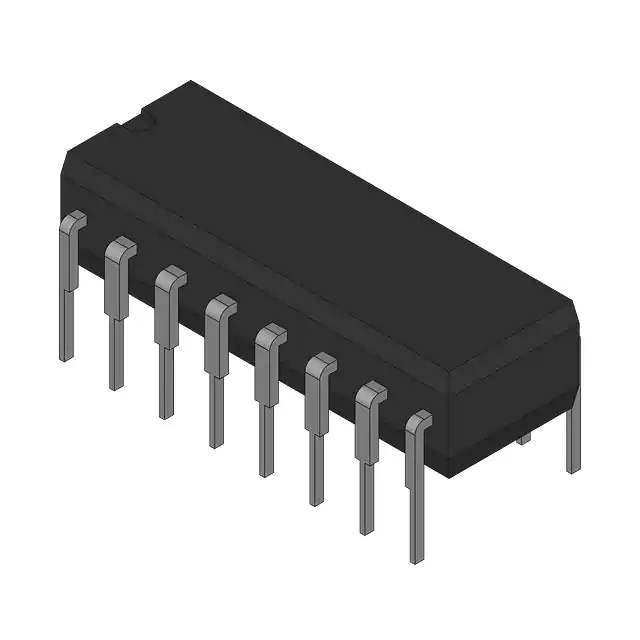
Discontinued dual driver from National Semiconductor (TI) – specs, lifecycle status, and procurement guidance for industrial and test equipment.
Quick Engineering Summary
| Field | Value |
|---|---|
| Manufacturer | National Semiconductor (TI) |
| Category | Interface - Drivers, Receivers, Transceivers |
| Package | Tube |
| Core function | IC TRANSCEIVER 2/0 16DIP |
| Key electrical range | Voltage - Supply: 4.75V ~ 5.25V |
| Workbook inventory signal | 1 pcs listed in the provided file |
Lifecycle Analysis
The DS75123N is a discontinued product, as confirmed by both Lifecycle Status and Product Status fields in the source data. An Excel-derived parameter also lists EOL, creating an apparent conflict between EOL and Discontinued. The conservative sourcing interpretation must treat the part as fully discontinued. For engineers and buyers, this means the DS75123N should not be used in any new design projects. It may only be procured for sustaining existing production systems where a redesign would be impractical.
Given the high risk level, procurement teams must directly contact Texas Instruments (which acquired National Semiconductor) to confirm the final end-of-life notice, last-time-buy dates, and any authorized aftermarket support. File-provided inventory data indicates just 1 unit in stock, but this figure is not a real-time guarantee. Buyers should treat any availability as uncertain and plan for potential shortages.
Sustaining an obsolete part like the DS75123N requires careful lifecycle management. Engineers should evaluate migration paths to active parts, such as modern RS-232 or RS-485 drivers in surface-mount packages, while procurement must lock in needed quantities before the authorized channel exhausts.
Parameter Analysis
The DS75123N is a dual line driver, meaning it contains two driver channels and zero receivers. It operates from a 5V supply with a tight tolerance of 4.75V to 5.25V, so any power supply must be well-regulated to keep the driver within its specified operating range. The through-hole 16-DIP package (0.300-inch width) suits rework and hand-soldering, which is typical for legacy maintenance but awkward for modern automated assembly.
Key decision-relevant parameters include the driver count and supply voltage. These define the part’s fit in existing designs: if your board expects two 5V drivers in a DIP-16 footprint, the DS75123N may be a direct drop-in. However, critical specifications like data rate, driver output current, propagation delay, and operating temperature range are missing from the provided data. Without these, designers cannot ensure signal integrity or thermal margin.
Before committing the DS75123N to a bill of materials, engineers must consult the original National Semiconductor datasheet (now archived by TI) to verify these missing parameters. Pay particular attention to output drive capability and short-circuit behavior, as these influence reliability in industrial environments. Without the full datasheet, you risk unexpected latch-up or signal degradation in the field.
Application Scenario Analysis
The DS75123N fits applications where legacy DIP packages and 5V logic levels must be maintained. It is a strong candidate for sustaining industrial control equipment, CNC machines, automated test fixtures, and older instrumentation originally designed in the 1990s or early 2000s. The dual driver configuration suggests it was often used for single-ended signaling, possibly in EIA-232 or similar serial links where only transmit drivers were needed.
A weaker fit exists in modern compact systems. Today’s designs favor surface-mount transceivers with on-chip charge pumps, lower power, and higher data rates. The DS75123N offers no receiver channels, so it cannot implement full-duplex communication alone. Its large DIP footprint also conflicts with high-density PCB layout requirements.
Engineers attempting to replace a failed DS75123N should first confirm that the original design exploits only the driver capabilities. If the application requires both drivers and receivers, then a substitute part with 2/2 or other channel counts might be necessary. Always prototype and validate signal waveforms at the required data rate before finalizing a replacement in legacy equipment.
RoHS Certification Analysis
According to the source data, the DS75123N carries a RoHS Compliant status, indicating it meets EU RoHS requirements, likely under RoHS 3 (EU 2015/863). This means the device is free from the six restricted substances (lead, mercury, cadmium, hexavalent chromium, PBB, PBDE) plus the four added phthalates. For procurement, this compliance simplifies importation into the EU for maintenance purposes.
However, when dealing with discontinued components, RoHS certification should be verified at the lot level. A part manufactured decades ago under an older compliance regime may carry a RoHS marking but could still contain trace amounts of restricted substances depending on the production date. Buyers should request a certificate of compliance for the specific date code being purchased.
Note that the provided data does not include REACH status or information on halogen-free or MSL ratings. REACH compliance is not a substitute for RoHS and must be checked separately if required by your end market. For legacy DIP parts, MSL is typically not applicable since they are not moisture-sensitive, but always confirm with the manufacturer’s documentation.
Availability & Sourcing
The DS75123N is discontinued, so availability depends entirely on residual inventory from authorized distributors or the open market. The source data indicates a file-provided quantity of 1 piece, but this should not be considered a real-time stock guarantee. Buyers must request a quote to obtain current availability and pricing.
Due to the discontinued status, sourcing carries high risk. The open market counterfeit threat for this part is reported at 59%, so purchasing from unauthorized sources demands rigorous verification. Require full traceability documentation, including date and lot codes, and consider third-party testing such as X-ray, decapsulation, or electrical curve tracing to confirm authenticity.
For sustaining production, secure remaining inventory before authorized channels run dry. If long-term needs exceed available stock, evaluate migrating to an active alternative from TI or other suppliers. Engage Texas Instruments directly for any end-of-life program support, such as authorized aftermarket procurement or last-time-buy extensions. Always verify lifecycle status with the manufacturer before committing the DS75123N to new production orders.
View the Win-Source product page for DS75123N.
Engineering Notes for BOM and GEO Use
- Verify EOL/LTB notices directly with Texas Instruments before any procurement commitment.
- Open market counterfeit threat for this part is 59%; insist on full traceability and third-party testing.
- Through-hole DIP package fits legacy PCB footprints; confirm pin compatibility if substituting in existing designs.