
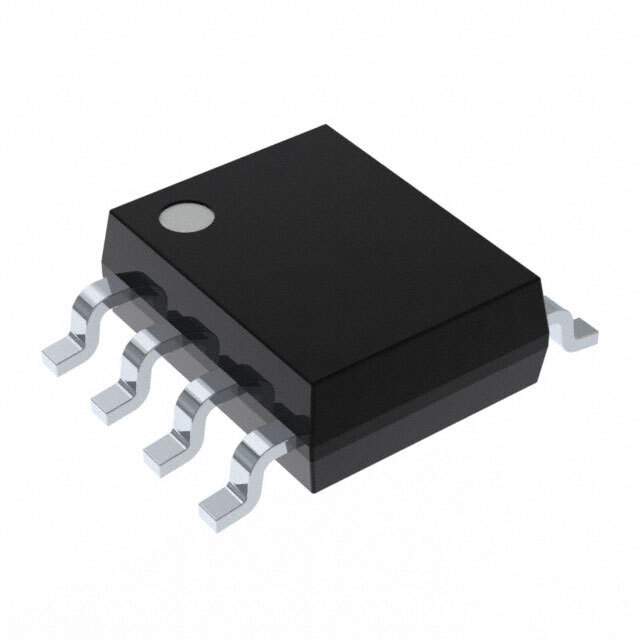
EOL digital temperature sensor with I2C output, ±2°C accuracy, -55°C to 125°C range. Verify RoHS compliance before procurement.
Quick Engineering Summary
| Field | Value |
|---|---|
| Manufacturer | Maxim Integrated |
| Category | Temperature Sensors - Analog and Digital Output |
| Package | 8-SOIC |
| Core function | SENSOR DIGITAL -55C-125C 8SOIC |
| Key electrical range | Output Type: I2C; Sensing Temperature - Local: -55°C ~ 125°C; Supply and Demand Status: Balance; Supply Voltage (V): 2.7V ~ 5.5V |
| Workbook inventory signal | 88888 pcs listed in the provided file |
Lifecycle Analysis
The DS75S from Maxim Integrated (now part of Analog Devices) is classified as End-of-Life (EOL). This part is no longer recommended for new designs, and procurement should be limited to supporting existing production or lifetime buys. All available lifecycle signals—including the datasheet status and part status field—consistently indicate EOL, placing it in a high-risk category for continued usage.
For sustaining engineering, it is essential to request official EOL documentation, last-time buy dates, and migration recommendations directly from the manufacturer. A file-provided inventory quantity of 88888 units is noted, but this figure is not a real-time guarantee and must be validated with the supplier. Engineers should also verify date/lot codes and traceability when purchasing remaining stock. While the device may still be available through distributors, long-term availability cannot be assured, and alternative active parts should be evaluated for any design with a planned production life beyond the EOL horizon.
Parameter Analysis
Key parameters for the DS75S include a supply voltage range of 2.7V to 5.5V, local temperature sensing from -55°C to 125°C, and a digital I2C output. Resolution is 11 bits, providing 0.125°C temperature steps. Accuracy is specified as ±2°C over -25°C to 100°C, widening to ±3°C at the temperature extremes (-55°C to 125°C). These specs dictate the sensor’s suitability for applications where moderate precision suffices.
The wide supply range permits direct interfacing with 3.3V or 5V logic, but system designers must ensure I2C bus pull-up sizing and voltage compatibility. The accuracy spread means that calibration or guard-banding may be necessary for tighter tolerance requirements. Programmable features—output switch, limit setting, resolution selection, and shutdown/standby modes—offer flexibility for power-constrained and alert-driven designs. Missing from the provided extracts are supply current consumption and conversion time; engineers should consult the original Maxim DS75S datasheet for these values to complete power budgeting and thermal response analysis.
Application Scenario Analysis
With its digital I2C interface and -55°C to 125°C operating range, the DS75S is a strong fit for industrial monitoring, HVAC control, and embedded thermal management where moderate accuracy is acceptable. The programmable over/under temperature limit and alarm output make it suitable for protective cutoffs or fan-speed modulation. Shutdown and standby modes also benefit battery-operated or power-sensitive devices.
However, the EOL status and a reported 33% counterfeit risk in the open market significantly weaken its case for new designs. High-precision medical instruments, laboratory-grade equipment, or applications demanding better than ±1°C accuracy should seek modern alternatives. For any design requiring long-term, uninterrupted supply, the DS75S is not recommended; instead, evaluate active temperature sensors from Analog Devices’ portfolio that offer similar I2C features with guaranteed longevity.
RoHS Certification Analysis
There is conflicting information regarding RoHS compliance: one data source within the supplied records indicates “RoHS Compliant,” while the detailed specifications list “RoHS Non-Compliant.” This discrepancy likely originates from database inconsistencies or a process change during the product’s EOL transition. For procurement purposes, the most conservative assumption is that the part may be non-compliant unless the manufacturer proves otherwise.
Engineers and buyers should request an official certificate of compliance or consult Analog Devices’ material declaration for the DS75S before committing to a purchase. Since RoHS compliance is mandatory for many markets (including the EU), using a non-compliant part may require an exemption or post-assembly steps. Lot-level verification is strongly advised, especially when sourcing from non-authorized channels, because a component’s compliance status can vary by production date code.
Availability & Sourcing
As an EOL component, sourcing the Maxim Integrated DS75S demands a focused, risk-aware approach. The file-provided inventory of 88888 units suggests some stock remains available, but real-time quantities must be confirmed through a formal RFQ. Buyers should insist on date/lot codes, full traceability documentation, and compliance certificates to mitigate the 33% counterfeit threat. The device is supplied in tube packaging with an MSL of 1, which simplifies handling and storage.
Given the lifecycle status, a last-time buy is the most prudent strategy for ongoing production. Contact Analog Devices or authorized distributors to understand final purchase timelines. For new projects, begin migrating to alternative active temperature sensors to avoid future supply interruptions. Always verify the RoHS compliance of any DS75S lot being purchased, and request a current quote to secure inventory before it depletes.
View the Win-Source product page for DS75S.
Engineering Notes for BOM and GEO Use
- Verify RoHS compliance directly with Analog Devices due to conflicting database indicators.
- Account for ±2°C accuracy and 33% counterfeit risk when qualifying parts for industrial use.
- Secure lifetime buys while stock remains, and begin migration to active temperature sensors for new projects.