
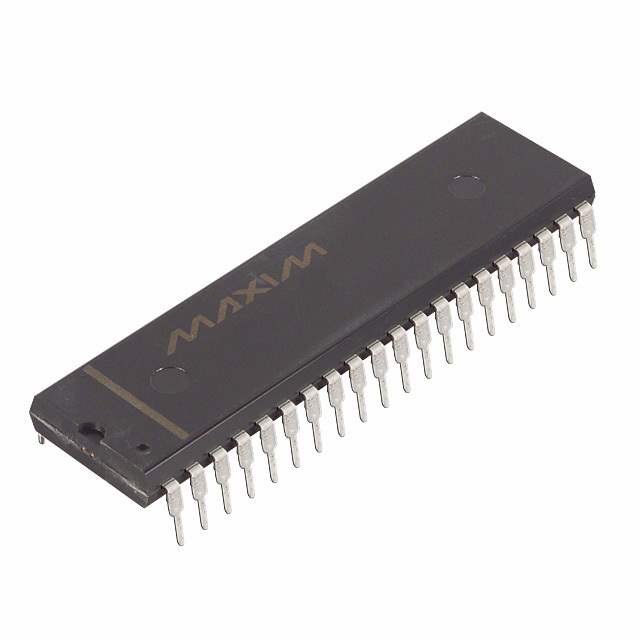
A reliable 8-bit ROMless MCU from Maxim Integrated for embedded applications.
Quick Engineering Summary
| Field | Value |
|---|---|
| Manufacturer | Maxim Integrated |
| Category | Embedded - Microcontrollers |
| Package | 40-PDIP |
| Core function | IC MCU 8BIT ROMLESS 40DIP |
| Key electrical range | Speed(Frequency): 18MHz; Supply and Demand Status: Limited; Supply Voltage - Operating: 2.7 V to 5.5 V; Temperature Range - Operating: 0°C to 70°C (TA) |
| Workbook inventory signal | 7600 pcs listed in the provided file |
Lifecycle Analysis
The DS80C323-MCD+ is listed as Active by Maxim Integrated, indicating the part is in full production and supported for new designs. All available lifecycle signals are consistent, with no conflicting data suggesting end-of-life or not-recommended-for-new-design status. This low-risk status allows procurement teams to plan with confidence for both existing and new production programs.
However, even for active parts, supply and demand dynamics can shift. The supply status is reported as limited, which may warrant attention for high-volume requirements. Engineers should verify lead times directly with authorized distributors and monitor any manufacturer notices. While the lifecycle is active, ensuring a stable supply chain is critical for production continuity.
For sustaining designs, this part remains a safe choice, but always reconfirm lifecycle status through official manufacturer channels before finalizing BOM decisions, as product lifecycles can change without broad notice.
Parameter Analysis
The DS80C323-MCD+ integrates an 8051 core operating at up to 18MHz with a wide operating voltage of 2.7V to 5.5V, making it adaptable to various power domains. The 256 bytes of on-chip RAM and 32 I/O lines provide moderate connectivity for basic control tasks. Being ROMless, it relies entirely on external program memory, which affects board space and component count.
The commercial temperature range (0°C to 70°C) limits its use to benign environments. Designers should pay close attention to the external oscillator requirement and ensure proper clock circuit design for the 18MHz operation. The supply voltage tolerance supports both 3.3V and 5V systems, but derating for noise and transient conditions is advised.
Key missing parameters in the available data include detailed electrical characteristics, current consumption, and peripheral features (timers, UART specs). Engineers should consult the full Maxim datasheet to verify I/O drive strength, interrupt structure, and frequency-dependent current draw before finalizing the design.
Application Scenario Analysis
The DS80C323-MCD+ is well-suited for embedded systems that need an 8051 architecture with external code memory, such as industrial controllers, simple communication interfaces, or educational platforms. Its 32 I/O lines and UART capability (implied by typical 8051 integration) support basic data acquisition and control.
Conversely, it is a weak fit for applications demanding low power consumption, high-temperature operation, or high integration, as the ROMless design increases component count and the temperature range is limited. For cost-sensitive designs, the need for external memory may negate the low unit cost of the MCU itself.
Designers should assess the total BOM cost and board space impact of adding external program memory and oscillator. The part's 49% fake threat rate indicates that sourcing reliable units is critical for production; thus, application suitability also hinges on procurement feasibility.
RoHS Certification Analysis
The DS80C323-MCD+ is marked as RoHS Compliant, indicating adherence to the EU Directive on hazardous substances. This status covers lead-free termination and restricted materials in the component body and packaging. As a 40-PDIP package, it likely uses lead-free plating, but specifics on exemptions (e.g., lead in glass or high-temperature solder) are not detailed in the supplied data.
Although RoHS compliance is attributed to the part, it is essential to request a certificate of compliance for the specific date and lot code when ordering. Compliance may be based on assembly family data; therefore, lot-level verification ensures conformity with the latest EU RoHS (2015/863) requirements.
No REACH or halogen-free statements are explicitly provided in the source data, so additional environmental compliance documentation should be requested if needed for your application. For EU market placement, verifying RoHS at the lot level is a standard procurement safeguard.
Availability & Sourcing
The DS80C323-MCD+ is an active part with a workbook quantity of 7600 units as reported in the provided file; however, live market availability can vary. Supply is characterized as limited, and the open market fake threat rate is noted at 49%, emphasizing the need for authorized sources. Packaging is tube/rail for the PDIP device, with dry storage and humidity protection conditions recommended for inventory.
Given the active lifecycle, procurement teams should request quotes from franchised distributors and verify stock, lead time, and date/lot code traceability. While the file-based inventory gives a snapshot, real-time confirmation is essential. Buyers should insist on full compliance documentation, including RoHS certificates and origin certificates, to mitigate counterfeit risks.
For high-volume or long-term projects, evaluate alternative supply channels and consider second-source strategies if available, though no direct pin-compatible equivalents are listed. Secure inventory early if the limited supply status suggests allocation. Always confirm lifecycle and compliance directly with Maxim Integrated or its authorized partners before finalizing procurement.
View the Win-Source product page for DS80C323-MCD+.
Engineering Notes for BOM and GEO Use
- Verify external oscillator frequency and voltage compatibility with your design, as the part requires an external crystal and supports 2.7V–5.5V.
- The 49% fake threat rate in open market underscores the need for authorized distribution and traceability checks.
- ROMless architecture demands external program memory; ensure your system design provides suitable non-volatile storage (e.g., parallel Flash/EPROM).