
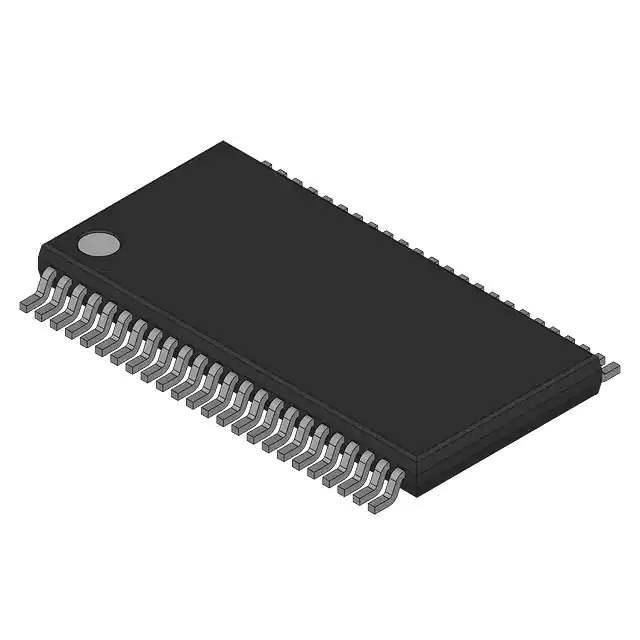
Discontinued National Semiconductor FPD-Link transceiver – secure inventory and verify compliance for legacy designs
Quick Engineering Summary
| Field | Value |
|---|---|
| Manufacturer | National Semiconductor (TI) |
| Category | Interface - Drivers, Receivers, Transceivers |
| Package | Bulk |
| Core function | IC TRANSCEIVER 3/21 48TSSOP |
| Key electrical range | Voltage - Supply: 3V ~ 3.6V |
| Workbook inventory signal | 15300 pcs listed in the provided file |
Lifecycle Analysis
The DS90C363AMTDX from National Semiconductor (now Texas Instruments) is officially listed as Discontinued. This lifecycle status indicates that the manufacturer has ceased production, and no further stock is being fabricated. For new designs, this part should not be considered, as long-term availability is not assured. Engineering teams must immediately evaluate pin-compatible or functionally equivalent alternatives if a redesign is feasible.
For existing products that still rely on the DS90C363AMTDX, procurement faces a high-risk scenario. The supplied file shows an inventory quantity of 15,300 units, but this number is not a live market reflection and may deplete quickly. Buyers should secure stock promptly and coordinate with the manufacturer or authorized distributors to verify whether a last-time buy (LTB) window remains open. Without official LTB communication, any remaining inventory is subject to gray market conditions, making traceability and authenticity checks essential.
Given the discontinuation, lifecycle revalidation is mandatory before committing this part to any new production run. Sustaining operations must weigh the cost of holding buffer stock against the risk of counterfeit parts, which is noted at 31% in open market assessments.
Parameter Analysis
The DS90C363AMTDX is a 3-driver, 21-receiver transceiver supporting FPD-Link and LVDS protocols. Its supply voltage range of 3V to 3.6V and surface-mount 48-TSSOP package are typical for space-constrained display applications. The high receiver count relative to drivers suggests a primary role in receiving parallel RGB data in flat-panel displays, where many LVDS pairs are needed.
Key parameters like the number of drivers/receivers and protocol directly impact compatibility with existing host controllers and panel interfaces. The 48-TFSOP package variant with 6.10mm width requires careful PCB footprint verification, as TSSOP packages are sensitive to soldering profiles. However, critical performance specifications are missing from the provided data—most notably the maximum data rate, operating temperature range, ESD rating, and AC timing parameters (setup/hold, skew). These are essential for signal integrity analysis, especially in high-resolution or long-cable applications.
Engineers must retrieve the official datasheet from TI to verify missing values before integration. Without the data rate, for example, it is impossible to determine if the device can support a desired pixel clock frequency. The voltage range alone does not guarantee noise margins; therefore, power supply decoupling and termination requirements should also be validated against the original design guidelines.
Application Scenario Analysis
This transceiver is designed for flat-panel display interfaces that utilize FPD-Link or general LVDS signaling. The 3-driver/21-receiver configuration is commonly found in applications where a graphics controller transmits digital video to an LCD panel, such as automotive infotainment systems, industrial HMI displays, medical monitors, and legacy notebook PCs. In these systems, the DS90C363AMTDX likely serves as the receiver (deserializer) side, converting the serialized LVDS stream into parallel TTL/CMOS data for the panel timing controller.
Strong-fit scenarios include legacy display modules that require pin-compatible replacements and industrial equipment with long lifecycles where field repairs are still supported. The part’s discontinuation, however, makes it unsuitable for new product development. Any new design win should be based on newer serializer/deserializer (SerDes) devices that offer better power efficiency and higher data rates.
Weak-fit scenarios would be those requiring higher channel counts, extended temperature ranges (automotive-grade -40°C to +105°C), or compliance with modern functional safety standards. Unless the exact original design specifications are met, the DS90C363AMTDX may introduce signal integrity risks in high-speed layouts. Designers should perform rigorous compatibility testing before substituting into systems that were not originally validated with this specific transceiver.
RoHS Certification Analysis
The RoHS status for the DS90C363AMTDX is ambiguous. The provided compliance field indicates RoHS Compliant, yet the detailed specification explicitly lists RoHS Non-Compliant. Such conflicts often arise from misinterpretation of component-level exemptions or outdated documentation. Until resolved, the conservative approach is to treat the part as non-compliant, since the specification detail is more granular.
If the device is indeed non-compliant, it may contain lead or other restricted substances above RoHS 3 (EU 2015/863) thresholds. For deployments in regions enforcing RoHS, engineering teams must either obtain a valid exemption certificate or ensure that the end product qualifies for an exemption (e.g., lead in solders for network infrastructure equipment). The absence of REACH or halogen-free statements further clouds the compliance picture.
Lot-level testing or a manufacturer Certificate of Compliance (CoC) is strongly recommended before procurement. If the part was manufactured prior to the RoHS conversion date for National Semiconductor products, it likely uses leaded terminal finishes. Buyers should request the exact date code and cross-reference with TI’s material composition declarations to determine the applicable compliance status.
Availability & Sourcing
With a discontinued lifecycle, availability of the DS90C363AMTDX is constrained to existing distributor or broker stock. The supplied file indicates 15,300 units in bulk packaging, with a standard package quantity of 1,000 pieces. However, this inventory level is not guaranteed real-time and may already be allocated to other buyers. The part is classified as EAR99 with HTSUS 8542.39.0001, facilitating export under general license, but no export restrictions are noted.
Given the 31% fake threat probability in the open market, rigorous anti-counterfeit measures are essential. Purchasers should mandate visual inspection, X-ray analysis, and electrical testing if sourcing from non-franchised channels. Date and lot codes must be verified against manufacturer traceability records to ensure authenticity. The bulk packaging designation suggests parts may be supplied in trays or tubes, which can complicate re-inspection processes; confirming the exact packaging format before ordering is advisable.
To secure genuine stock, engineering and sourcing teams should request a quote through a vetted supply chain partner and ask for re-confirmation of lifecycle status directly from Texas Instruments. For any remaining production needs, a last-time buy strategy should be explored immediately. In parallel, initiate a redesign effort to migrate to an active replacement to avoid future supply disruptions.
View the Win-Source product page for DS90C363AMTDX.
Engineering Notes for BOM and GEO Use
- Lifecycle is discontinued; avoid new designs; secure remaining inventory for legacy production support.
- Verify RoHS compliance with manufacturer due to conflicting datasheets: a non-compliant part may require exemption documentation.
- Confirm data rate, temperature range, and timing parameters from official datasheet before integration into legacy systems.