
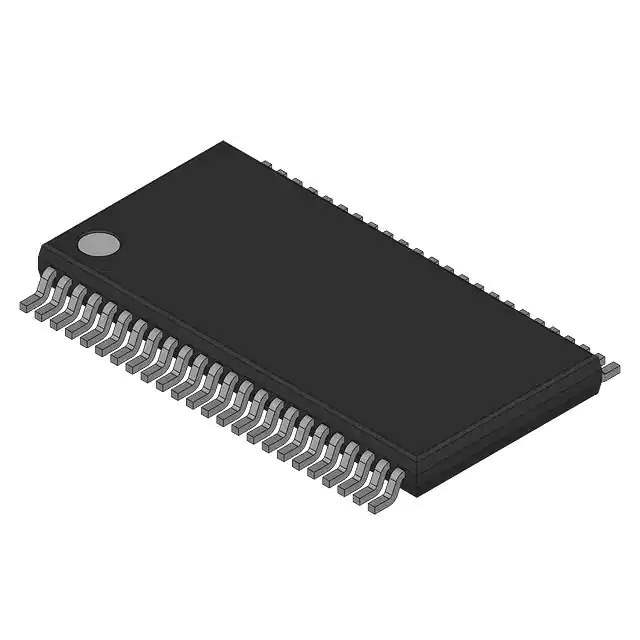
Discontinued LVDS driver for FPD-Link applications; verify availability and avoid new designs.
Quick Engineering Summary
| Field | Value |
|---|---|
| Manufacturer | National Semiconductor (TI) |
| Category | Interface - Drivers, Receivers, Transceivers |
| Package | Bulk |
| Core function | IC TRANSCEIVER 1/0 48TSSOP |
| Key electrical range | Voltage - Supply: 3V ~ 3.6V |
| Workbook inventory signal | 1 pcs listed in the provided file |
Lifecycle Analysis
The DS90C365MTDX from National Semiconductor (TI) is officially discontinued, with all available lifecycle signals indicating end-of-life. The manufacturer’s status is Discontinued, and internal tracking parameters reflect EOL. This means the component should not be used in new designs; any engineering activity allocating this part to a new PCB or system carries high supply risk and long-term unavailability.
For existing production lines, the discontinued lifecycle demands immediate action. Design teams must evaluate last-time buy opportunities or begin migration to a functionally compatible alternative. File-provided inventory may show limited quantities, but these figures are not updated in real time. Procurement should verify actual stock levels and date codes with the distributor before placing orders.
Engineers should request formal product discontinuation notices from Texas Instruments (which acquired National) to understand remaining support timelines and any suggested replacement parts. Without such documentation, sustaining production using the DS90C365MTDX is not advisable beyond short-term buffer stock.
Parameter Analysis
The DS90C365MTDX is configured as a single driver with no receiver function (1/0), targeting FPD-Link and LVDS signaling protocols. This unidirectional transmitter suits point-to-point high-speed video links common in flat panel displays. The supply voltage range of 3V to 3.6V allows integration with low-power 3.3V system rails, and the 48-TSSOP surface-mount package (6.10 mm width) facilitates automated assembly.
Critical datasheet parameters are missing from available sources, including maximum data rate, propagation delay, differential output voltage swing, and operating temperature grade. Without data rate specifications, designers cannot confirm whether this driver meets the throughput demands of a targeted display resolution. The temperature range, likely commercial or industrial, must be verified to ensure reliability in the intended application environment. Additionally, the part’s driver output characteristics influence termination and PCB impedance control, making a full datasheet essential.
Engineers re-evaluating legacy designs should cross-reference the DS90C365MTDX original datasheet against current replacement candidates. The 1/0 configuration means any substitute must provide a compatible LVDS transmitter, not a transceiver, unless system changes are possible. The high fake threat rating of 42 percent emphasizes the need for thorough incoming inspection and authorized source verification.
Application Scenario Analysis
The DS90C365MTDX finds its strongest application fit in legacy flat panel display interfaces that employ FPD-Link or standard LVDS transmission. It would typically serve as the timing controller or source driver side of an LVDS link in older LCD monitors, notebook panels, or industrial display modules. Since it is a driver only, the design must employ a separate receiver IC on the other side.
Weak-fit scenarios include any new display product development, where the part’s discontinuation and missing performance specifications preclude its use. Even in current designs requiring an LVDS transceiver, this part is unsuitable because it lacks receiver functionality. Applications demanding high-speed data rates beyond the unspecified original specification, or those that need advanced power management features, would not be well served.
When maintaining or repairing existing equipment, the DS90C365MTDX may still be a valid service part if exact replacements are required and can be sourced. However, engineers should plan for an eventual redesign as stock depletes. For prototypes or low-volume new builds, the risk of obtaining nonconforming or counterfeit components makes an alternative, active part a safer path.
RoHS Certification Analysis
The RoHS compliance status of the DS90C365MTDX is contradictory. One source indicates RoHS Compliant, while another specification field explicitly states RoHS Non-Compliant. This discrepancy suggests that different production lots or data snapshots may have been mixed. In an official procurement context, such ambiguity must be resolved before the part can be used in products destined for markets requiring RoHS conformity.
If the part is genuinely non-compliant, its use is restricted to non-RoHS applications or regions without equivalent legislation, unless an exemption applies. The available compliance data does not mention any exempted substances or applications. Also missing are REACH, halogen-free, and MSL ratings, which are often needed for full material declaration. Buyers must not assume family-level compliance and should obtain a lot-specific RoHS certificate from the supplier.
Given the open market nature of this discontinued component, the risk of sourcing non-compliant or counterfeit material is elevated. For any EU-bound product, the lack of clear RoHS documentation presents a regulatory risk. Engineering teams should flag this part in their bill of materials and mandate that procurement only accepts stock accompanied by valid compliance documentation.
Availability & Sourcing
Procurement of the DS90C365MTDX is challenging due to its discontinued lifecycle. File-provided inventory data indicates a workbook quantity of just one unit, while other records suggest larger quantities (e.g., 1,541 pieces), but these figures are not real-time and must be verified through a formal RFQ. Buyers should request a current quote and not rely on static numbers.
Sourcing this part demands rigorous counterfeit avoidance measures. The open market fake threat is rated at 42 percent, meaning a significant proportion of offered parts may be substandard or fraudulent. Insist on full traceability, including date and lot code verification, and require certificates of conformance and RoHS compliance for each lot. Visual inspection and electrical testing may be warranted for critical applications.
For active designs migrating away from the DS90C365MTDX, Texas Instruments may offer successor parts or reference designs. Engage with authorized distributors to identify functional replacements and plan a transition timeline. In the interim, any purchases should be limited to trusted suppliers with a track record in end-of-life component management. Always confirm packaging condition (original bulk vs. repackaged) to avoid damages induced by improper storage.
View the Win-Source product page for DS90C365MTDX.
Engineering Notes for BOM and GEO Use
- Verify exact RoHS compliance per lot; conflicting data may impact acceptance in regulated markets.
- Confirm retrofit feasibility by checking data rate, temperature grade, and pinout against replacement LVDS drivers.
- Mitigate counterfeit risk by requiring authorized source traceability, date code verification, and visual inspection.