
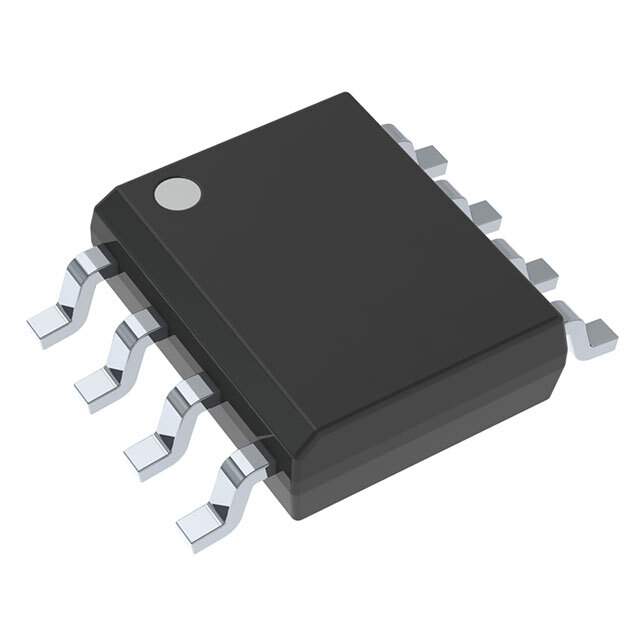
DS90C401MX/NOPB | Texas Instruments LVDS Driver | 155.5 Mbps | 8-SOIC
Quick Engineering Summary
| Field | Value |
|---|---|
| Manufacturer | Texas Instruments |
| Category | Interface - Drivers, Receivers, Transceivers |
| Package | 8-SOIC |
| Core function | IC TRANSCEIVER 2/0 8SOIC |
| Key electrical range | Supply and Demand Status: Balance; Supply Voltage - Operating: 4.5 V to 5.5 V; Temperature Range - Operating: -40°C to 85°C |
| Workbook inventory signal | 7300 pcs listed in the provided file |
Lifecycle Analysis
The DS90C401MX/NOPB from Texas Instruments is currently listed as Active, indicating that the manufacturer continues to produce and support this component. All available lifecycle signals are consistent, with no conflicting obsolete or NRND warnings. For new designs, this Active status means the part can be sourced reliably for production planning, and engineering teams can proceed with confidence. However, it is always prudent to revalidate the lifecycle status directly through Texas Instruments before committing to a high-volume program, as statuses can change without notice.
The file-provided inventory quantity of 7300 units suggests current market availability, but this figure is not a real-time guarantee and should be verified through an RFQ to the distributor. For sustaining production, this part remains a low-risk choice; nevertheless, monitoring manufacturer PCN (Product Change Notification) announcements is recommended to catch any potential transition to NRND or EOL. Because the part is Active, procurement teams can follow standard quote-and-order workflows, but they should ensure that compliance documentation and traceability are validated for each lot to mitigate risks when integrating DS90C401MX/NOPB into critical systems.
Parameter Analysis
The DS90C401MX/NOPB is an LVDS transceiver configured with two drivers and zero receivers, indicating it is designed as a line driver for differential signaling. Key decision parameters include a data rate of 155.5 Mbps, a supply voltage range of 4.5 V to 5.5 V, and an operating temperature range of -40°C to 85°C. The 155.5 Mbps data rate is typical for telecom and high-speed serial links, making it suitable for applications requiring moderate bandwidth with noise immunity. The 5 V supply is common in many industrial and automotive systems, but designers must verify that the part can interface with lower-voltage logic, possibly through level translation. The wide temperature range supports use in harsh environments.
The 8-SOIC SMD package simplifies PCB layout and is compatible with standard reflow soldering. However, several parameters critical for thorough evaluation are absent from the supplied data. Engineers should consult the full Texas Instruments datasheet to obtain missing specifications such as output voltage swing, propagation delay, channel-to-channel skew, input clock frequency requirements, and power consumption. Without these, it is difficult to guarantee timing closure or signal integrity in a high-speed design. Additionally, verifying the driver’s compliance to the LVDS standard (TIA/EIA-644) is essential for interoperability. For procurement, confirming that the part meets specific ESD ratings and MSL (Moisture Sensitivity Level) is important before finalizing the BOM.
Application Scenario Analysis
As an LVDS driver with two output channels, the DS90C401MX/NOPB is particularly well-suited for point-to-point high-speed data transmission in applications such as clock distribution, backplane communication, or serialization of parallel data streams. The 155.5 Mbps data rate aligns with SONET OC-3 and similar telecom standards, making it a candidate for networking equipment. Its differential signaling provides strong common-mode noise rejection, which is beneficial in electrically noisy environments like automotive or industrial control systems. The device can also serve in medical imaging or test equipment where reliable high-speed data transfer is required.
However, it is less appropriate for single-ended interfaces or protocols that do not support LVDS levels. In designs where only a single driver is needed, the second driver may remain unused, though this wastes capability. For applications requiring bidirectional communication, this part lacks a receiver, so a separate receiver chip would be necessary. Designers should also consider whether the 5 V supply is compatible with their system, as newer low-voltage designs may have migrated to 3.3 V or lower. Overall, the DS90C401MX/NOPB excels in dedicated LVDS driving roles but should be evaluated for system-level compatibility before integration.
RoHS Certification Analysis
The DS90C401MX/NOPB is listed as RoHS Compliant, indicating that it adheres to the European Union’s Restriction of Hazardous Substances directive. This compliance is essential for products sold in the EU and many other global markets. No specific RoHS standard version (e.g., RoHS 2 or RoHS 3) or exemption details are provided in the supplied data, so buyers should confirm with Texas Instruments whether the part meets the latest RoHS 3 (EU 2015/863) requirements, which include additional phthalate restrictions.
The documentation also lacks other environmental compliance markers such as REACH, halogen-free, or MSL ratings. While RoHS compliance is provided, it is typically at the family level; for high-assurance applications, it is advisable to request a certificate of compliance for the specific lot being procured. This ensures that any process changes have not introduced restricted substances. Additionally, check that the solderable finish on the leads is compatible with lead-free reflow profiles, as lead-free processing is often required in RoHS-compliant systems. Procurement teams should incorporate verification of environmental compliance documentation into their incoming inspection procedures when sourcing DS90C401MX/NOPB.
Availability & Sourcing
Sourcing the Texas Instruments DS90C401MX/NOPB through authorized channels is recommended to ensure authentic, traceable parts. As an Active component, it should be readily available through franchised distributors and global marketplaces; however, supply dynamics can fluctuate. The file-provided workbook quantity of 7300 units offers an indication of inventory, but real-time stock must be confirmed via a request for quote (RFQ). Buyers should request date and lot code information to verify that components have not exceeded shelf-life requirements or been subject to uncontrolled storage.
The device is supplied on tape and reel (TR) packaging, which facilitates automated assembly but requires careful handling to prevent electrostatic discharge damage during production. Given the part’s Active lifecycle, the procurement focus should be on competitive quoting and compliance verification rather than last-time buys. To mitigate counterfeit risks, always source from trustable suppliers who provide full traceability back to Texas Instruments. Verify that the RoHS compliance documentation is current and that the part’s MSL rating is appropriate for your manufacturing process. For design revisions or migration planning, there is no immediate pressure, but staying informed of manufacturer lifecycle updates is prudent. Request a quote today to secure current availability for the DS90C401MX/NOPB.
View the Win-Source product page for DS90C401MX/NOPB.
Engineering Notes for BOM and GEO Use
- Verify the LVDS driver output swing and common-mode voltage against your receiver’s input specifications.
- Consider signal integrity at 155.5 Mbps; evaluate PCB trace length and termination for minimal reflections.
- For automated assembly, confirm that the reel packaging (TR) is compatible with your pick-and-place equipment.