
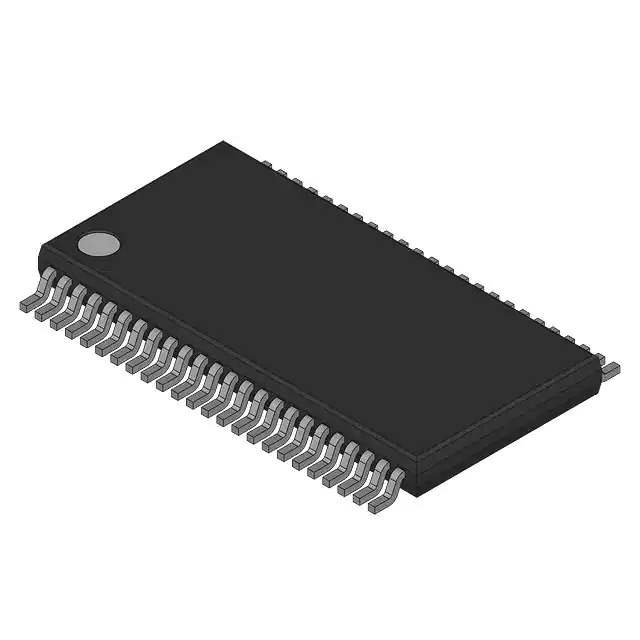
Technical sourcing guide for DS90CF364MTD, an LVDS deserializer from National Semiconductor, covering specs, lifecycle, compliance, and procurement.
Quick Engineering Summary
| Field | Value |
|---|---|
| Manufacturer | National Semiconductor (TI) |
| Category | Interface - Serializers, Deserializers |
| Package | Bulk |
| Core function | LINE RECEIVER, 4 FUNC, 4 RCVR, P |
| Key electrical range | Input Type: LVDS; Number of Inputs: 3; Number of Outputs: 18; Output Type: CMOS, TTL |
| Workbook inventory signal | 1000 pcs listed in the provided file |
Lifecycle Analysis
DS90CF364MTD is classified as an Active component across all lifecycle signals provided, including the manufacturer’s product status and independent lifecycle tracking. An Active status indicates that the part is currently in production and generally available for both new design starts and sustaining procurement. Engineers can incorporate DS90CF364MTD into new projects with reasonable expectations of supply continuity.
However, Active status is point-in-time data and does not guarantee future availability. Texas Instruments (which acquired National Semiconductor) may revise the product lifecycle without notice. Therefore, it is prudent to periodically verify the official lifecycle status through TI’s product pages or authorized channel communications, especially before ramping high-volume production. The provided inventory quantity of 1000 units reflects a snapshot from the sourcing file and should not be interpreted as live market availability. For long-term programs, confirm phase-out roadmaps and consider alternate sourcing strategies to mitigate any eventual EOL risk.
Parameter Analysis
The DS90CF364MTD deserializer features a maximum data rate of 455Mbps, which is critical for matching the timing requirements of the LVDS input stream. With 3 LVDS input pairs and 18 parallel CMOS/TTL outputs, the device performs a 1:6 deserialization per input channel, enabling it to reconstruct wide digital buses from serialized video or data streams. The 3V to 3.6V supply voltage aligns with standard 3.3V logic, simplifying power supply design while supporting an industrial temperature range of -40°C to 85°C, making it suitable for rugged environments.
The 48-TSSOP surface-mount package balances board density and hand-soldering feasibility. Key parameters missing from the provided data include power consumption, LVDS input common-mode range, output timing characteristics (setup/hold times, clock jitter), and ESD robustness. Before committing to this part, designers should consult the Texas Instruments datasheet to confirm that the input eye diagram margins, supply current profiles, and thermal derating curves meet system requirements. Pay special attention to the output drive strength and simultaneous switching noise specifications, as these directly affect signal integrity on the 18-bit bus.
Application Scenario Analysis
DS90CF364MTD is best suited for deserializing LVDS video signals in flat-panel display interfaces, digital signage, and industrial HMI systems. Its 3-input, 18-output configuration is commonly used to convert an 18-bit RGB (6 bits per color) LVDS stream from a graphics processor into parallel CMOS/TTL signals for LCD panels. The 455Mbps data rate comfortably supports SVGA and lower XGA resolutions at standard refresh rates, making it a practical choice for embedded display applications.
Potential weaker fits include high-resolution video links exceeding 65MHz pixel clocks, where the 455Mbps limit may become a bottleneck, or applications requiring direct LVCMOS logic-level inputs, as the device only accepts LVDS inputs. Additionally, systems that demand data transfers beyond the 18-bit bus width would need multiple devices or alternative deserializer architectures. While the industrial temperature range allows deployment in outdoor or factory-floor environments, design teams should validate the LVDS signal quality under worst-case cable lengths and noise conditions. No specific compliance certifications (such as AEC-Q100 for automotive) are indicated, so automotive-grade applications would require additional qualification.
RoHS Certification Analysis
The RoHS compliance data for DS90CF364MTD presents a conflict: one field within the source lists a RoHS Status of 'RoHS Non-Compliant', while a higher-level compliance indicator states 'RoHS Compliant'. This discrepancy demands immediate attention from the procurement and engineering teams. Without resolution, assuming full EU RoHS compliance could lead to regulatory exposure for products destined for European markets.
It is possible that different assembly lots or date codes carry varying compliance levels, or that the compliance information pertains to the original National Semiconductor packaging before TI’s full material transition. The specific RoHS directive version is not provided in the source data, so verifying compliance to EU Directive 2015/863 (RoHS 3) is essential. Additionally, no REACH or China RoHS declarations are available, which further limits the environmental compliance picture. The safest course is to request a current RoHS certificate of compliance from Texas Instruments or an authorized distributor, tied to the exact part number and lot codes being procured. Until that verification is complete, treat the part as potentially non-compliant for any EU-bound products.
Availability & Sourcing
DS90CF364MTD is currently flagged as Active, so the primary procurement focus should be on securing genuine components through authorized Texas Instruments distributors. However, the open-market fake threat is rated at 69%, underscoring the importance of traceability. The source file indicates a quantity of 1000 units, but this is a static record and not a reflection of real-time stock. Buyers should request a current quote to confirm available inventory, lead time, and minimum order quantities.
The part is supplied in bulk packaging with a standard package of 80 pieces, which may influence handling and production line setup. For each order, require full traceability documentation including date/lot codes and a certificate of compliance covering RoHS status. Given the conflicting RoHS data highlighted earlier, insist on lot-specific environmental compliance reports. For production planning, note that bulk packaging may need repacking for automated pick-and-place equipment. Finally, engage with TI’s authorized network early to secure allocation, especially if the program volume is significant, as the Active status can shift if the manufacturer reallocates fab capacity.
View the Win-Source product page for DS90CF364MTD.
Engineering Notes for BOM and GEO Use
- Verify RoHS compliance per lot; conflicting data found between primary compliance flag and raw specification.
- High open-market counterfeit risk (69%) demands authorized sourcing and thorough visual inspection.
- 455Mbps LVDS deserializer with 3-to-18 channel expansion suits industrial display interfaces; validate timing margins.