
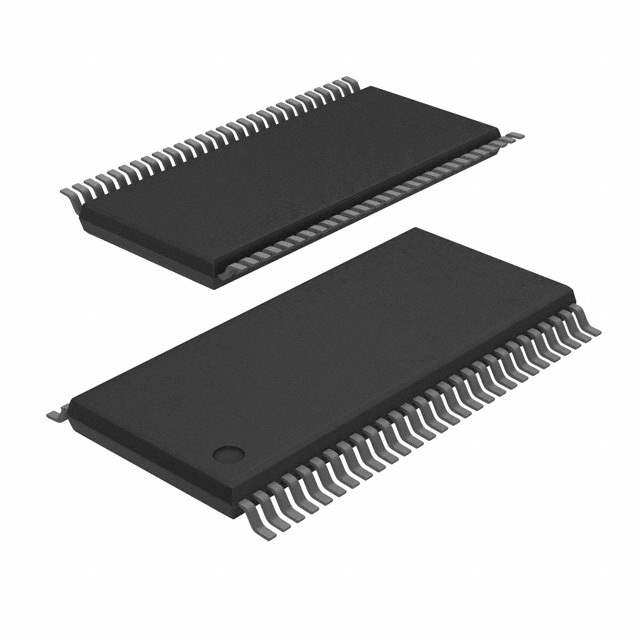
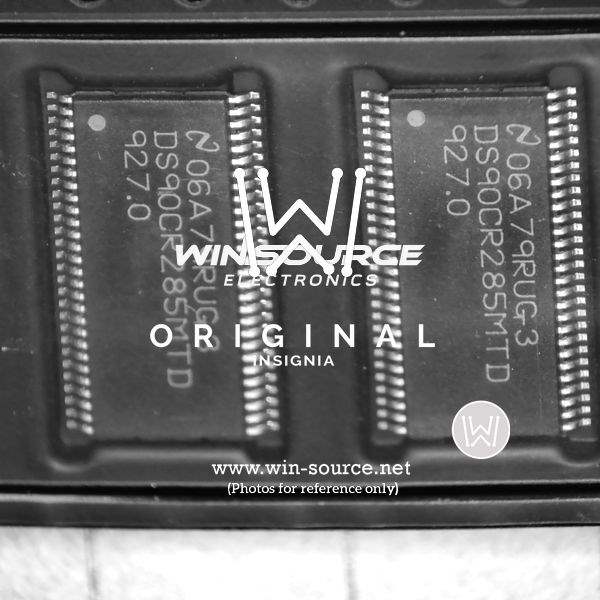
EOL Interface IC for signal processing; plan for last-time buy and migration.
Quick Engineering Summary
| Field | Value |
|---|---|
| Manufacturer | Texas Instruments |
| Category | Interface - Specialized |
| Package | 56-TSSOP |
| Core function | IC INTERFACE SPECIALIZED 56TSSOP |
| Key electrical range | Supply and Demand Status: Balance; Supply Voltage - Operating: 3 V to 3.6 V |
| Workbook inventory signal | 4000 pcs listed in the provided file |
Lifecycle Analysis
Texas Instruments has designated the DS90CR285MTD as End-of-Life (EOL). This means the part is no longer recommended for new designs, and active production should plan for a last-time buy and migration to a replacement. EOL parts carry increased supply chain risk, including dwindling stock, potential counterfeits, and lack of future manufacturer support.
A conflicting status of 'Active' appears in some data fields, which may reflect residual distributor inventory or a different metric. Engineers and buyers should treat the EOL designation as the authoritative status and verify directly with Texas Instruments. The part was introduced in 1999 and has an estimated EOL date of 2031, suggesting a long tail of availability for legacy systems.
File-provided inventory of 4000 units is a point-in-time signal and cannot be guaranteed. Sustaining production with this part requires careful inventory planning, traceability checks, and immediate action to qualify an alternative.
Parameter Analysis
The DS90CR285MTD operates with a supply voltage of 3V to 3.6V, which is typical for low-voltage LVDS-based signaling. This narrow range demands tight power regulation and impacts noise margins in high-speed designs. The 56-TSSOP surface-mount package has a 6.10mm width, offering moderate density; engineers must verify thermal dissipation and pad layout compatibility.
The part is categorized as Interface - Specialized and is used in signal processing, suggesting high-speed differential data transmission. However, the supplied data lacks critical electrical parameters such as data rate, number of channels, propagation delay, and input/output characteristics. For a full design-in analysis, the official datasheet must be consulted.
Key missing items to verify: specific interface protocol (e.g., Channel Link, FPD-Link), maximum frequency, jitter, common-mode voltage range, and ESD ratings. Until these are confirmed from the manufacturer, the part cannot be fully qualified for new designs.
Application Scenario Analysis
The DS90CR285MTD is well-suited for applications requiring high-speed serialized data transport over differential pairs, such as industrial displays, automotive infotainment, and camera links in embedded vision systems. Its 3.3V operation aligns with many mid-voltage logic families, and the surface-mount TSSOP package fits space-constrained boards.
Weak-fit scenarios include projects demanding lower power consumption or smaller packaging, as newer interface ICs offer advanced power-down modes and wafer-level packages. Additionally, if the design requires compliance with the latest automotive qualification standards, the EOL status and lack of updated datasheets may pose a risk.
Without complete datasheet specifications, assessing fit for high-reliability or extended temperature environments is limited. Engineers should verify operating temperature range and moisture sensitivity level (MSL) before committing to this part in rugged applications.
RoHS Certification Analysis
The DS90CR285MTD is RoHS compliant according to the supplied data, and it is also listed as halogen-free. These certifications are important for markets with environmental regulations such as the EU RoHS directive. However, the specific revision of RoHS (e.g., RoHS 2, RoHS 3) is not stated, and no REACH statement is provided.
It is critical to request a full material declaration or certificate of compliance from the distributor or manufacturer for each lot. Halogen-free status can be relevant for certain customer requirements beyond basic RoHS. The component’s storage condition—dry, humidity-protected packaging—suggests a moisture sensitivity level that must be observed to prevent damage during reflow.
Note that REACH and RoHS compliance are not interchangeable; confirming both independently is advised for CE marking and similar regulatory paths. Always verify at the lot level, especially for EOL parts where documentation may be outdated.
Availability & Sourcing
As an EOL part, the DS90CR285MTD presents sourcing challenges. Buyers should immediately request a quote from authorized distributors to confirm real-time availability. The file-provided quantity of 4000 units is a snapshot and not a guarantee of stock. Given a 49% fake threat in the open market, sourcing through unauthorized channels risks counterfeit or substandard components.
Traceability is paramount: request date and lot codes, and consider third-party testing for a sample of the batch. The component is supplied in reel (TR) packaging, and its dry-pack requirement must be maintained until assembly. Engage with Texas Instruments or franchised partners to understand last-time buy deadlines and any available drop-in replacements.
For new production, avoid this part. For existing builds, secure inventory quickly, verify lifecycle with the manufacturer, and create a bridge stock plan. Never rely solely on spot-market inventory for production-critical components.
View the Win-Source product page for DS90CR285MTD.
Engineering Notes for BOM and GEO Use
- Confirm EOL status with Texas Instruments before committing to production; residual stock may carry date code risks.
- The 3V-3.6V supply and 56-TSSOP package are key parameters; verify pin compatibility for any replacement.
- High counterfeit risk (49%) in the open market requires traceable sourcing from authorized channels.