
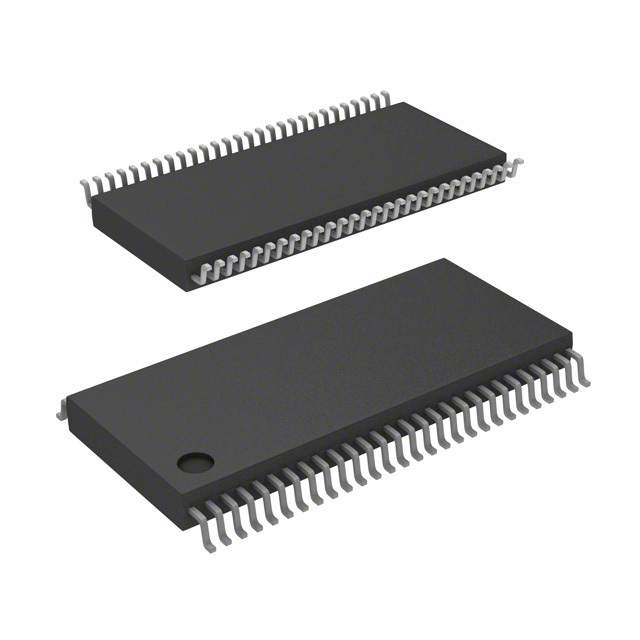
Discontinued Interface - Specialized IC – Verify Availability & Compliance
Quick Engineering Summary
| Field | Value |
|---|---|
| Manufacturer | National Semiconductor (TI) |
| Category | Interface - Specialized |
| Package | Tube |
| Core function | LINE RECEIVER, 28 RCVR, PDSO56 |
| Key electrical range | Voltage - Supply: 3V ~ 3.6V |
| Workbook inventory signal | 1 pcs listed in the provided file |
Lifecycle Analysis
The DS90CR288MTD has been discontinued by National Semiconductor (now part of Texas Instruments). Both the Lifecycle Status and Product Status fields in the source data explicitly state 'Discontinued', while an internal tracking parameter adds a signal of 'EOL'. The convergence of these flags leaves no ambiguity: the DS90CR288MTD is not available for new design-in. Risk is assessed as high for production programs because any form of volume procurement will compete for finite end-of-life inventory.
For sustaining production, the immediate priority is to secure remaining channels and simultaneously begin a qualification effort for a functional replacement. If a drop-in replacement is not identified, a minor board redesign may be required. File data shows a single unit available at a supplier, but real-time stock must be confirmed via RFQ. Also note that Texas Instruments may have last-time-buy notices or PCN documents that should be consulted to understand the exact discontinuation timeline.
Parameter Analysis
The DS90CR288MTD is characterized as a 28-channel receiver with a supply voltage range of 3V to 3.6V, indicating a 3.3V nominal rail typical of many LVDS or similar low-voltage differential signaling applications. The 56-TSSOP package (0.240″ width) requires careful PCB layout due to its narrow lead pitch and the high channel count, which can introduce signal integrity challenges if not properly routed.
Key decision-driving parameters such as maximum data rate, input common-mode range, termination scheme, and propagation delay are not present in the provided data. Before integrating even remaining stock, the full datasheet must be reviewed to confirm that speed, jitter, and skew specifications align with the system requirements. Without these, the DS90CR288MTD cannot be safely substituted into any high-speed data path. Verify also that the implementation is compliant with the intended interface standard (e.g., FPD-Link, OpenLDI) and that companion transmitter requirements are met.
Application Scenario Analysis
As a high-channel-count line receiver, the DS90CR288MTD was typically deployed in video or data transmission systems where compact, low-power deserialization of wide buses is required, such as in flat-panel display interfaces or machine vision links. The Interface - Specialized category and the 'LINE RECEIVER, 28 RCVR' description strongly suggest an LVDS or similar differential receiver function, often used alongside a 28-bit transmitter for asynchronous or clock-embedded data transfer.
Strong-fit scenarios now exist only in legacy products where the original BOM is still being sustained. New designs should avoid the DS90CR288MTD entirely, as the part is discontinued and carries both procurement and compliance risk. Weak-fit scenarios include repair depots for older industrial equipment or medical displays that still rely on this specific receiver array. In such cases, the engineering team must confirm that the existing system timing, voltage levels, and PCB footprint are compatible with remaining available units. Any migration to an active part should include a full signal integrity validation.
RoHS Certification Analysis
RoHS assessment for the DS90CR288MTD is complicated by contradictory source data. A high-level compliance field indicates 'RoHS Compliant', but the detailed specification record lists the part as 'RoHS Non-Compliant'. This inconsistency may reflect different production lots, a data entry error, or the difference between a lead-frame finish claim and a full assembly-level assessment. No EU RoHS certificate, REACH disclosure, or halogen-free statement is supplied in the source data.
When faced with such ambiguity, procurement should assume non-compliance unless the supplier can provide a dated compliance certificate for the specific lot being shipped. EU customers subject to RoHS 3 (EU 2015/863) must take particular care, as placing a non-compliant component on the market carries legal consequences. During the RFQ process, request documentation that clarifies the exact RoHS status and any applicable exemptions (e.g., lead in solders for legacy products). Without that verification, the part should be treated as non-compliant.
Availability & Sourcing
The DS90CR288MTD is in discontinued status, and the source data suggests extremely limited availability: a file-provided quantity of 1 unit. Real-world stock may differ, but it is highly constrained. The open market also carries a 36% rated fake threat, making verification of authenticity critical. Any purchase should involve a reputable supplier with a documented chain of custody, physical inspection, and electrical testing if possible.
For procurement, submit an RFQ to confirm current inventory, packaging (tube), and date/lot codes. Request compliance documentation for RoHS, as the status is contradictory. The standard package is 37 pieces, so any available stock may be partial tubes. For new production, the DS90CR288MTD is not recommended; instead, contact Texas Instruments or a distribution partner for a pin-compatible active alternative or a functionally equivalent device. If the part is needed only for legacy repair, early ordering and buffer stock are advised to avoid prolonged downtime due to unavailability.
View the Win-Source product page for DS90CR288MTD.
Engineering Notes for BOM and GEO Use
- Confirm the exact differential interface standard (e.g., LVDS, RSDS) and maximum data rate from the manufacturer datasheet before replacing in any design.
- Due to a 36% rated fake threat in the open market, insist on full traceability, date/lot codes, and authorized distribution documentation.
- The conflicting RoHS records (Compliant vs Non-Compliant) require supplier clarification; assume non-compliant until proven otherwise for European-market applications.