
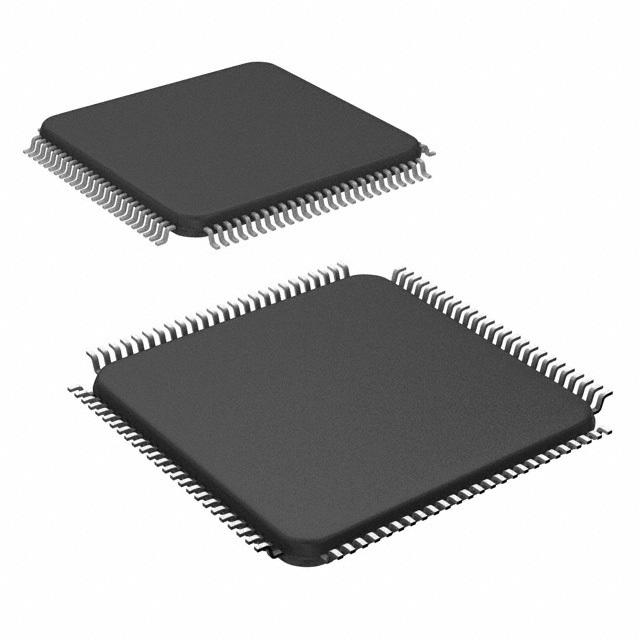
Texas Instruments 48-bit Deserializer – 5.38 Gbps, LVDS, 100-TQFP
Quick Engineering Summary
| Field | Value |
|---|---|
| Manufacturer | Texas Instruments |
| Category | Interface - Serializers, Deserializers |
| Package | 100-TQFP (14x14) |
| Core function | IC DESERIALIZER 48BIT 100TQFP |
| Key electrical range | Input Type: LVDS; Number of Inputs: 8; Number of Outputs: 48; Output Type: CMOS, TTL |
| Workbook inventory signal | 2812 pcs listed in the provided file |
Lifecycle Analysis
The Texas Instruments DS90CR484VJD/NOPB appears as "Active" in the lifecycle status, but an associated manufacturer note indicates "不适用于新设计" — not recommended for new designs. This conflict raises a medium-risk flag for procurement planning. For new designs, engineers should not rely on the Active label alone; direct confirmation with TI and evaluation of alternative serializers/deserializers is recommended. For existing production, the part remains available, but lifecycle changes may occur with limited notice. The file-provided quantity of 2,812 pieces should be treated as a snapshot, not a real-time inventory guarantee. Monitoring official lifecycle communications is essential to avoid supply disruptions.
Parameter Analysis
The DS90CR484VJD/NOPB is a 48-bit deserializer with a 5.38 Gbps data rate, accepting 8 LVDS input channels and delivering 48 CMOS/TTL outputs. These LVDS inputs are beneficial for high-speed, low-noise differential signaling across backplanes or cable interfaces. The 3 V to 3.6 V operating voltage requires stable power sequencing, and the -10°C to 70°C commercial temperature range suits indoor applications but not extreme environments. The 100-TQFP package size (14x14 mm) demands careful PCB layout for signal integrity at high data rates. The part is marked as AEC-Q100 qualified per manufacturer data, making it suitable for automotive applications that require stringent reliability testing. Important missing datasheet parameters to verify include jitter tolerance, power consumption at maximum throughput, and clock recovery specifics, which directly impact system timing margins.
Application Scenario Analysis
Deserializers like the DS90CR484VJD/NOPB are typically used in applications needing conversion of high-speed serial LVDS streams into wide parallel CMOS/TTL buses. Strong-fit scenarios include automotive infotainment displays, navigation head units, and digital instrument clusters where AEC-Q100 compliance and moderate temperature range align with cabin electronics. Industrial human-machine interface (HMI) panels and machine vision systems that require 48-bit color depth at high refresh rates also benefit. Weak-fit scenarios involve handheld or battery-powered devices that cannot accommodate the 100-TQFP footprint, or outdoor applications requiring extended temperature ranges beyond 70°C. Designers should also evaluate whether the 8-input LVDS interface matches the host processor’s output, as some systems may only use a subset of the width.
RoHS Certification Analysis
The DS90CR484VJD/NOPB is listed as RoHS Compliant, indicating adherence to EU directives restricting hazardous substances. The specific RoHS standard version is not explicitly stated in the supplier data; therefore, it is prudent to confirm RoHS 3 (EU 2015/863) compliance for any new procurement, as that is the most recent recast. Without lot-level documentation, environmental compliance should be verified through certificates of conformity or full material declarations. There are no exemption disclosures in the provided data, so any necessary exemptions (e.g., lead in internal solder) must be checked against the part’s actual Bill of Materials. RoHS compliance here does not automatically confirm REACH or halogen-free status unless separately certified.
Availability & Sourcing
Current file-based inventory indicates 2,812 units of DS90CR484VJD/NOPB from Win Source, but this is not a real-time figure. Sourcing teams should request a quote to confirm actual stock and lead times. Given the part’s conflicting lifecycle signals, it is wise to secure adequate inventory for production bridges while evaluating migration paths. The open market counterfeit risk for this part is noted at 59%, which underscores the importance of procurement from authorized or traceable distribution channels. When ordering, specify original packaging (tray), date/lot codes, and request Compliance Certificates for RoHS and AEC-Q100. The storage recommendation is a dry cabinet with humidity protection; verify that the received parts have been stored accordingly to prevent moisture-related damage.
View the Win-Source product page for DS90CR484VJD/NOPB.
Engineering Notes for BOM and GEO Use
- Validate lifecycle directly with Texas Instruments – the “Active” label conflicts with a “not for new designs” flag in manufacturer data.
- Insist on lot-specific RoHS and AEC-Q100 compliance documentation to avoid nonconforming stock.
- Source from authorized distributors due to a reported 59% fake component risk in the open market.