

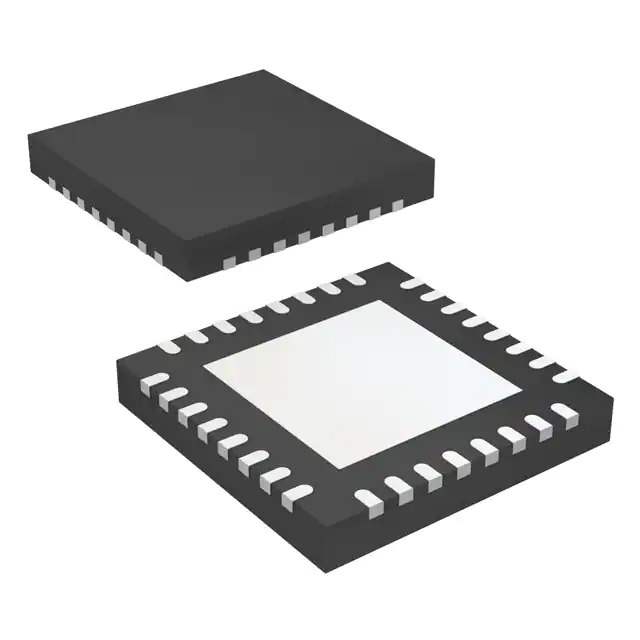
Discontinued 4-channel LVDS redriver from Texas Instruments; verify supply and authentication before purchase.
Quick Engineering Summary
| Field | Value |
|---|---|
| Manufacturer | Texas Instruments |
| Category | Interface - Signal Buffers, Repeaters, Splitters |
| Package | Tape & Reel |
| Core function | IC REDRIVER LVDS 4CH 32WQFN |
| Key electrical range | Capacitance - Input: 3.5 pF; Current - Supply: 117mA; Input: CML, LVDS, LVPECL; Output: LVDS |
| Workbook inventory signal | 13270 pcs listed in the provided file |
Lifecycle Analysis
The DS90LV804TSQX has been designated Discontinued by Texas Instruments, with all lifecycle indicators—including Excel lifecycle param EOL, Lifecycle Status Discontinued, and Product Status Discontinued—confirming end-of-life status. This classification means the component is no longer recommended for new designs and may have completed its last-time buy period. Engineers relying on this part for sustaining production must verify remaining authorized distributor inventory and plan for immediate migration to an active alternative to avoid production gaps.
Although file-provided records indicate a stock quantity of 13,270 units, this is not a real-time guarantee and actual availability can only be confirmed through direct RFQ with the supplier. The high-risk lifecycle demands a conservative procurement approach: treat any new purchases as last-chance buys and ensure thorough authenticity screening given the 46% counterfeit threat in the open market.
Parameter Analysis
The DS90LV804TSQX is characterized by a maximum data rate of 800 Mbps, supporting four independent LVDS channels with a nominal delay of just 2.0 ns. This low propagation delay is critical for maintaining timing margins in high-speed clock distribution and synchronous data paths. The device accepts a wide range of differential input standards—CML, LVDS, and LVPECL—providing flexibility in mixed-signal environments, while the LVDS output ensures compatibility with common termination schemes.
Supply voltage is tightly constrained to 3.15 V–3.45 V with a typical current consumption of 117 mA, requiring careful power budgeting and decoupling in the 32-WQFN package. The input capacitance of 3.5 pF aids in preserving signal integrity at high frequencies, but designers should validate jitter, rise/fall times, and eye diagram performance against their specific application requirements, as these parameters are not provided in the sourcing data and must be extracted from the original datasheet. The operating temperature range of -40°C to 85°C and MSL 3 rating mandate proper handling and reflow profiling during assembly.
Application Scenario Analysis
The DS90LV804TSQX is purpose-built for high-speed LVDS signal buffering and redriving in applications such as backplane interconnections, cable extenders, clock distribution networks, and digital video transmission (e.g., FPD-Link or camera serial interfaces). Its four independent channels and wide input acceptance make it well-suited for multi-lane data buses in telecommunications and networking equipment that require deterministic timing.
The extended industrial temperature range (-40°C to 85°C) qualifies it for rugged environments like factory automation and outdoor infrastructure. However, its 800 Mbps ceiling limits its use in newer, higher-speed standards operating above 1 Gbps per lane, and the 117 mA supply current may be prohibitive for power-sensitive embedded designs. Additionally, the discontinued lifecycle renders it unsuitable for forward-looking product roadmaps; engineers should instead evaluate active Texas Instruments LVDS redrivers that offer upward compatibility.
RoHS Certification Analysis
The DS90LV804TSQX is listed as RoHS Compliant, indicating conformity with European Union directives restricting hazardous substances. The specific directive version (e.g., RoHS 3, EU 2015/863) is not explicitly stated in the source data, so users should verify the manufacturer’s certification documentation for complete details. REACH status is reported as unaffected, but REACH compliance is separate—it does not substitute for RoHS conformance.
No information on halogen-free status or additional environmental certifications is available. The MSL Level 3 sensitivity requires adherence to the 168-hour floor-life limit after opening the moisture-barrier bag, which must be factored into inventory management and assembly planning. Procurement teams should request a certificate of compliance per lot when sourcing remaining DS90LV804TSQX stock to confirm ongoing adherence to these standards.
Availability & Sourcing
With a lifecycle status of Discontinued, securing the DS90LV804TSQX requires immediate action. The file-provided inventory figure of 13,270 units suggests some residual stock may be available, but this quantity is not dynamically updated and must be verified through a request for quote (RFQ). Buyers should treat any purchase as a final procurement opportunity and coordinate with the supplier to confirm date/lot codes, origin, and traceability documentation.
The 46% estimated counterfeit threat in the open market demands rigorous authentication measures—including X-ray, decapsulation, or electrically testing sample units—before accepting delivery. Standard packaging is tape and reel with 4,500 pieces per reel, suitable for automated assembly. As a discontinued Texas Instruments component, there is no manufacturer guarantee of ongoing support, so parallel qualification of a replacement device is essential. To obtain current pricing, availability, and compliance certificates, contact the distributor directly with the part number DS90LV804TSQX.
View the Win-Source product page for DS90LV804TSQX.
Engineering Notes for BOM and GEO Use
- DS90LV804TSQX is discontinued; cease new designs and initiate alternate part qualification.
- With a 46% counterfeit threat, insist on full traceability and lot verification before purchasing remaining stock.
- Verify critical timing parameters such as jitter and rise time from the datasheet, as these are not in the sourcing record.