
Texas Instruments Automotive Deserializer for ADAS Camera Systems
Quick Engineering Summary
| Field | Value |
|---|---|
| Manufacturer | Texas Instruments |
| Category | Interface - Serializers, Deserializers |
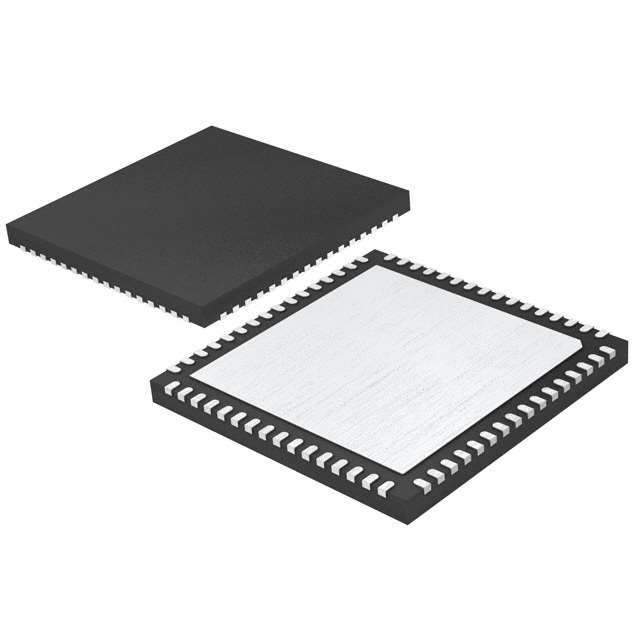
| Package | 64-VQFN (9x9) |
| Core function | IC DESERIALIZER 800MBPS 64VQFN |
| Key electrical range | Operating Temperature Range: -40°C ~ 105°C (TA); Supply and Demand Status: Limited |
| Workbook inventory signal | 3810 pcs listed in the provided file |
Lifecycle Analysis
The DS90UB964TRGCRQ1 from Texas Instruments is classified as Active in the product lifecycle, indicating it is currently in full production and suitable for both new designs and sustaining production. All provided lifecycle signals, including the manufacturer's official status and Excel parameter, align without conflict, confirming a low risk of near-term obsolescence. Engineers can proceed with design-in activities for automotive applications requiring AEC-Q100 qualified deserializers.
However, procurement teams should note that the part's supply-demand status is listed as Limited, and a high open-market counterfeit threat of 88% exists. While the lifecycle is stable, securing genuine components requires careful sourcing from authorized distributors or direct manufacturer channels. It is advisable to monitor Texas Instruments' PCN alerts for any future changes, even though current status suggests long-term availability. The 34-week estimated production lead time underscores the need for forward planning in inventory management.
For qualification and compliance, verify the latest datasheet and Product Change Notifications directly from Texas Instruments to confirm that the Active status remains unchanged before finalizing production schedules.
Parameter Analysis
The DS90UB964TRGCRQ1 is a four-input FPD-Link III deserializer with a data rate of 800 Mbps per channel, outputting over MIPI CSI-2 interface. It operates over an automotive temperature range of -40°C to 105°C and is AEC-Q100 qualified, making it suitable for rigorous automotive environments. Dual supply voltages of 1.8V and 3.3V allow flexible power management in vehicle systems. The 64-VQFN surface-mount package with 9x9 mm footprint enables compact PCB layout for multi-camera clusters.
Critical parameters for design integration include input compliance with FPD-Link III and LVDS signaling levels, which must be matched to the camera source for reliable deserialization. The MSL level 3 rating requires adherence to 168-hour floor life constraints after opening the moisture barrier bag, necessitating proper handling and baking procedures during assembly. The EAR99 ECCN classification simplifies export compliance.
However, the provided data does not include details on power dissipation, ESD protection levels, or jitter specifications. Engineers should consult the full Texas Instruments DS90UB964 datasheet to verify these parameters, as well as recommended PCB layout guidelines, decoupling requirements, and thermal management strategies. The absence of device-specific eye diagram masks or bit error rate curves means that system-level signal integrity validation is essential before production release.
Application Scenario Analysis
The DS90UB964TRGCRQ1 targets automotive vision processing systems that aggregate data from multiple high-definition cameras via FPD-Link III. It is strongly suited for advanced driver-assistance systems (ADAS) such as surround view, rear-view, and camera monitoring systems where up to four 2-megapixel sensors are deserialized and forwarded to a central processor over MIPI CSI-2. The AEC-Q100 qualification and wide temperature range ensure reliability in under-hood and exterior automotive placements.
In consumer or industrial imaging, this deserializer may be over-specified due to its automotive-grade ruggedness and cost structure. However, applications requiring robust long-distance camera links with power-over-coax capabilities (when paired with compatible FPD-Link III serializers) could benefit from its features. Non-automotive uses would need to validate that the 1.8V/3.3V supply and tight temperature range fit the target environment.
Designs not needing the full four-channel aggregation or MIPI output, or those with incompatible input formats (e.g., parallel RGB or non-FPD-Link III LVDS), should consider alternative interface ICs. Additionally, systems with power budgets sensitive to the deserializer's consumption must verify total thermal dissipation, as the 64-VQFN package may require heatsinking in enclosures with limited airflow.
RoHS Certification Analysis
The DS90UB964TRGCRQ1 is declared RoHS Compliant according to the supplied data, indicating conformity with EU Directive 2011/65/EU and its amendments, including the RoHS 3 (2015/863) restricted substances. Additionally, it is REACH Unaffected, meaning no substances of very high concern (SVHC) exceed threshold limits as per EU Regulation 1907/2006. These certifications support use in European and global markets requiring hazardous substance compliance.
While the component-level RoHS status is affirmative, engineers and compliance officers should request the full material declaration from Texas Instruments for lot-specific verification, especially for automotive supply chains with stringent documentation requirements. The MSL level 3 rating (168 hours) is not directly a RoHS attribute but indicates moisture sensitivity, which should be considered alongside lead-free reflow soldering profiles typical of RoHS-compliant assembly.
No exemptions are noted in the provided data. In practice, RoHS exemptions such as lead in solders for high-reliability applications are unlikely for this IC package, but confirm via the manufacturer’s latest compliance certificates. For high-volume production, it is prudent to maintain traceability to the specific RoHS test reports or declarations for each shipment to satisfy IATF 16949 or similar quality management system audits in the automotive sector.
Availability & Sourcing
Sourcing the DS90UB964TRGCRQ1 Texas Instruments deserializer requires attention to its limited supply-demand status and high counterfeit risk. The provided inventory file shows a quantity of 3,810 units, but this is not a real-time guarantee and should be verified at the time of procurement. The estimated production lead time is 34 weeks, which demands early ordering and buffer stock planning to avoid production delays.
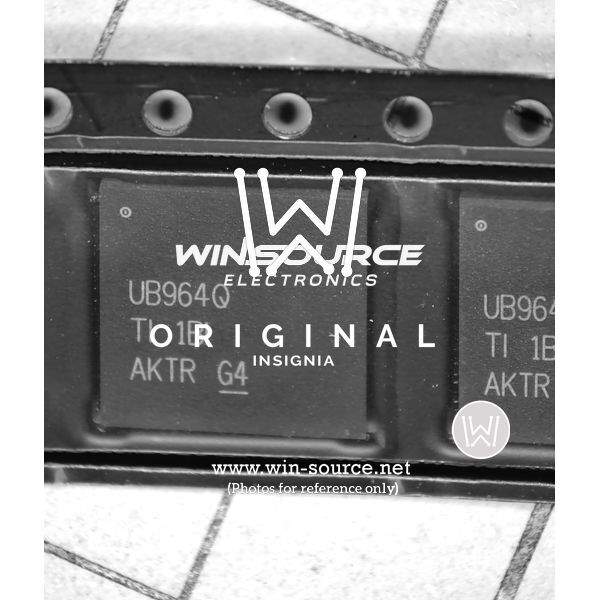
Due to the 88% open-market counterfeit threat, buyers must only source from authorized TI distributors or directly from Texas Instruments to ensure authenticity. Each shipment should include full traceability documentation, such as date and lot codes, Certificate of Conformance, and RoHS compliance certificates. The packaging is on reel (TR) with 2,000 units per reel, simplifying automated pick-and-place but requiring proper ESD and moisture protection given the MSL 3 level.
For current availability and pricing, request a quotation through Win Source or other franchised partners, specifying the exact part number DS90UB964TRGCRQ1. Because the device is Active, normal procurement channels should be used, but given the constraints, also monitor alternative part numbers (such as DS90UB964TRGCRQ1-ND or 296-DS90UB964TRGCRQ1TR) as cross-reference for distributor inventory. For critical projects, consider safety stock agreements or last-time-buy planning if future supply uncertainties arise.
View the Win-Source product page for DS90UB964TRGCRQ1.
Engineering Notes for BOM and GEO Use
- Verify input signal compatibility with FPD-Link III serializer; ensure matched impedance and equalization settings per TI reference design.
- Account for MSL 3 handling — use dry pack storage and follow JEDEC baking requirements before reflow.
- For high-temperature environments, validate thermal performance of 64-VQFN package with adequate copper pour and airflow.