
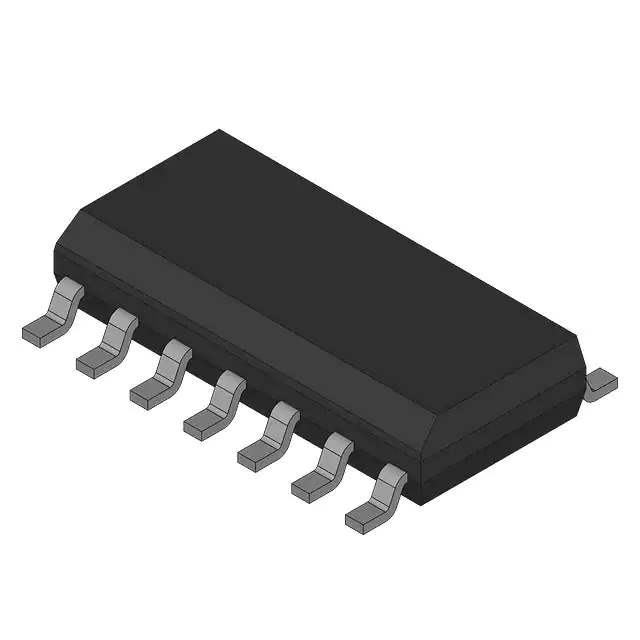
National Semiconductor (TI) Interface Transceiver - EOL Status, RoHS Compliant, 14-SOIC
Quick Engineering Summary
| Field | Value |
|---|---|
| Manufacturer | National Semiconductor (TI) |
| Category | Interface - Drivers, Receivers, Transceivers |
| Package | Bulk |
| Core function | IC TRANSCEIVER HALF 1/1 14SOIC |
| Key electrical range | Temperature Range - Operating: -40°C ~ 85°C; Voltage - Supply: 3V ~ 3.6V |
| Workbook inventory signal | 29000 pcs listed in the provided file |
Lifecycle Analysis
The DS91D180TMA is confirmed as End-of-Life (EOL) in multiple lifecycle parameters, though a conflicting 'Product Status: Active' signal appears in the data. This contradiction demands a conservative procurement stance: the part should be treated as EOL for both new designs and long-term production planning. Engineering teams must avoid incorporating this transceiver into new projects, as future availability cannot be assured.
For existing designs that depend on the DS91D180TMA, immediate action is required. Contact Texas Instruments (which absorbed National Semiconductor) directly to obtain official last-time-buy (LTB) dates and end-of-life notifications. A file-provided inventory quantity of 29,000 units is noted, but this is not a real-time stock guarantee and may include bulk or residual supply. Any inventory purchased must be verified for date/lot codes and authenticity, especially given the high counterfeit risk in the open market.
Procurement should treat this component as a bridging measure only. Begin evaluating pin-compatible, active LVDS transceivers with comparable data rates and package dimensions to maintain production continuity. Without a clear migration path, sustaining operations will face escalating supply risks.
Parameter Analysis
The DS91D180TMA is a half-duplex LVDS transceiver with one driver and one receiver, delivering data rates up to 200Mbps. The LVDS protocol is critical for low-power, high-speed differential signaling, making the part suitable for noise-sensitive applications where common-mode rejection is essential. The half-duplex configuration means that transmission and reception occur on the same pair but not simultaneously, imposing system-level design constraints for turnaround timing and bus arbitration.
Supply voltage spans 3V to 3.6V, aligning with standard 3.3V systems and allowing some tolerance for voltage droop. The operating temperature range of -40°C to 85°C covers most industrial and extended commercial environments, though it is not rated for automotive or military extremes. The 14-SOIC package (0.154-inch width) is compact and surface-mountable, enabling reasonable PCB density without requiring advanced assembly techniques.
However, several decision-critical parameters are absent from the available data. Engineers should verify the receiver input sensitivity, propagation delay, and differential output voltage swing directly from the manufacturer datasheet before qualifying the part. Additionally, power consumption and termination requirements are not specified; these must be checked to ensure proper signal integrity and thermal management in the end application.
Application Scenario Analysis
The DS91D180TMA is best suited for point-to-point, half-duplex communication links where LVDS signaling provides noise immunity and low power consumption. Typical strong-fit applications include industrial sensor interfaces, backplane control buses, and low-latency data acquisition systems where bidirectional communication is needed but not simultaneously. In these scenarios, the 200Mbps rate supports moderate-bandwidth control and monitoring tasks, and the industrial temperature range covers most factory-floor or outdoor cabinet environments.
Weaker-fit scenarios arise when full-duplex operation is required. For example, high-speed Ethernet or video links demand simultaneous transmit and receive, making a half-duplex device like the DS91D180TMA unsuitable. Similarly, applications exceeding 200Mbps or needing extended temperature ranges beyond -40°C to 85°C would require a different part. Designers should also note that the EOL status makes this component inappropriate for any new product introduction, regardless of technical fit. Even in sustaining production, the half-duplex limitation must be weighed against the risk of future supply gaps.
Before integrating the DS91D180TMA into a design, verify that the LVDS signaling levels and bus topology match the intended use. Improper termination or incorrect common-mode range can lead to signal integrity failures, so a thorough simulation and prototype validation are advised.
RoHS Certification Analysis
The DS91D180TMA is listed as RoHS Compliant, meaning it meets the requirements of the EU Restriction of Hazardous Substances directive. However, the available data does not specify the exact directive version (e.g., RoHS 3 (EU 2015/863)), so it is prudent to request the supplier's declaration of conformity to confirm coverage of all restricted substances, including the four phthalates added under RoHS 3.
Separately, the REACH status is reported as 'REACH Affected.' This indicates that the part may contain Substances of Very High Concern (SVHC) above the 0.1% weight threshold, necessitating compliance documentation and possible disclosure under EU REACH regulations. REACH and RoHS are distinct regulatory frameworks; REACH compliance does not replace RoHS certification. Procurement teams should obtain both RoHS and REACH certificates for each lot, as composition can vary by production batch.
The part also carries an MSL rating of 1 (Unlimited), meaning it has no moisture sensitivity once properly packaged. This simplifies handling and storage, but in the context of EOL and high counterfeit risk, buyers must ensure that packaging integrity has been maintained and that the MSL rating is still validated for any purchased inventory.
Availability & Sourcing
The DS91D180TMA is an EOL component, and sourcing it carries high risk. A file-provided inventory quantity of 29,000 units is noted, but this is not a guaranteed real-time stock. Buyers must request a quote and verify current availability before placing orders. The open-market fake threat for this part is reported at 44%, underscoring the need for rigorous authenticity checks. Accept only lots with full traceability, including date/lot codes and manufacturer certificates of conformance.
To procure the DS91D180TMA, issue an RFQ specifying the exact part number and request documentation including RoHS, REACH, and country-of-origin certificates. Insist on a signed waiver of authenticity for any non-franchised source. Because the part is EOL, consider securing enough inventory to cover remaining production life, but only after verifying the manufacturer's LTB date and any end-of-life transition notices from Texas Instruments.
Given the high risk and lifecycle status, the recommended action is to simultaneously initiate migration to an active LVDS transceiver. Contact Texas Instruments or authorized distributors to identify a recommended replacement with similar footprint and performance. For immediate needs, the sourcing process must prioritize compliance verification and stringent anti-counterfeit measures to avoid production disruptions.
View the Win-Source product page for DS91D180TMA.
Engineering Notes for BOM and GEO Use
- Verify EOL and last-time-buy dates directly with TI before committing to any production build using DS91D180TMA.
- Request full compliance documentation (RoHS, REACH) for each lot to mitigate counterfeit risk, as reported open-market fake threat is 44%.
- Plan migration to an active LVDS transceiver with similar footprint and 200Mbps performance to avoid future supply disruptions.