
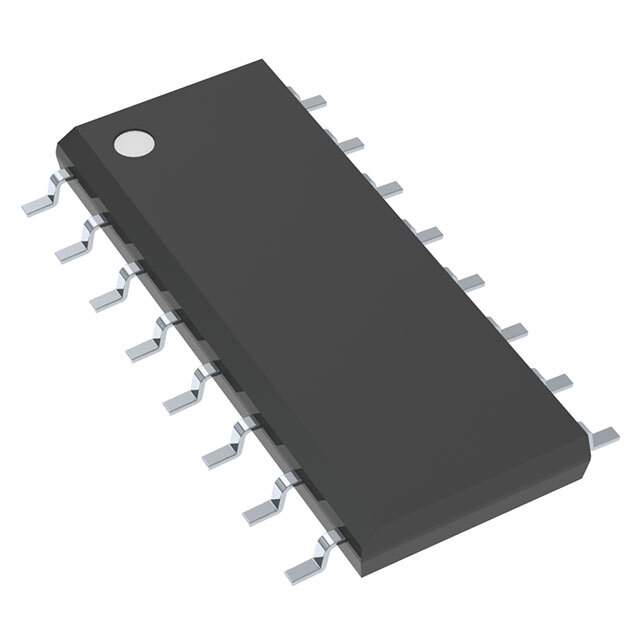
250 Mbps M-LVDS 1:4 Buffer/Repeater in 16-SOIC
Quick Engineering Summary
| Field | Value |
|---|---|
| Manufacturer | Texas Instruments |
| Category | Interface - Signal Buffers, Repeaters, Splitters |
| Package | 16-SOIC |
| Core function | DS91M125 125 MHZ 1:4 M-LVDS REPE |
| Key electrical range | Capacitance - Input: 5pF; Input: CML, LVDS, LVPECL, MLVDS; Operating Supply Current: 67mA; Output: MLVDS |
| Workbook inventory signal | 500 pcs listed in the provided file |
Lifecycle Analysis
The DS91M125TMAX/NOPB from Texas Instruments is in Active lifecycle status with low risk for new designs and ongoing production. All supplied lifecycle indicators, including manufacturer status and distributor data, align on active availability, indicating no immediate end-of-life or discontinuation concerns. Engineers can confidently integrate this M-LVDS repeater into new projects while implementing standard lifecycle monitoring practices.
For sustaining procurement, the active status supports stable supply chain planning. However, it is advisable to periodically revalidate with Texas Instruments or authorized distributors for any updates, as unforeseen changes in demand or silicon availability can affect long-term supply. The file-provided inventory quantity of 500 units is a snapshot and should not be treated as a real-time guarantee.
Parameter Analysis
Key parameters for the DS91M125TMAX/NOPB include its function as a 1:4 M-LVDS buffer/multiplexer with a maximum data rate of 250 Mbps and a low propagation delay of 5.5 ns. The wide input compatibility—accepting CML, LVDS, LVPECL, and MLVDS signals—provides flexibility for mixed-signal environments, while the MLVDS outputs ensure robust multi-point bus operation. Operating from a 3 V to 3.6 V supply with a modest 67 mA current draw, the device suits low-power distribution tasks. The 5 pF input capacitance minimizes loading on high-speed sources, and the -40°C to 85°C temperature range covers industrial applications.
However, several parameters critical for signal integrity are absent from the supplied data: channel-to-channel output skew, jitter performance, and output current drive capability must be verified in the official Texas Instruments datasheet. Additionally, the 16-SOIC package requires attention to thermal resistance and PCB land pattern for reliable operation. For designs pushing the 250 Mbps limit, confirm the eye diagram compliance and any needed termination schemes.
Application Scenario Analysis
The DS91M125TMAX/NOPB fits strongly in M-LVDS signal distribution systems, such as backplane clock fanouts, multi-drop bus repeaters, and cable extension nodes in telecom or industrial automation. Its 1:4 fan-out with multi-input acceptance makes it ideal for replicating high-speed signals to multiple destinations while maintaining timing coherence. The 250 Mbps capability supports many LVDS-based protocols like Ethernet over backplane or serializer-deserializer links.
Weak-fit scenarios include low-speed single-ended logic translation, applications requiring voltage levels above 3.6 V, or environments demanding extended temperature beyond 85°C. It is not designed as a galvanic isolator or level translator for non-M-LVDS standards. Engineers should evaluate the 5.5 ns delay for overall system timing budget and consider the 5 pF input capacitance when driving with weak sources. Always verify bus loading limits per M-LVDS specifications.
RoHS Certification Analysis
The DS91M125TMAX/NOPB is listed as RoHS Compliant according to the provided data. While the exact directive version is not specified, Texas Instruments typically aligns with RoHS 3 (EU 2015/863) requirements, which restrict lead, mercury, cadmium, and other hazardous substances. No exemptions are mentioned, but for high-reliability applications, users should request the manufacturer’s full material declaration.
Although REACH compliance is not explicitly indicated, it is separate from RoHS; buyers should request REACH SVHC declarations if needed. The part’s packaging as reel-tape and storage condition (dry cabinet, humidity protection) suggests MSL sensitivity, but no MSL level is provided—confirm with the datasheet. For each procurement lot, obtain lot-level certificates to ensure ongoing compliance, as changes in manufacturing processes can occur.
Availability & Sourcing
The DS91M125TMAX/NOPB is currently available, with a file-provided inventory quantity of 500 units from the source. This figure is not guaranteed real-time and may change; direct readers to request a quote for up-to-date availability, pricing, and lead times. The part is supplied in reel packaging, suitable for automated assembly, and requires dry storage per manufacturer guidelines. The open market indicates a 28 percent counterfeit threat level, underscoring the importance of sourcing through authorized Texas Instruments distributors or qualified independent distributors with full traceability.
When procuring, verify date and lot codes, request certificates of conformance, and confirm RoHS status on the actual shipment. For sustaining production, secure a buffer stock to mitigate any allocation risks, even for an active component. For high-volume needs, early engagement with suppliers can help manage lead times.
View the Win-Source product page for DS91M125TMAX/NOPB.
Engineering Notes for BOM and GEO Use
- Verify datasheet for jitter and channel-to-channel output skew before committing to high-speed PCB layout.
- Use proper M-LVDS termination and controlled impedance traces to maintain signal integrity at maximum 250 Mbps data rate.
- Confirm lot-level RoHS and REACH compliance certificates during procurement to avoid counterfeit or non-conforming parts.