
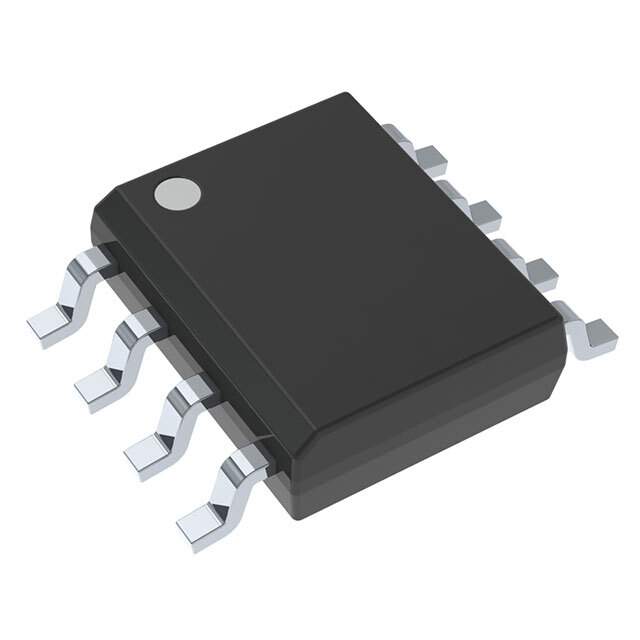
Single-channel BLVDS redriver, 400 Mbps, 1.4 ns delay, LVDS output, 8-SOIC package.
Quick Engineering Summary
| Field | Value |
|---|---|
| Manufacturer | Texas Instruments |
| Category | Interface - Signal Buffers, Repeaters, Splitters |
| Package | 8-SOIC |
| Core function | IC REDRIVER BLVDS 1CH 8SOIC |
| Key electrical range | Input: CML, LVDS, LVPECL; Operating Supply Current: 50mA; Output: LVDS; Supply and Demand Status: Balance |
| Workbook inventory signal | 3290 pcs listed in the provided file |
Lifecycle Analysis
Texas Instruments marks the DS92001TMA/NOPB with an active lifecycle status, indicating full availability for new designs and ongoing production. No end-of-life notice or pending discontinuation is reported, and all lifecycle signals in the supplied data align on active. This stability allows engineers to incorporate the part into long-life industrial systems with confidence.
For procurement, an active lifecycle means standard lead times, consistent supply, and ongoing manufacturer support. However, as with any active part, verify lifecycle status through the official TI product page before committing to high-volume production, as status can change without immediate distributor notification. The file-provided inventory quantity of 3290 units suggests currently healthy buffer stock, but real-time availability must be confirmed via RFQ.
In summary, the DS92001TMA/NOPB represents a low-risk component for both new design and sustaining builds, provided that lifecycle status is re-checked periodically.
Parameter Analysis
Key parameters for the DS92001TMA/NOPB begin with its maximum data rate of 400 Mbps and a typical propagation delay of 1.4 ns. These values define the device’s suitability for high-speed differential signal conditioning in BLVDS and similar multi-point bus architectures. The 1.4 ns delay is particularly critical for timing closure in backplane or cabled systems where skew management is paramount.
The input stage accepts CML, LVDS, and LVPECL levels, offering broad compatibility with various drivers and FPGAs. The output is fixed as LVDS, so designers must ensure the receiving end accepts LVDS-compatible common-mode and swing. The single-channel 8-SOIC package supports a 3 V to 3.6 V supply with a typical current draw of 50 mA, demanding careful local decoupling and thermal consideration in dense layouts. The industrial temperature range of -40°C to 85°C covers most rugged environments.
Notable missing specifications in the provided data include input equalization, jitter tolerance, output rise/fall times, and detailed eye-pattern masks. These parameters should be confirmed from the manufacturer’s datasheet to guarantee signal integrity under worst-case PCB loss and connector conditions. Additionally, verify the device’s internal biasing and termination requirements, as they directly influence impedance matching and noise margin.
Application Scenario Analysis
The DS92001TMA/NOPB is purpose-built for BLVDS (Bus Low-Voltage Differential Signaling) environments, where multiple nodes share a backplane or cabled bus. Its redriver function restores signal amplitude and edge speed after transmission-line losses, making it ideal for backplane communication in telecommunications, industrial control, and automotive infotainment systems. The ability to accept CML and LVPECL inputs also enables it to bridge non-LVDS sources into a unified LVDS bus.
While the device can function as a simple buffer in point-to-point LVDS links, its strength lies in multi-drop or long-distance applications where signal degradation occurs. For standard short-reach LVDS transceiver requirements without signal conditioning, a basic LVDS driver may be more cost-effective. Additionally, if the application demands bidirectional operation or higher channel integration, alternate parts should be evaluated because the DS92001TMA/NOPB provides only one unidirectional channel.
Engineers should also consider that the part’s 400 Mbps limit and 1.4 ns delay may impose constraints in protocols with tight deterministic timing. For gigabit-class backplanes, a redriver with equalization and higher bandwidth would be necessary. Hence, the primary fit is legacy or moderate-speed BLVDS buses, while high-speed PCIe or SATA redriver applications fall outside the intended scope.
RoHS Certification Analysis
According to the supplied data, the DS92001TMA/NOPB is RoHS Compliant. This designation typically indicates conformance to the EU RoHS Directive 2011/65/EU and its amendments (e.g., 2015/863), restricting hazardous substances such as lead, mercury, and cadmium. No specific exemptions are listed, but certain passive or packaging exemptions may apply; these should be verified through Texas Instruments’ material declaration documentation, often available via the manufacturer’s product page.
While REACH compliance is not separately reported in the data, RoHS compliance does not automatically guarantee full REACH coverage, so it is advisable to request the complete material declaration if required for European market access. For high-reliability and military applications, lot-level certification may be necessary to ensure that no restricted substances were introduced in process variations.
Given the 68% reported fake threat rate for this part in the open market, RoHS compliance should be verified with the actual lot certificate upon receipt. Counterfeit components often falsely bear RoHS markings, making physical inspection and authorized sourcing critical for environmental compliance assurance.
Availability & Sourcing
The DS92001TMA/NOPB is currently in active production, and the file indicates a stock quantity of 3290 units across the supply chain. This figure is a snapshot and not a real-time guarantee; actual availability, lead times, and minimum order quantities must be confirmed via quoting. The part ships in tube/rail packaging for the 8-SOIC package, a format suitable for automated pick-and-place with proper handling.
To mitigate sourcing risk, emphasize RFQ requests that include verification of date/lot codes, traceability to Texas Instruments’ authorized channel, and compliance documentation (RoHS certificate, full material declaration). The reported high counterfeit risk in the open market makes purchasing from franchised distributors or directly from TI critical. This proactive vetting protects against receiving non-compliant or non-functional units.
For an active component like this, standard sourcing strategies apply: request quotes for volume pricing (without assuming any price level), confirm lead times, and establish a safety stock if the part is sole-sourced in a BOM. Because the lifecycle is stable, there is no immediate need to secure last-time buys, but inventory management should still include periodic supply-monitoring alerts.
View the Win-Source product page for DS92001TMA/NOPB.
Engineering Notes for BOM and GEO Use
- Verify BLVDS signaling compatibility; the DS92001TMA/NOPB outputs LVDS only, ensuring the receiving stage can accept the correct common-mode range.
- With a 68% open-market counterfeit threat, require authorized distribution and perform incoming lot inspection/datacode verification for the DS92001TMA/NOPB.
- Confirm 3.3V supply rail integrity for the 50mA current draw per channel; decoupling and thermal design should follow the datasheet layout guidelines.