
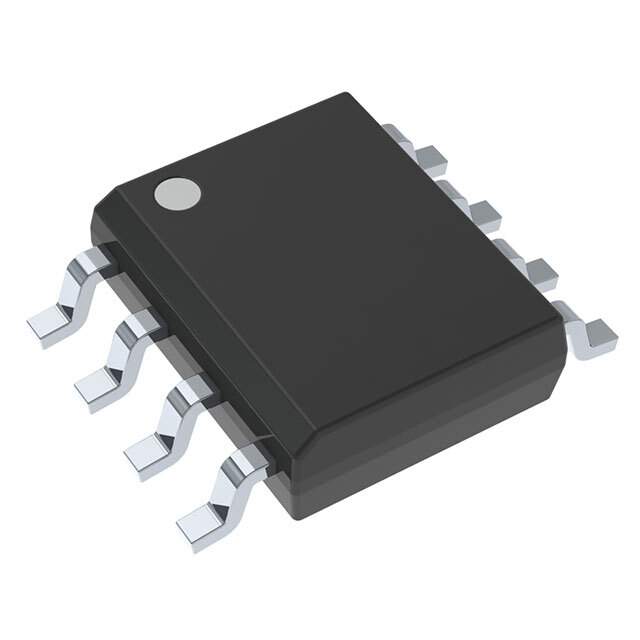
Active 1-channel BLVDS redriver with 400Mbps data rate, 1.4ns delay, 3.3V supply, 8-SOIC. Sourcing guide for engineers.
Quick Engineering Summary
| Field | Value |
|---|---|
| Manufacturer | Texas Instruments |
| Category | Interface - Signal Buffers, Repeaters, Splitters |
| Package | 8-SOIC |
| Core function | IC REDRIVER BLVDS 1CH 8SOIC |
| Key electrical range | Input: CML, LVDS, LVPECL; Operating Supply Current: 50mA; Operating Supply Voltage: 3 V ~ 3.6 V; Operating Temperature Range: -40°C ~ 85°C |
| Workbook inventory signal | 3268 pcs listed in the provided file |
Lifecycle Analysis
Texas Instruments lists the DS92001TMAX/NOPB as Active with an estimated EOL date of 2028. This indicates stable manufacturing support and suitability for new designs with a clear multi-year horizon. The lifecycle status is confirmed by multiple signals in the supplied data, showing no conflicts.
For procurement teams, the Active status means strong ongoing availability and manufacturer backing. However, as the estimated EOL falls in 2028, design teams should plan migration paths or last-time-buy strategies for programs extending beyond that window. Monitoring TI product change notifications (PCNs) is recommended.
File-provided inventory indicates 3268 units, suggesting current stock levels are accessible for prototype and production builds. Nonetheless, all inventory numbers should be validated through a formal RFQ to confirm real-time availability.
Parameter Analysis
The DS92001TMAX/NOPB is a single-channel buffer/redriver optimized for BLVDS applications, supporting data rates up to 400Mbps with a very low propagation delay of 1.4ns. Its input compatibility spans CML, LVDS, and LVPECL standards, while the output is LVDS, enabling flexible integration in high-speed backplane or cable-extension designs.
The device operates on a 3V to 3.6V supply rail, drawing a typical 50mA, which aids power budgeting in 3.3V systems. The 8-SOIC package with a 3.90mm wide body is suitable for standard surface-mount assembly, and the -40°C to 85°C temperature range covers most industrial environments.
Key parameters requiring verification from the Texas Instruments datasheet include input common-mode voltage range, differential output swing, jitter specifications, and ESD ratings. Additionally, the maximum capacitive load drive and termination requirements are critical for ensuring signal integrity in the target application.
Application Scenario Analysis
The DS92001TMAX/NOPB is inherently suited for BLVDS (Bus LVDS) point-to-point or multi-drop backplane communications, where it can redrive signals to combat attenuation and maintain data integrity over long traces or cables. Its support for multiple input standards makes it adaptable to legacy CML or LVPECL sources that need level translation to LVDS.
Strong-fit scenarios include telecom line cards, industrial automation backplanes, and test instrumentation where high-speed low-voltage differential signaling is required. It can also serve as a clock buffer for distributing precision clocks, leveraging its low 1.4ns delay and 400Mbps throughput.
Weak-fit scenarios might involve applications requiring hot-swap capability or those demanding extended temperature ranges beyond -40°C to 85°C, as the device lacks explicit mention of hot-swap protection or wider industrial temperature grades. Additionally, multi-channel designs may necessitate multiple devices, given the single-channel limitation.
RoHS Certification Analysis
The DS92001TMAX/NOPB is marked as RoHS Compliant and Halogen Free Compliant in the supplied data. This indicates conformance with the EU RoHS directive restrictions on hazardous substances, including lead, and meets halogen-free requirements for environmentally conscious manufacturing.
While the specific RoHS exemption code or the exact directive version (e.g., RoHS 3, EU 2015/863) is not explicitly stated in the provided information, Texas Instruments typically provides detailed compliance documentation on their website. Buyers should verify the certificate of compliance for the specific lot to ensure ongoing conformity, especially for export to regions with strict regulations.
Since RoHS compliance can sometimes be designated at the family level, it is advisable to confirm that the NOPB suffix on this part indeed denotes lead‑free and RoHS‑compliant plating, as per TI's naming conventions, and request the latest full material declaration from the manufacturer if required for audit purposes.
Availability & Sourcing
Currently, file-provided inventory shows 3268 units of the DS92001TMAX/NOPB, with a supply and demand status described as 'Balance'. The part ships in tape-and-reel packaging, suitable for automated SMT placement, and requires storage in a dry cabinet with humidity protection, indicating an MSL rating that should be observed.
Despite the reported stock, a notable 41% fake threat in the open market underscores the importance of sourcing from authorized Texas Instruments distributors. Buyers should request date/lot code traceability and full compliance documentation to mitigate counterfeit risk. Given the Active lifecycle, normal RFQ processes apply, and lead times are expected to be standard.
For production procurement, contact Win Source or other authorized channels to request a quote for current pricing and availability. As the part remains Active with an EOL estimate of 2028, it can be confidently designed into new products, but long-term programs should lock in supply agreements or consider second-source strategies early.
View the Win-Source product page for DS92001TMAX/NOPB.
Engineering Notes for BOM and GEO Use
- Always verify the DS92001TMAX/NOPB input common-mode and differential swing against your signal source specifications; the datasheet is essential.
- Account for the 41% open-market counterfeit risk by purchasing only through Texas Instruments authorized channels and inspecting marking consistency.
- Plan for the 2028 estimated EOL if your design lifecycle extends beyond; stockpiling or approving an alternate may be prudent.