
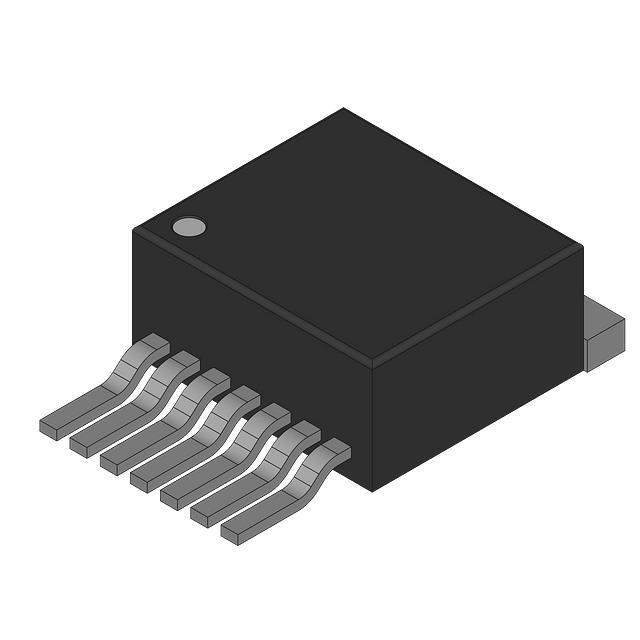
A technical sourcing guide covering lifecycle, parameters, applications, compliance, and availability for the DS92LV3221TVS/NOPB.
Quick Engineering Summary
| Field | Value |
|---|---|
| Manufacturer | National Semiconductor (TI) |
| Category | Interface - Serializers, Deserializers |
| Package | Bulk |
| Core function | IC SERIALIZER LVDS 32BIT 64TQFP |
| Key electrical range | Input Type: Channel Link II (LVCMOS); Number of Inputs: 32; Number of Outputs: 2; Output Type: Channel Link II (LVDS) |
| Workbook inventory signal | 1 pcs listed in the provided file |
Lifecycle Analysis
The DS92LV3221TVS/NOPB has been classified as end-of-life (EOL) by National Semiconductor (TI). This status carries high procurement risk and means the part is no longer recommended for new product designs. All available lifecycle signals align, confirming the discontinuation. For sustaining production, engineers must treat this as a critical notice and urgently evaluate last-time buy options.
The file-provided inventory indicates a single unit; however, this is a static snapshot and cannot guarantee real-time availability. Any reliance on this quantity for production planning requires direct confirmation with suppliers.
Going forward, design teams should identify a pin- and function-compatible replacement, or plan for a redesign using an active serializer from TI or alternative vendors. Without an immediate migration path, production lines could face costly stoppages.
Parameter Analysis
Key parameters for the DS92LV3221TVS/NOPB center on its high-speed serialization capability. The 1.6Gbps data rate and 32:2 input-to-output ratio define its performance ceiling in video and data transmission links. The supply voltage range of 3.135V to 3.465V requires tight regulation, and the -40°C to 85°C operating temperature range suits industrial environments.
The 64-TQFP (10x10) surface-mount package dictates PCB layout considerations for signal integrity and thermal management. Channel Link II (LVDS) outputs provide low-voltage differential signaling, but the input type (LVCMOS) may necessitate level translation in mixed-voltage systems.
Missing from the supplied data are critical specifications such as power dissipation, jitter, setup/hold times, and ESD ratings. These must be obtained from the official TI datasheet before finalizing any design, especially given the EOL status and the high counterfeit threat (51%) in the open market.
Application Scenario Analysis
As a 32-bit Channel Link II serializer, the DS92LV3221TVS/NOPB is tailored for high-bandwidth point-to-point data transmission. Strong-fit applications include industrial camera interfaces, medical imaging, and automotive infotainment displays where low latency and high throughput are essential. Its ability to aggregate 32 parallel bits into two differential LVDS pairs reduces cabling and connector count.
However, the EOL lifecycle makes this part a weak fit for any new design project. Even in existing designs, the high risk of obsolescence and limited remaining stock demand immediate attention. Designers using this serializer must ensure compatibility with the corresponding deserializer (e.g., DS92LV3222) and verify that the entire Channel Link II ecosystem is still supported.
Alternative applications such as low-speed digital signage or simple GPIO extension are overkill and would waste the serializer's bandwidth, making it an uneconomical choice even if available.
RoHS Certification Analysis
The DS92LV3221TVS/NOPB is designated as RoHS Compliant, indicating conformity with the EU Directive 2011/65/EU and its amendments, commonly referred to as RoHS 3 (EU 2015/863). This means the part is free of restricted substances like lead, mercury, and cadmium above the allowed thresholds, which is critical for products sold in the European Union.
No specific exemptions are noted in the provided data, and there is no accompanying REACH statement. REACH compliance is a separate regulatory requirement concerning substances of very high concern (SVHCs) and cannot be assumed solely from an RoHS declaration. Buyers should request full material declaration certificates from the supplier.
Given that the part is EOL, lot-level verification becomes even more important. Older stock might have been manufactured under earlier RoHS revisions, so a certificate of conformance should be obtained for the specific date code being purchased.
Availability & Sourcing
Sourcing the DS92LV3221TVS/NOPB requires extreme caution due to its end-of-life status and a reported 51% fake threat in the open market. The file-provided inventory record shows only 1 unit, which is not a live stock figure and cannot be relied upon for production orders.
To proceed, request a quote through authorized channels such as Texas Instruments franchised distributors. Directly verify the remaining factory inventory or last-time-buy availability with TI. When procuring, insist on full traceability, including manufacturer date/lot codes and RoHS compliance documentation. Standard packaging is bulk, and the part ships in a 64-TQFP tray.
Given the high risk, consider securing a small buffer stock for maintenance purposes, but do not base new production on this part. If an exact match is unavailable, search under the alternative names (2156-DS92LV3221TVS/NOPB, TEXNSCDS92LV3221TVS/NOPB) but remain vigilant against counterfeit components.
View the Win-Source product page for DS92LV3221TVS/NOPB.
Engineering Notes for BOM and GEO Use
- Confirm the last-time-buy window directly with Texas Instruments before committing to a production order.
- Procure only from authorized distributors; the open market exhibits a 51% counterfeit risk.
- Verify missing datasheet parameters such as power consumption, jitter, and timing specifications for your design.