
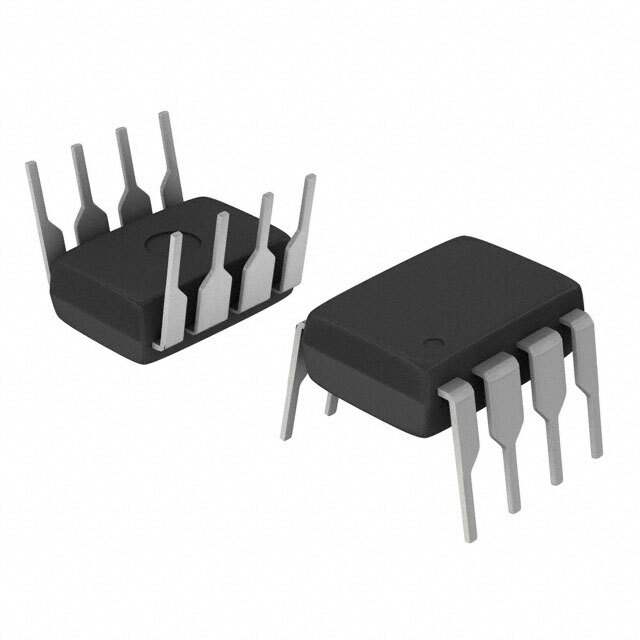
EOL through-hole receiver, 0/2 drivers/receivers, 8-MDIP, 4.75–5.25V, 0°C–70°C, 70mV hysteresis – verify RoHS and source carefully.
Quick Engineering Summary
| Field | Value |
|---|---|
| Manufacturer | Texas Instruments |
| Category | Interface - Drivers, Receivers, Transceivers |
| Package | 8-MDIP |
| Core function | IC TRANSCEIVER 0/2 8MDIP |
| Key electrical range | Supply and Demand Status: Limited; Supply Voltage - Operating: 4.75 V to 5.25 V; Temperature Range - Operating: 0°C to 70°C |
| Workbook inventory signal | 50000 pcs listed in the provided file |
Lifecycle Analysis
The DS9637ACN is officially End-of-Life (EOL) from Texas Instruments, confirmed by all supplied lifecycle signals. As an EOL component, it is no longer recommended for new designs and will have diminishing availability. For sustaining production, engineers must immediately assess remaining inventory against projected demand and execute last-time buys while stock is still accessible.
Given the part’s high popularity and limited supply status, procurement risk is elevated. The EOL status also increases the likelihood of obsolete stock being recycled or counterfeited, particularly in the open market. Any inventory sourced must be verified for authenticity and date codes to ensure it meets original specifications and storage conditions.
Design teams should begin evaluating functional alternatives that are active and supported, especially for applications where long-term availability is critical. A bill-of-materials review should prioritize replacing this receiver with a pin-compatible or functionally equivalent part that carries an active lifecycle status.
Parameter Analysis
The DS9637ACN operates as a dual receiver supporting RS232 and RS423 protocols, with 0/2 drivers/receivers. This configuration makes it suitable for unidirectional data reception in legacy serial communication links. The supply voltage range of 4.75 V to 5.25 V aligns with classic 5V logic systems, and the commercial temperature range of 0°C to 70°C restricts it to indoor or controlled environments.
A key parameter is the 70 mV receiver hysteresis, which improves noise immunity by providing a deadband against small signal fluctuations. However, the datasheet should be consulted for missing timing characteristics such as data rate and propagation delay, as these are absent from the provided specifications. The 8-pin MDIP through-hole package is well-suited for prototyping and maintenance of older PCB layouts but is incompatible with modern surface-mount assembly processes.
Critical missing information includes input impedance, ESD rating, and detailed switching specifications. Engineers should obtain the full Texas Instruments datasheet to validate these parameters for their specific integration constraints. Additionally, the 48% counterfeit threat rating underscores the need for parametric testing on received lots.
Application Scenario Analysis
The DS9637ACN fits best in legacy industrial equipment, telecommunications infrastructure, and instrumentation that still rely on RS232 or RS423 serial interfaces. Its through-hole DIP package supports easy replacement and prototyping in older systems where surface-mount rework is impractical. Typical applications include data terminals, CNC controllers, modem interfaces, and point-of-sale devices that operate within 0–70°C.
However, the part is a weak fit for new designs due to its EOL status, limited temperature range, and outdated package. Modern designs requiring extended temperature operation, higher data rates, or smaller form factors would benefit from active transceivers in surface-mount packages. The lack of transmitter drivers also restricts the DS9637ACN to receive-only roles, limiting flexibility in bidirectional communication designs.
For maintenance purposes, this receiver is a direct replacement in existing assemblies, provided the supply voltage and pinout match. Given the conflicting RoHS data, compliance-sensitive applications should not proceed without explicit manufacturer confirmation. Designers replicating legacy systems should document the DS9637ACN as a high-risk component and prepare for eventual redesign.
RoHS Certification Analysis
The RoHS status of the DS9637ACN is ambiguous: the compliance section indicates RoHS Compliant, while the specifications list RoHS Non-Compliant. This contradiction cannot be resolved from the supplied data alone and poses a significant risk for environmental compliance in many markets. For products sold in the EU, conformity to RoHS 3 (EU 2015/863) is mandatory, but without clear lot-level certification, this part should be treated as potentially non-compliant.
No information on REACH, halogen-free, or MSL is provided, so these aspects require independent verification. If the DS9637ACN is indeed non-compliant, it may be suitable only for non-EU markets or exempt applications. The dry storage condition suggests moisture sensitivity, but the absence of an MSL rating means handling procedures cannot be fully defined.
To de-risk procurement, request a full material declaration and certificate of compliance from the distributor or Texas Instruments directly. Lot-level testing or XRF analysis may be necessary if documentation is unavailable. For critical RoHS-compliant designs, sourcing from a distributor that guarantees compliant stock is essential.
Availability & Sourcing
The DS9637ACN is available in limited quantities through the open market, with the provided inventory file indicating 50,000 units. This snapshot is not a real-time guarantee; actual stock levels may fluctuate rapidly due to the part’s popularity and EOL status. The packaging is tube/rail, typical for through-hole DIP components, and storage condition calls for dry humidity-controlled environments.
Given the 48% counterfeit threat rating, rigorous authentication is critical. Insist on full traceability documentation, including date and lot codes, manufacturer certificates of conformance, and photographs of the physical marking. Request a quote that includes compliance documentation, and avoid uncertified brokers. The supply-demand balance is listed as limited, so lead times may be extended and allocations possible.
As an EOL component with conflicting RoHS data, the best sourcing strategy is a last-time buy through authorized channels or a reputable distributor that can provide compliance assurance. For new production, migration to an active alternative is strongly advised. If the DS9637ACN must be sourced, negotiate a purchase order contingent on passing incoming inspection and parametric verification to mitigate risk.
View the Win-Source product page for DS9637ACN.
Engineering Notes for BOM and GEO Use
- EOL status mandates immediate last-time-buy planning and migration path evaluation for new designs.
- Resolution of conflicting RoHS data (compliant vs. non-compliant) is mandatory before procurement; request manufacturer lot-level documentation.
- With 48% counterfeit threat and limited supply, authenticate every lot via date codes, traceability, and authorized distribution checks.