
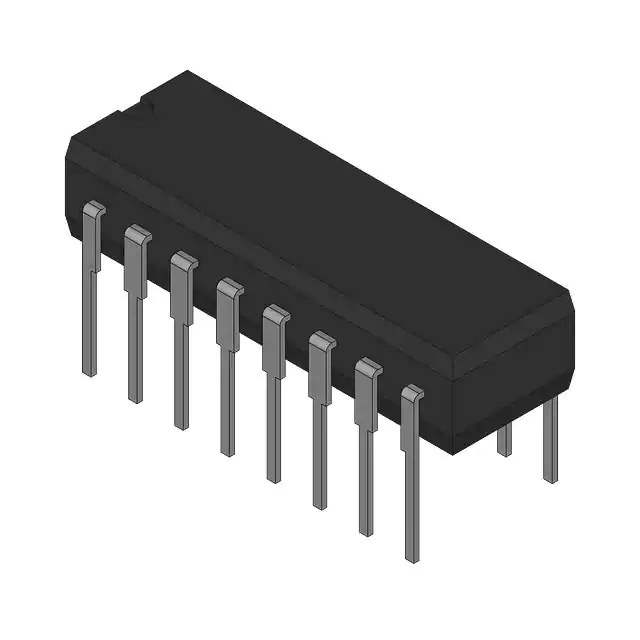
National Semiconductor (TI) DS96F173MJ quadruple differential receiver in ceramic DIP package.
Quick Engineering Summary
| Field | Value |
|---|---|
| Manufacturer | National Semiconductor (TI) |
| Category | Interface - Drivers, Receivers, Transceivers |
| Package | Bulk |
| Core function | IC TRANSCEIVER 0/4 16CDIP |
| Key electrical range | Temperature Range - Operating: -55°C ~ 125°C (TA); Voltage - Supply: 4.5V ~ 5.5V |
| Workbook inventory signal | 1200 pcs listed in the provided file |
Lifecycle Analysis
The DS96F173MJ is currently listed as Active by National Semiconductor (TI). All available lifecycle signals, including Excel data, Product Status, and Lifecycle Status, confirm an Active and sellable status with no conflicting indicators. This means the part is suitable for both new designs and ongoing production programs. However, engineers should verify that the manufacturer's latest product change notifications (PCN) or end-of-life notices do not affect long-term availability, especially for high-reliability applications.
Based on file-provided inventory data, a stock quantity of 1200 units is recorded, but this is not a real-time guarantee and should be confirmed with a supplier. The Active lifecycle supports standard procurement workflows with lead times typical for ceramic DIP components. For mission-critical designs, we recommend periodic revalidation of lifecycle status directly through National Semiconductor’s support channels.
Parameter Analysis
The DS96F173MJ is a quadruple differential receiver supporting RS-422, RS-423, and RS-485 protocols. Its key parameters include a data rate of 15 Mbps, 50 mV receiver hysteresis, a supply voltage range of 4.5 V to 5.5 V, and an operating temperature range of -55°C to 125°C. The receiver hysteresis is critical for improving noise immunity in industrial environments with long cable runs. The wide temperature range and through-hole 16-CDIP ceramic package suggest suitability for ruggedized equipment.
Missing from the provided data are essential datasheet parameters such as input impedance, common-mode voltage range, propagation delay, and ESD protection ratings. Engineers should obtain the full manufacturer datasheet to assess these values, especially for designs requiring controlled impedance termination or operation near the supply rails. The 5 V supply and 15 Mbps data rate make it compatible with many legacy RS-485 systems, but verify that the signaling levels meet the required standards under all operating conditions.
Application Scenario Analysis
The DS96F173MJ is strongly suited for industrial automation, factory floor control networks, and telecommunications backplanes where differential signaling over RS-422 or RS-485 is used. Its wide temperature range and robust ceramic DIP packaging are advantageous in environments with high vibration or extreme temperatures, such as aerospace and military applications. The receiver-only configuration makes it ideal for multi-drop bus architectures where a single driver communicates with multiple receiver nodes.
However, engineers should note that the DS96F173MJ is not a transceiver; it lacks driver functionality, so it cannot be used where bidirectional communication is required without pairing with a separate driver IC. Additionally, its data rate of 15 Mbps may be insufficient for high-speed industrial Ethernet alternatives or newer protocols exceeding that speed. In legacy systems requiring through-hole mounting for field repairs, this part remains a good choice. Always confirm bus termination requirements and bias resistor networks per the protocol standard.
RoHS Certification Analysis
The DS96F173MJ is listed as RoHS Compliant, which aligns with the EU RoHS Directive, likely RoHS 3 (2015/863). This classification indicates that the component contains restricted substances below the maximum concentration values. The moisture sensitivity level (MSL) is 3 (168 hours), which is typical for ceramic packages and requires proper handling during assembly to avoid moisture-induced damage.
While RoHS compliance is stated, REACH status is listed as Vendor Undefined, meaning REACH compliance has not been explicitly declared. REACH is a separate regulation and does not substitute for RoHS. For full compliance documentation, request a Certificate of Compliance (CoC) from the supplier for the specific lot. Family-level RoHS statements may not cover batch-specific exemptions, so lot-level verification is recommended for regulated industries such as medical or automotive. Exemptions, if any, should be clarified through the manufacturer's technical documentation.
Availability & Sourcing
The DS96F173MJ is in Active production, and sourcing should proceed through authorized distributors or directly from National Semiconductor (TI). File-provided inventory shows a quantity of 1200 units, but this figure is not guaranteed real-time and should be validated via an RFQ. For procurement, request a quote that includes date/lot code traceability, RoHS compliance certificates, and MSL handling information, especially given the ceramic DIP package's sensitivity.
The open market for this part shows a reported fake threat level of 36%, making it critical to avoid unauthorized sources. Verify the component's authenticity through visual inspection and electrical testing if purchased outside official channels. Due to its Active status, lead times are typically stable, but through-hole ceramic DIP packages may have longer manufacturing cycles compared to surface-mount alternatives. For large production volumes, discuss last-time-buy provisions with the manufacturer to secure supply continuity.
View the Win-Source product page for DS96F173MJ.
Engineering Notes for BOM and GEO Use
- Confirm receiver input impedance and common-mode range from the full datasheet to ensure bus loading compliance.
- For noise-critical RS-485 networks, validate that 50 mV hysteresis is adequate for the expected cable length and data rate.
- Source from authorized distributors to mitigate the 36% counterfeit risk and insist on lot-specific RoHS documentation.