
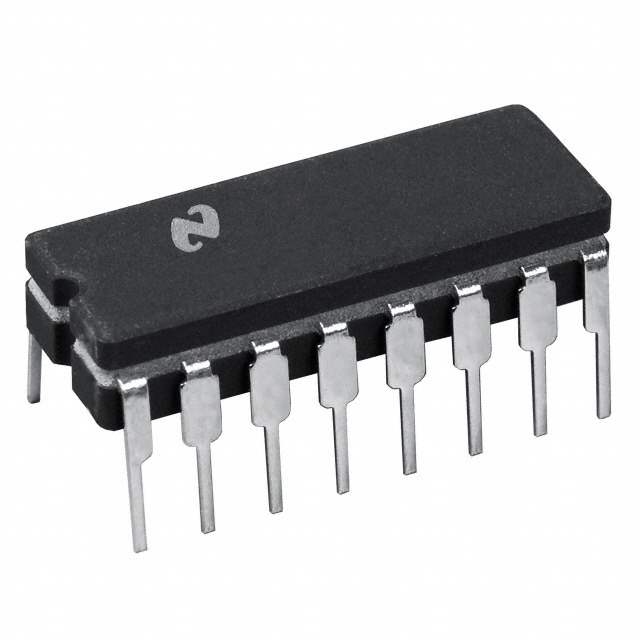
EOL RS-422/RS-485 receiver in 16-CDIP through-hole package. Verify availability and compliance before design-in.
Quick Engineering Summary
| Field | Value |
|---|---|
| Manufacturer | Texas Instruments |
| Category | Interface - Drivers, Receivers, Transceivers |
| Package | 16-CDIP |
| Core function | IC TRANSCEIVER 0/4 16CDIP |
| Key electrical range | Supply and Demand Status: Limited; Supply Voltage - Operating: 4.75 V to 5.25 V; Temperature Range - Operating: 0°C to 70°C |
| Workbook inventory signal | 1 pcs listed in the provided file |
Lifecycle Analysis
The DS96F175CJ from Texas Instruments is officially designated End-of-Life (EOL), as confirmed by multiple lifecycle signals in the supplied data. For new designs, this part should not be specified; instead, engineers should seek an alternative receiver or plan a migration to a newer device. For existing production lines, it is critical to verify the manufacturer’s last-time-buy (LTB) notice and any associated last-ship dates. Without such documentation, the remaining supply may be exhausted quickly, especially given the limited inventory reported in the file.
EOL status carries elevated procurement risk, including the possibility of no further production, limited distributor stock, and reliance on the open market. The file indicates only one unit is currently available, which is not a real-time guarantee and should be treated as a snapshot. Buyers should contact authorized sources immediately to confirm if additional units can be secured or if a lifetime buy is still possible.
Given the part’s age and EOL confirmation, quality assurance teams should also watch for counterfeits; a fake threat level of 66% is noted. All sourcing should include rigorous traceability and authenticity verification, and any stock from non-franchised channels should undergo thorough inspection.
Parameter Analysis
The DS96F175CJ is a quad receiver (0 drivers / 4 receivers) designed for RS-422 and RS-485 differential data transmission. Its 15 Mbps data rate and 50 mV receiver hysteresis are critical for balancing speed and noise immunity in multidrop buses. Designers must ensure the system’s signaling rate does not exceed 15 Mbps and that bus termination maintains sufficient differential swing above the 50 mV threshold.
Supply voltage is specified from 4.75 V to 5.25 V, making it compatible with standard 5 V logic systems. However, careful decoupling and regulation are necessary to stay within this narrow window, especially in industrial environments. The operating temperature range of 0°C to 70°C restricts use to commercial-grade applications; extended-temperature requirements would disqualify this part. The 16-CDIP through-hole ceramic package provides robust mechanical strength but demands through-hole PCB design, which may not suit modern high-density SMT assemblies.
Key missing datasheet parameters that must be verified include common-mode voltage range, maximum operating frequency margins, per-channel propagation delay, and ESD protection ratings. Without these, a complete signal integrity analysis and worst-case margin calculation cannot be performed. Engineers should obtain the original datasheet from Texas Instruments to confirm these values before finalizing any design or replacement qualification.
Application Scenario Analysis
The DS96F175CJ is best suited for RS-485 or RS-422 differential data reception in legacy systems where through-hole mounting is required or preferred. It can serve in multidrop industrial control networks, factory automation, or instrumentation backplanes that operate at data rates up to 15 Mbps and use a 5 V supply rail.
Because of its commercial temperature range (0°C to 70°C), this part is inappropriate for outdoor, automotive, or harsh-environment equipment without additional thermal management, which may not be practical. The through-hole 16-CDIP package also limits its use in modern compact designs; applications that have migrated to surface-mount technology will need a redesign if this part is used as a drop-in replacement. Additionally, with only receiver channels (0 drivers), it cannot be used as a full transceiver node; it must be paired with a separate driver IC for bidirectional communication.
Engineers should note that while RS-485 supports thousands of nodes in theory, actual loading depends on bus topology and unit load characteristics not listed here. Without the unit load specification from the datasheet, the number of receivers per bus cannot be accurately determined. This further emphasizes the need to consult the manufacturer’s original documentation.
RoHS Certification Analysis
The RoHS compliance status for the DS96F175CJ is ambiguous based on the supplied data. One data field lists ‘RoHS Compliant,’ while a detailed specification entry marks ‘RoHS Non-Compliant.’ This discrepancy likely arises from different data sources or manufacturing revisions. For safety in procurement, engineers should treat the part as potentially non-compliant until the actual lot or date code can be verified against the manufacturer’s official compliance documentation.
No REACH or MSL information is provided, so those certifications cannot be assumed. Note that REACH compliance is separate from RoHS and does not substitute for it. Buyers should request a valid RoHS certificate of compliance (CoC) for the specific inventory being shipped. Because this is an EOL part, it is possible that older non-RoHS stock remains in the supply chain while newer compliant lots once existed. Lot-level verification is essential before using this part in products requiring RoHS 3 (EU 2015/863) or similar regulations.
If the application is destined for the European market, non-compliance could pose a significant market access risk. Design teams should plan for a compliant alternative if verified RoHS-compliant units cannot be sourced reliably.
Availability & Sourcing
The DS96F175CJ is obsolete and available only through remaining distributor stock or the open market. The supplied file indicates a single unit in stock, but this is not real-time data and should be confirmed through an RFQ to authorized Texas Instruments distributors or approved surplus vendors. Pricing is not disclosed; interested parties must contact suppliers for a current quotation.
Because the part is in tube/rail packaging, it may have been stored under proper conditions; however, buyers must verify the storage environment and request documentation such as date/lot codes and MSDS. The high open-market fake threat (66%) necessitates strict counterfeit avoidance measures: insist on full traceability back to the original manufacturer, perform visual inspection, and consider electrical testing for any lot purchased from non-franchised sources.
Given the EOL status, the primary sourcing strategy should be to secure all known valid inventory immediately if a lifetime buy is still possible. Before paying, verify the lifecycle status directly with Texas Instruments and request written confirmation of last-time-buy dates, as the EOL may have occurred years ago. For new designs, redesign to a current-generation RS-485 receiver is strongly recommended.
View the Win-Source product page for DS96F175CJ.
Engineering Notes for BOM and GEO Use
- Verify the EOL status and obtain last-time-buy documentation from Texas Instruments before committing to production.
- The high counterfeit risk (66%) demands full traceability, lot/date code inspection, and authorized sourcing.
- The 16-CDIP through-hole package requires manual assembly; confirm PCB compatibility and soldering process.