
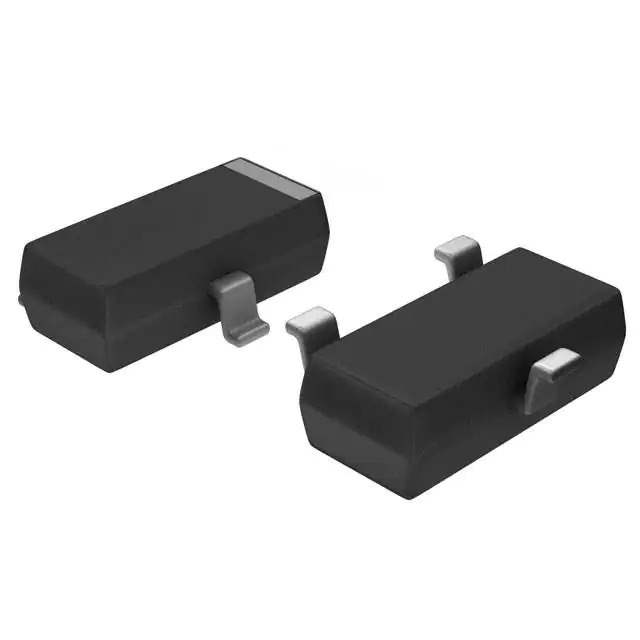
Discontinued PNP BJT for small-signal applications; verify stock availability before sourcing.
Quick Engineering Summary
| Field | Value |
|---|---|
| Manufacturer | Panasonic |
| Category | Transistors (BJT) - Single |
| Package | Tape & Reel |
| Core function | TRANS PNP 50V 0. |
| Key electrical range | Current - Collector (Ic) (Max): 500 mA; Current - Collector Cutoff (Max): 100nA (ICBO); DC Current Gain (hFE) (Min) @ Ic, Vce: 170 @ 150mA, 10V; Frequency - Transition: 130MHz |
| Workbook inventory signal | 3160 pcs listed in the provided file |
Lifecycle Analysis
The DSA2002S0L has been marked Discontinued by Panasonic, placing it in a high-risk lifecycle category for any new design activity. This status means the manufacturer has stopped producing the part, and no further engineering support, qualification documents, or guaranteed supply will be available. For new designs, this part should not be considered; instead, look for an active replacement from Panasonic or an alternative manufacturer.
For existing production or repair lines, the lifecycle demands a fast, conservative sourcing approach. The supplied data set shows a file-level inventory quantity of 3160 units, but this is not a real-time update and does not guarantee availability. Buyers must confirm the current stock position, request date code information, and verify that the parts are from a reliable, traceable source. Without direct manufacturer validation, any residual inventory should be treated as limited and potentially mixed-lot.
Given the discontinuation, last-time-buy windows and end-of-life notifications may have already passed. Engineering teams should audit bills of materials and initiate a migration plan to an active alternative. If the DSA2002S0L must still be procured, only transact with suppliers who can provide full traceability and a clear counterfeit mitigation process.
Parameter Analysis
The DSA2002S0L is a PNP BJT with a collector-emitter breakdown of 50 V and a maximum collector current of 500 mA. These headline ratings make it suitable for low-voltage, small-signal switching and analog amplification, but they impose firm design boundaries. Exceeding the 50 V limit can cause junction breakdown, while pushing beyond 500 mA risks thermal failure given the 200 mW power dissipation maximum. The DC current gain (hFE) is specified at a minimum of 170 when measured at 150 mA and 10 V, which provides sufficient gain for many buffer and driver circuits, but note that gain can fall at temperature extremes or under different operating points—the datasheet should be consulted for a full curve.
Surface-mount mounting in the SOT-23 (SC-59) package yields a compact footprint, but it also limits thermal performance. The maximum junction temperature is 150°C, yet without a published junction-to-ambient thermal resistance, it is difficult to accurately calculate derating for elevated ambient conditions. The transition frequency of 130 MHz supports operation up to moderate RF frequencies, but parasitic and layout effects in the SOT-23 will matter above 50 MHz. Key missing parameters that must be verified in the official datasheet include the safe operating area curve, thermal resistance values, and more complete hFE vs. Ic characteristics. Additionally, the Vce(sat) of 600 mV at 300 mA collector current is relatively low for a small-signal PNP, improving switching efficiency in saturated-switch applications.
Application Scenario Analysis
Typical applications for the DSA2002S0L include generic small-signal switching, low-power amplification, and level shifting in consumer and industrial electronics. In a battery-powered sensor node, for example, its 50 V rating and 500 mA capability can interface with higher-voltage rails while the low saturation voltage helps preserve battery life when driving small relays or LEDs. The SOT-23 package and 130 MHz transition frequency also make it a plausible choice for simple oscillator or RF driver circuits up to around 50 MHz, provided layout parasitics are managed.
Conversely, the part is not suitable for applications that require continuous power handling above a few hundred milliwatts, or for high-current loads exceeding 500 mA. Its 200 mW maximum power dissipation makes it a poor fit for linear regulator pass elements or class-A amplifier stages operating at more than a few tens of milliamps. Designs that need guaranteed performance at very low temperatures or that operate near the 150°C junction limit must consider the lack of published thermal resistance data. Finally, the high counterfeit threat (46% according to the data) adds supply-chain risk for applications in safety-critical or high-reliability systems.
RoHS Certification Analysis
The component is listed as RoHS Compliant, which ordinarily would indicate conformity with the EU Directive 2011/65/EU and its amendments, most recently EU 2015/863 (RoHS 3). No specific exemptions are noted in the supplied data, so it is likely free of the six restricted substances (lead, mercury, cadmium, hexavalent chromium, PBBs, and PBDEs) and the four additional phthalates. However, because the part is discontinued, this compliance claim cannot be blindly carried forward to any residual stock without lot-level validation.
For procurement, compliance documentation such as the CE declaration of conformity, lab test reports, or manufacturer compliance certificates should be requested. The absence of REACH data in the source file does not mean the part is non-REACH; it simply means no REACH attestation was provided. Additionally, the Moisture Sensitivity Level (MSL) is 1, which means it is not moisture sensitive and has an unlimited floor life after opening, simplifying storage and handling. Even so, any stock sourced from the open market may have been stored in uncontrolled conditions, so visual inspection is advisable.
Availability & Sourcing
Sourcing the DSA2002S0L requires immediate attention to the part's discontinued lifecycle and a high open-market counterfeit threat of 46%. The workbook data shows a file-level quantity of 3160 units; however, this is not a real-time stock picture and must be confirmed directly with a supplier. Buyers should request a formal quote that includes the exact quantity, date code range, packaging condition (original tape and reel or repackaged), and a compliance pack that demonstrates RoHS status for the specific lot.
Given the high risk of counterfeit or substandard parts, source only through authorized channels or vetted independent distributors who can provide full traceability back to Panasonic. Standard transactions should include visual inspection, component testing on a sample basis, and a written guarantee against fake parts. The standard package of 3,000 pieces per reel means that small quantities may be cut tape, which can affect traceability. For legacy designs that cannot be redesigned, securing a last-time buy quantity now may be the safest path, but this must be balanced against the carrying cost and the part's eventual obsolescence. Because the manufacturer has already discontinued the device, no further factory production is possible: all supply is from existing distribution inventory or the spot market.
View the Win-Source product page for DSA2002S0L.
Engineering Notes for BOM and GEO Use
- DSA2002S0L is discontinued; avoid new designs and secure remaining inventory for existing production lines.
- High open-market fake threat (46%) necessitates strict supplier verification and provenance tracking.
- Verify RoHS compliance and date codes on specific lots before procurement.