
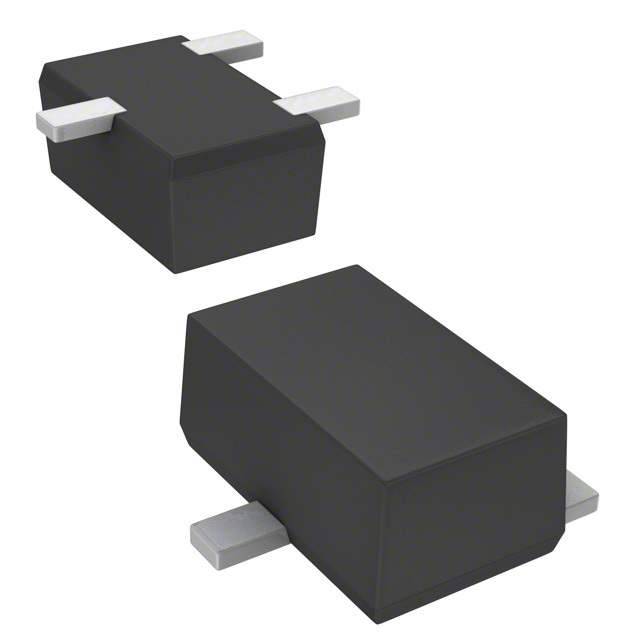
Sourcing guide for Panasonic DSA5002R0L PNP transistor with lifecycle conflict and stock availability
Quick Engineering Summary
| Field | Value |
|---|---|
| Manufacturer | Panasonic |
| Category | Transistors (BJT) - Single |
| Package | SMini3-F2-B |
| Core function | TRANS PNP 50V 0. |
| Key electrical range | Collector Cut-off Current(Max): 100nA (ICBO); Frequency - Transition: 130MHz; Maximum Current Collector: 500mA; Maximum Power Dissipation: 150mW |
| Workbook inventory signal | 2900 pcs listed in the provided file |
Lifecycle Analysis
The lifecycle information for the Panasonic DSA5002R0L presents conflicting signals. One source parameter indicates 'Discontinued' (停止提供), while another field reports the status as 'Active'. In engineering procurement, such a conflict demands a conservative interpretation—the part should not be assumed to be fully active for new designs without manufacturer confirmation. The risk level is elevated to medium because the discrepancy could mean the device is in a phase-out transition or that older data is being updated.
For production programs already using the DSA5002R0L, sustaining engineers should validate the current lifecycle status directly with Panasonic. Sudden shifts to NRND or EOL without notice can disrupt supply chains. The file-provided inventory quantity of 2900 pieces may reflect a snapshot of available stock, but it does not guarantee future factory output. Treat this quantity as a temporary buffer while seeking a definitive lifecycle statement.
If the discontinued signal proves correct, immediate steps should include evaluating pin-compatible alternatives, monitoring distributor stock, and considering last-time buy opportunities. Relying on unverified Active status could lead to unnecessary redesigns later. Given the part’s general-purpose nature, a migration path should be feasible, but it requires early action.
Parameter Analysis
Key electrical parameters for the Panasonic DSA5002R0L PNP transistor include a maximum collector-emitter voltage (VCEO) of 50 V and a continuous collector current rating of 500 mA. The maximum power dissipation is 150 mW at a junction temperature (TJ) of 150 °C. These values define the part’s use in low-voltage, low-current signal processing or saturated switching where power margins are tight. The VCE(sat) is specified at a maximum of 600 mV under test conditions of 30 mA base current and 300 mA collector current, indicating reasonable saturation performance for its class.
The minimum DC current gain (hFE) is 120 at 150 mA and 10 V, giving engineers a baseline for driver circuitry and biasing. The transition frequency of 130 MHz supports moderate-speed amplification up to the lower RF range, though for high-frequency applications, careful PCB layout and small-signal analysis are necessary. Packaging is the SMini3-F2-B (SC-85 variant), a miniature surface-mount outline compatible with automated assembly and dense board layouts.
Missing from the provided data are critical thermal metrics such as junction-to-ambient thermal resistance (RθJA), maximum junction temperature in absolute terms (only TJ is noted as 150 °C without further qualification), and detailed SOA (Safe Operating Area) curves. Before finalizing a design, engineers should obtain the official Panasonic datasheet to verify derating guidelines, thermal pad design requirements, and pulse current capability. Also, confirm the exact pinout and footprint against the ECAD model, which is available only upon request.
Application Scenario Analysis
The DSA5002R0L fits naturally into general‑purpose low‑power switching and small‑signal amplification. Typical strong‑fit applications include portable consumer electronics, IoT sensor nodes, battery‑powered devices, and logic‑level interfaces where a PNP transistor with a 50 V rating and 0.5 A capability is sufficient. Its SMD package and 130 MHz fT make it suitable for audio pre‑amplifiers, signal inverters, and simple motor drivers in toys or low‑cost actuators.
In designs where ultra‑low leakage or precision analog performance is required, the 100 nA ICBO cutoff current may be acceptable, but it is not a precision device. The DSA5002R0L is a commodity transistor, so it should be avoided in high‑reliability or harsh environment applications unless additional testing is performed. The 150 mW power limit restricts its use in circuits where continuous collector current approaches the maximum rating; adequate derating (typically 50‑70%) is necessary for thermal margin.
Weak‑fit scenarios include high‑speed digital switching above 50 MHz, high‑current motor control (beyond 500 mA steady‑state), and automotive or industrial environments requiring AEC‑Q qualification. The miniature package has limited heat sinking capability, so forced air cooling or extended temperature range operation beyond the 150 °C junction limit will accelerate failure. For such use cases, a more robust transistor with better thermal path and higher current rating would be more appropriate.
RoHS Certification Analysis
The supplied data identifies the Panasonic DSA5002R0L as RoHS Compliant. This indicates that, at the family or specification level, the part meets the European Union's Restriction of Hazardous Substances directive, likely RoHS 2 (2011/65/EU) or RoHS 3 (EU 2015/863). No explicit exemptions or additional certifications (e.g., REACH, MSL, halogen‑free) are mentioned in the provided fields.
While RoHS compliance is a baseline requirement for many markets, engineers and buyers should note that this classification may be a manufacturer‑level claim rather than a lot‑specific certificate. In the context of the lifecycle conflict, older non‑compliant date codes could still circulate in the open market. Therefore, a certificate of compliance (CoC) should be requested with each shipment, and if the part is sourced from independent distributors, verification of lead‑free terminal finish and homogeneous material compliance is recommended.
The absence of REACH data does not automatically indicate non‑compliance, but REACH is a separate regulation. If full material disclosure is needed, the manufacturer's safety data sheet (MSDS) is available on request. For mission‑critical designs, it may be prudent to audit the environmental compliance status through direct Panasonic channels rather than relying solely on the provided status string.
Availability & Sourcing
The Panasonic DSA5002R0L appears in the provided inventory with a quantity of 2900 units on tape and reel packaging. This figure is a file‑based snapshot and not a real‑time stock guarantee; therefore, interested parties should request a quotation to confirm current availability, exact date codes, and lead times. The storage condition specified is a dry storage cabinet with humidity protection, aligning with standard MSL handling for SMD components.
A notable red flag is the 52% counterfeit threat rating in the open market. This high risk underscores the need to source the DSA5002R0L exclusively through authorized Panasonic distributors or trusted franchised partners. Full traceability documentation, including lot codes and proof of purchase from the factory, is essential. The part is supplied in reel packaging (TR), which is standard for automated PCB assembly.
Given the lifecycle uncertainty, a pragmatic sourcing strategy would be: first, verify lifecycle directly with Panasonic; second, request a quote for the available 2900 pieces; third, if the part is indeed active, proceed with procurement while ensuring compliance paperwork; if discontinued, secure the existing stock as a last‑time buy buffer, and concurrently qualify a pin‑compatible alternative. In all cases, insist on a certificate of conformance and RoHS compliance for each lot to mitigate risk.
View the Win-Source product page for DSA5002R0L.
Engineering Notes for BOM and GEO Use
- Verify lifecycle status directly with Panasonic as signals conflict between 'Active' and 'Discontinued'.
- The 52% open-market counterfeit risk mandates sourcing from authorized channels with full traceability.
- The 150 mW maximum power dissipation and small SMD package limit use to low-power general-purpose applications.