
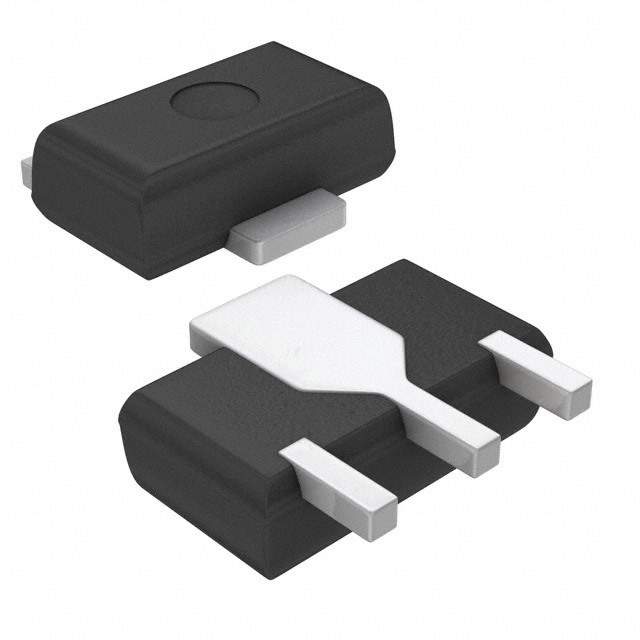
20V, 4A PNP Transistor in MiniP3-F2-B package. Lifecycle conflict requires verification.
Quick Engineering Summary
| Field | Value |
|---|---|
| Manufacturer | Panasonic |
| Category | Transistors (BJT) - Single |
| Package | MiniP3-F2-B |
| Core function | TRANS PNP 20V 4A MINIP3-F2-B |
| Key electrical range | Collector Cut-off Current(Max): 100nA (ICBO); Frequency - Transition: 180MHz; Maximum Current Collector: 4A; Maximum Power Dissipation: 1W |
| Workbook inventory signal | 1 pcs listed in the provided file |
Lifecycle Analysis
The DSA7504R0L by Panasonic is listed as Active in supplier databases, but conflicting lifecycle signals exist. A manufacturer parameter note indicates 停止提供 (discontinued), while the formal lifecycle status remains Active. This contradiction inserts medium risk into any sourcing decision, and the part should be treated as potentially NRND.
For sustaining production, the DSA7504R0L may still be available, but engineering teams must revalidate lifecycle directly with Panasonic Electronic Components. New designs should avoid assuming long-term supply without explicit manufacturer assurance.
File-provided inventory shows limited quantity, adding urgency to lifecycle verification before committing to high-volume BOMs. The MiniP3-F2-B packaged PNP transistor may require alternate qualification if the manufacturer confirms a phase-out.
Parameter Analysis
Key parameters from the supplied data include a 20V collector-emitter breakdown voltage, a continuous collector current rating of 4A, and a minimum DC current gain (hFE) of 180 at 2A and 2V. The transition frequency of 180MHz suggests moderate speed capability for a PNP transistor. These specs define the DSA7504R0L's fit in low-voltage power switching and amplification.
The 1W maximum power dissipation at an operating junction temperature of 150°C requires careful thermal design. Vce(sat) of 1V at 100mA base current and 3A collector current indicates conduction losses that demand PCB copper area for heat spreading. Missing from the dataset are thermal resistance values (junction-to-ambient), safe operating area curves, and pulse-current deratings, which are critical for rugged design.
Engineers should obtain the full Panasonic datasheet for the DSA7504R0L to verify these missing parameters and to confirm pinout and footprint for the MiniP3-F2-B (TO-243AA equivalent) surface-mount package.
Application Scenario Analysis
The DSA7504R0L PNP transistor suits low‑voltage switching applications such as small DC motor drivers, solenoid controls, and LED constant‑current sinks, where 20V breakdown and 4A capability provide headroom. Its hFE of 180 at 2A enables effective base drive from logic‑level sources in moderate‑current circuits.
In amplifier stages, the 180MHz transition frequency allows use up to low‑VHF, but the device is not optimized for RF front‑ends; parasitic capacitances and noise figure data are absent, making it a weak fit for high‑frequency signal chains. Similarly, continuous high‑current loads near 4A will push thermal limits unless substantial PCB heatsinking is employed.
For battery‑operated designs, the DSA7504R0L can serve as a load switch, but the 1V saturation voltage may become a limitation in low‑dropout scenarios. Always evaluate switching speed versus the 100nA ICBO leakage to ensure off‑state power consumption meets system requirements.
RoHS Certification Analysis
The DSA7504R0L is labeled RoHS Compliant, indicating that Panasonic’s PNP transistor meets the requirements of EU RoHS Directive 2011/65/EU. This covers restricted substances such as lead, mercury, and cadmium, which is critical for European market access.
Since the MiniP3-F2-B package is a plastic‑encapsulated surface‑mount device, it typically contains no exemptions. However, buyers should note that RoHS compliance is often declared at the component family level, and lot‑level variations can occur in plating or mold compounds. Request a certificate of compliance for each purchase order to satisfy environmental audit trails.
Additional regulations like REACH or halogen‑free status are not explicitly provided for the DSA7504R0L. If needed, these must be verified through the manufacturer’s material declarations. The availability of a Material Safety Data Sheet (MSDS) can be requested to further assess chemical compliance.
Availability & Sourcing
Given the lifecycle conflict on the DSA7504R0L, sourcing activity should begin with a request for quote (RFQ) that mandates current production status, date and lot code information, and full traceability documentation. File-provided inventory lists only 1 unit, which is not a real‑time indicator; actual stock must be confirmed before procurement.
The MiniP3-F2-B package is delivered on tape‑and‑reel (Reel‑TR), suitable for automated assembly. Buyers should specify packaging quantity and confirm that the moisture sensitivity level (MSL) and storage conditions (dry cabinet, humidity protection) are met to avoid soldering defects.
Authenticity is a concern: open‑market fake threat is reported at 29%. Therefore, purchase from authorized Panasonic distributors or reputable brokers with verified traceability. Request compliance certificates (RoHS, and REACH if needed) and lifecycle re‑verification directly from Panasonic before finalizing BOM decisions. For sustained production, consider qualifying an alternate PNP transistor if the manufacturer confirms discontinuation.
View the Win-Source product page for DSA7504R0L.
Engineering Notes for BOM and GEO Use
- Verify lifecycle status directly with Panasonic; conflicting data indicates possible NRND.
- Confirm Vce(sat) and hFE at target operating current; test conditions differ from max ratings.
- Assess thermal management: 1W dissipation with 150°C Tj max requires PCB heat sinking for 4A operation.