
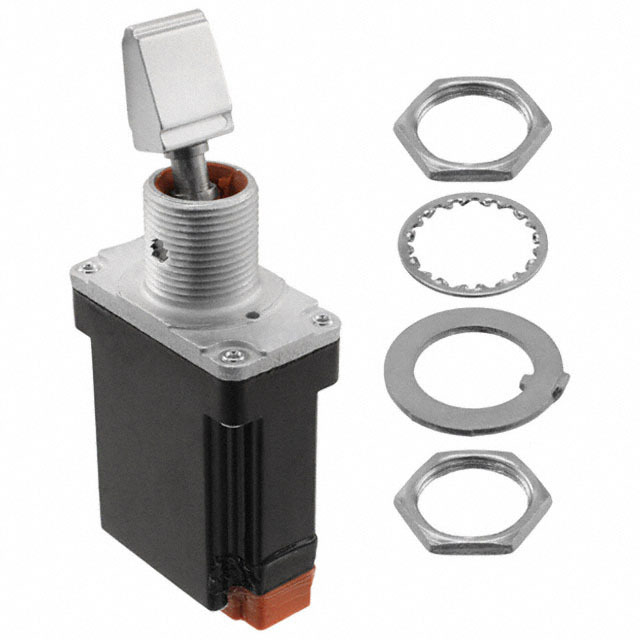
Active tilt switch sensor with ±30° to ±60° operating angle, through-hole right-angle mounting, NPN output. RoHS compliant.
Quick Engineering Summary
| Field | Value |
|---|---|
| Manufacturer | NKK Switches |
| Category | Motion Sensors - Tilt Switches |
| Package | PCB Mount |
| Core function | SENSOR TILT SW 30-60DEG 20MA TH |
| Key electrical range | Current - Output: 20mA; Output Type: NPN; Supply and Demand Status: Shortage; Temperature Range - Operating: -25°C ~ 80°C |
| Workbook inventory signal | 920 pcs listed in the provided file |
Lifecycle Analysis
All supplied lifecycle indicators show the NKK Switches DSBA1H as an Active part. Active status means the device is in full production, supported by the manufacturer, and generally suitable for both new designs and ongoing volume production. The risk level is low for immediate sourcing.
Since all signals align, there is no conflict requiring caution. Nevertheless, for programs with long design cycles, it is advisable to periodically revalidate lifecycle status with NKK Switches or authorized distributors. Workbooks indicate a file-provided quantity of 920 units, but that is not a guaranteed real-time inventory figure. Engineers should plan procurement lead times accordingly and avoid relying on single sources for critical program milestones.
Parameter Analysis
The DSBA1H by NKK Switches is a motion sensor tilt switch with key parameters: operating angle range of ±30° to ±60°, output current of 20 mA, supply voltage of 5 V, NPN output type, and through-hole right-angle mounting. The operating angle is the most application-critical characteristic; it defines the tilt thresholds at which the switch state changes. Engineers must carefully evaluate whether the specified range covers the tilt angles expected in their mechanical assembly, considering mounting orientation and vibration tolerance.
The 20 mA output current is suitable for direct logic-level interfacing, but the NPN output requires a pull-up resistor to define the high state. The 5 V supply is common for digital systems, but designers should verify that the sensor’s internal voltage tolerance and power consumption align with their power budget. Missing parameters in the supplied data—such as mechanical life cycles, contact resistance, and bounce characteristics—should be obtained from the official NKK datasheet before final qualification.
Application Scenario Analysis
Based on its category as a tilt switch sensor, the DSBA1H is well-suited for orientation detection in consumer electronics, industrial equipment, and safety interlock systems. Strong-fit applications include portable devices that need to detect horizontal or vertical positioning, anti-tip alarms for appliances, and tilt-based activation in battery-powered equipment. The right-angle through-hole mount and ±30° to ±60° operating angle make it a good match for PCB-mounted tilt sensing where board orientation relative to gravity is fixed.
However, in scenarios requiring precise angle measurement or continuous tilt feedback, the DSBA1H’s binary NPN output may be less suitable than an accelerometer or inclinometer. Applications demanding high switching frequency or vibrations should verify that the switch can handle expected mechanical stress without contact degradation. Similarly, outdoor or high-humidity environments require checking the sensor’s sealing or conformal coating compatibility, as these details are not present in the supplied data.
RoHS Certification Analysis
The DSBA1H is listed as RoHS Compliant according to the available data. This indicates compliance with EU RoHS directives, typically the latest RoHS 3 (EU 2015/863), which restricts hazardous substances such as lead, mercury, cadmium, and others. No exemptions are noted, suggesting the part achieves full compliance without relying on specific use-case exemptions.
While family-level certification is common, actual lot-level documentation may need to be verified for production audits. Buyers should request a certificate of compliance from NKK Switches or authorized distributors to confirm that the specific batch meets RoHS requirements. If REACH or halogen-free compliance is also needed, those standards are not mentioned in the supplied data and should be separately validated. The RoHS status is critical for electronic products sold in the European market, so maintaining reliable documentation is essential for customs and regulatory bodies.
Availability & Sourcing
For the NKK Switches DSBA1H tilt switch, availability is indicated by a file-provided stock quantity of 920 units, with a supply-and-demand status note of "Shortage." Because the lifecycle is Active and the risk is low, the primary procurement strategy is to request a quote from authorized distributors to secure current pricing and lead times. Buyers should confirm the exact packaging (tray, as per data) and request lot/date code traceability to ensure component freshness and compliance.
Given the shortage note, it is prudent to avoid relying on a single source without backup inventory. Verify with NKK Switches or distributors whether the shortage is temporary and what the expected restocking timeline is. For production planning, request a formal quotation that includes RoHS documentation and PCN (product change notification) alerts. This will help mitigate risks associated with last-time buys or sudden EOL, even though the part is currently active.
View the Win-Source product page for DSBA1H.
Engineering Notes for BOM and GEO Use
- Verify the exact operating angle threshold (±30° to ±60°) in the manufacturer datasheet for your application’s tilt requirement, as angle tolerance may affect switching consistency.
- Observe the 20mA output current limit and 5V supply voltage when designing the interface circuit; ensure pull-up resistor values and MCU input ratings are compatible with NPN open-collector output.
- Confirm lot-level RoHS documentation and traceability during procurement, especially if your end product requires EU RoHS declaration.