
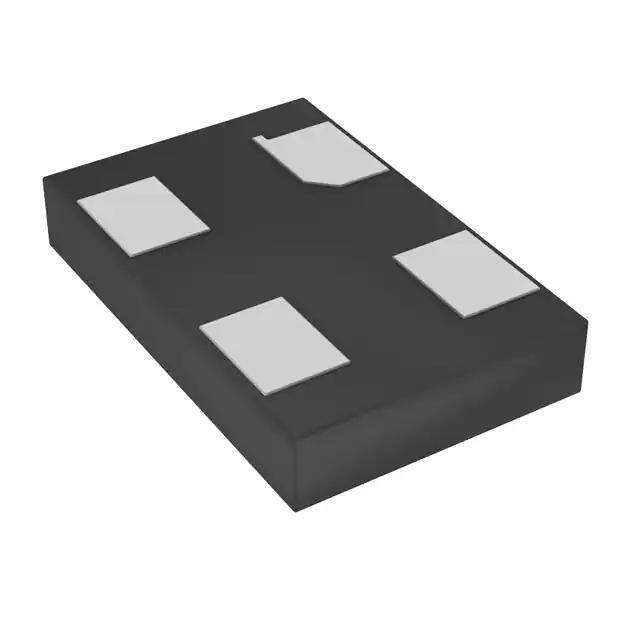
50 MHz CMOS MEMS Oscillator – Discontinued, Not for New Designs
Quick Engineering Summary
| Field | Value |
|---|---|
| Manufacturer | Microchip Technology |
| Category | Oscillators |
| Package | 22-VFQFN Exposed Pad |
| Core function | MEMS OSC XO 50. |
| Key electrical range | Frequency: 330kHz; Output: 3-State |
| Workbook inventory signal | 1 pcs listed in the provided file |
Lifecycle Analysis
The DSC1001BL2-050.0000TVAO from Microchip Technology is listed as Discontinued. Conflicting lifecycle signals exist: an Excel parameter shows Active, but official Product Status and Lifecycle Status indicate Discontinued. For procurement planning, the conservative interpretation is that this part is no longer in active production and should not be used in new designs. Engineers designing new boards must select an alternative oscillator.
For existing designs in sustaining production, it is critical to confirm last-time-buy availability directly with Microchip Technology or authorized distributors. Relying on file-provided inventory counts—currently showing 1 unit—is not recommended for production commitment, as these numbers are not guaranteed real-time. Verify lifecycle status through manufacturer documentation before committing to any volume purchase.
Given the high risk of obsolescence, sourcing teams should assess form-fit-function replacements and plan a migration path. Even if limited stock is found, long-term support cannot be assured. A formal product change notification (PCN) search is advised to understand the obsolescence timeline.
Parameter Analysis
Key specifications for the DSC1001BL2-050.0000TVAO MEMS oscillator include a 50 MHz output frequency with CMOS logic levels, operating from a supply voltage of 1.7 V to 3.6 V, and drawing up to 8.5 mA maximum supply current. The frequency stability is rated at ±25 ppm over an industrial temperature range of -40°C to +105°C, making it suitable for harsh environments. The oscillator comes in a 4-VDFN (5.0 mm x 3.2 mm) surface-mount package and supports a standby function for power-down mode.
These parameters are critical for clock tree design and signal integrity. The CMOS output drives standard digital loads, but engineers should verify rise/fall times and jitter specifications from the official datasheet, as they are not provided in the aggregated source data. The wide voltage range allows operation with common 1.8 V, 2.5 V, or 3.3 V rails, but decoupling and layout guidelines from Microchip’s application notes must be followed.
Given the inconsistencies in the source data (e.g., an erroneous 330 kHz entry), always cross-check the datasheet to confirm absolute maximum ratings and exact electrical characteristics before PCB layout or qualification testing.
Application Scenario Analysis
As a 50 MHz MEMS oscillator with CMOS output, the DSC1001BL2-050.0000TVAO is suitable for providing reference clocks in microcontrollers, FPGAs, Ethernet interfaces, and communication processors that require a stable, single-ended clock. Its ±25 ppm stability and wide temperature range support industrial and automotive applications where temperature variation is a concern. The standby function can be used in battery-powered devices to reduce power consumption during idle periods.
However, because this part is discontinued, its use is limited to ongoing production of existing designs where requalification cannot be done immediately. It is not recommended for new projects, especially those needing long product lifecycles. For applications requiring a different supply voltage, differential output (e.g., LVDS), or higher frequencies, this oscillator would be a poor fit.
Designers should evaluate pin-compatible alternatives from Microchip’s DSC1001 series or other manufacturers, ensuring they meet the same stability and temperature requirements.
RoHS Certification Analysis
The DSC1001BL2-050.0000TVAO is marked as RoHS Compliant, indicating it meets the restrictions on hazardous substances according to EU RoHS directives. However, the specific standard version (e.g., RoHS 3 (EU 2015/863)) is not explicitly stated in the source data. Additionally, no REACH or halogen-free declarations are provided, so compliance cannot be assumed beyond basic RoHS.
For strict regulatory environments, procurement should request a full material declaration or certificate of compliance from Microchip Technology for the specific lot. Family-level certifications are often available, but lot-level verification is recommended for discontinued parts to ensure no process changes occurred before end-of-life.
Exemptions, if any, would need to be confirmed from the datasheet or manufacturer’s compliance documentation.
Availability & Sourcing
Sourcing the DSC1001BL2-050.0000TVAO requires careful attention due to its discontinued lifecycle status. The file-provided inventory shows 1 unit; this is not a real-time stock level and should be verified with a distributor or the manufacturer. This Microchip Technology oscillator was supplied in tape-and-reel packaging, but exact reel quantities and moisture sensitivity level (MSL) are not confirmed in the available data.
To purchase this part, initiate a request for quote (RFQ) through Win Source or an authorized channel, specifying part number and desired quantity. Request date/lot code traceability and a certificate of compliance to guarantee RoHS and authenticity. Because the part is discontinued, secure sufficient inventory for your production lifetime and investigate last-time-buy opportunities.
For new designs, do not select this part; work with Microchip or distributors to identify active replacements. Always confirm current lifecycle status directly with the manufacturer before placing any order.
View the Win-Source product page for DSC1001BL2-050.0000TVAO.
Engineering Notes for BOM and GEO Use
- Verify all electrical parameters against the official Microchip DSC1001BL2-050.0000TVAO datasheet; source data contains inconsistencies that must be resolved before design-in.
- Plan for immediate migration away from this oscillator for new designs—it is discontinued and long-term availability is not guaranteed.
- When procuring remaining stock, require lot-specific RoHS and authenticity documentation due to the high risk of obsolete inventory.