
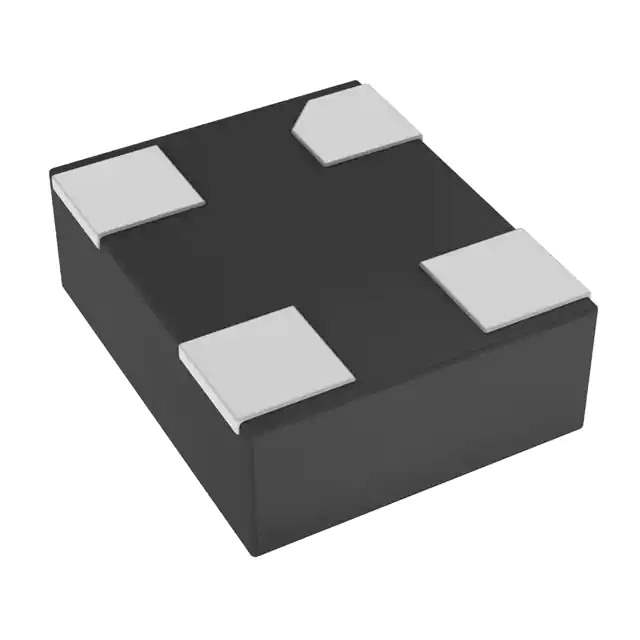
Active MEMS oscillator with 59.78 MHz, CMOS output, standby function, AEC-Q100 qualified, surface-mount 2.5x2.0mm package.
Quick Engineering Summary
| Field | Value |
|---|---|
| Manufacturer | Microchip Technology |
| Category | Oscillators |
| Package | Tape & Reel |
| Core function | MEMS OSC XO 59. |
| Key electrical range | Current - Supply (Disable) (Max): 15µA; Current - Supply (Max): 7.2mA; Frequency: 59.78 MHz; Output: CMOS |
| Workbook inventory signal | 1 pcs listed in the provided file |
Lifecycle Analysis
Microchip Technology lists the DSC1001DI4-059.7800T as Active with no lifecycle conflicts. This status indicates the part is in full production, supported for new designs, and has no immediate end-of-life notifications. Procurement and design teams can incorporate this oscillator into new projects with confidence that manufacturer support, documentation, and long-term availability are maintained.
For production planning, note that the file-provided inventory signal shows a single unit, but this is not a live stock indication. Engineers should request current lead times and stock levels directly from authorized distributors. While the lifecycle risk is low today, it is prudent to periodically revalidate status through Microchip's PCN alerts, especially for automotive or high-reliability programs where AEC-Q100 qualification is required.
Parameter Analysis
The DSC1001DI4-059.7800T delivers a fixed 59.78 MHz CMOS output across a supply voltage range of 1.8 V to 3.3 V (the datasheet may specify 1.7 V to 3.6 V; cross-check manufacturer documents). This wide input range allows operation in mixed-voltage designs but verify that your power rail falls within the specified min/max. The maximum active current of 7.2 mA and standby current under 15 µA make the part manageable in power-budgeted systems.
Critical for timing margin is the frequency stability specification: the data sheet indicates ±15 ppm over -40 °C to 85 °C. Designers should confirm this value and any aging requirements. The small 2.5 mm x 2.0 mm 4-SMD no‑lead package has a 0.9 mm profile and MSL 1 rating, enabling simple reflow assembly. Missing parameters from the provided summary—such as startup time, phase jitter, and rise/fall times—must be pulled from the full Microchip datasheet before schematic sign-off. Always confirm the actual voltage, stability, and output drive characteristics for your load.
Application Scenario Analysis
The DSC1001DI4-059.7800T is well suited as a reference clock for microcontrollers, FPGAs, and SoCs in automotive modules, given its AEC-Q100 qualification and -40 °C to 85 °C operating range. Typical applications include camera systems, engine control units, and infotainment platforms where a stable 59.78 MHz source simplifies board design. Industrial control, IoT gateways, and battery-operated devices benefit from the low standby current and 1.8 V to 3.3 V supply flexibility.
Scenarios where this oscillator may be a weaker fit include high‑speed serial interfaces demanding extremely low jitter—the device’s phase noise performance must be verified from the manufacturer datasheet. Ultra‑low‑power sensor nodes that can never consume above a few microamps would exceed the active current. Designs requiring extended industrial temperature (e.g., -40 °C to 125 °C) should investigate the DSC1001 family’s extended temperature variants, as this specific part is rated only to 85 °C. Always prototype and validate at system level.
RoHS Certification Analysis
Microchip Technology declares the DSC1001DI4-059.7800T RoHS Compliant, satisfying EU RoHS directive requirements for hazardous substance restrictions. This status is accompanied by a REACH Unaffected statement, indicating no substances of very high concern above the 0.1% weight threshold. The MSL 1 rating confirms unlimited floor life after opening, simplifying handling during assembly.
Because compliance is typically asserted at family level, procurement teams should request a lot‑specific certificate of conformity for high‑volume purchases or regulated industries. REACH status on its own does not replace a full RoHS assessment, but the combination of RoHS Compliant and REACH Unaffected gives a strong environmental compliance baseline. If the part will be used in automotive applications requiring IMDS submissions, ask for the full material declaration to meet end‑customer obligations. No exemptions (such as lead in glass or ceramics) are noted, but this should be confirmed per the latest datasheet or PCN.
Availability & Sourcing
As an Active product, the DSC1001DI4-059.7800T is available through Microchip’s authorized distribution network and can be sourced via standard RFQ channels. The device ships on tape and reel with a standard package quantity of 1,000 pieces. The file‑provided quantity of one unit is a point‑in‑time snapshot and does not reflect real‑time availability; obtain current stock levels and lead times directly from franchised distributors.
A 63 % open‑market fake threat indicator is reported for this part, so strict supply chain controls are essential. Insist on full traceability with manufacturer date codes and lot numbers. Request a quote for volume pricing and schedule, and confirm that the order includes compliance documentation (RoHS, REACH, MSL) and AEC‑Q100 qualification evidence if needed for automotive programs. Because the lifecycle is active, there is no immediate need to secure last‑time‑buy inventory, but for production commitments, place orders early to mitigate allocation risks.
View the Win-Source product page for DSC1001DI4-059.7800T.
Engineering Notes for BOM and GEO Use
- Verify the exact supply voltage range and frequency stability (±15 ppm) from Microchip’s datasheet; the 1.7 V–3.6 V Excel parameter differs slightly from the 1.8 V–3.3 V listed spec.
- Account for 7.2 mA max active current in power budgets and leverage the 15 µA standby mode for power‑sensitive applications.
- Mitigate the 63% open‑market fake threat by sourcing only from authorized distributors and requesting lot‑traceable documentation.