
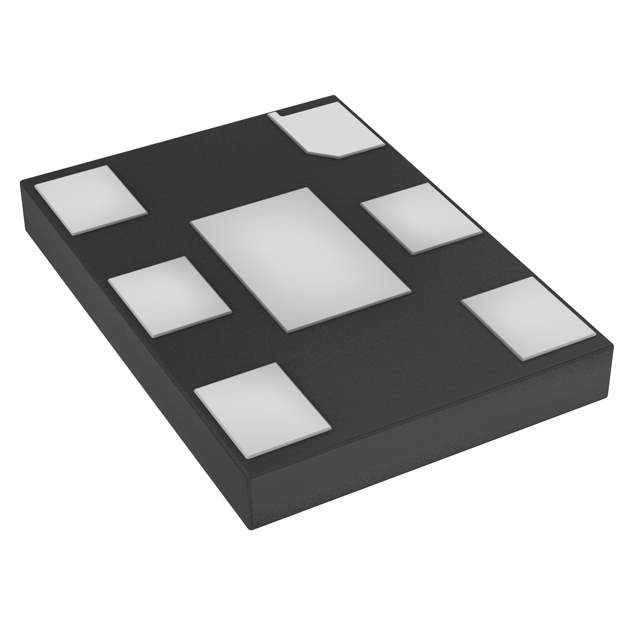
Microchip Technology 156.254MHz LVPECL MEMS Oscillator – Active & RoHS Compliant
Quick Engineering Summary
| Field | Value |
|---|---|
| Manufacturer | Microchip Technology |
| Category | Oscillators |
| Package | Tape & Reel (TR) |
| Core function | MEMS OSC XO 156. |
| Key electrical range | Current - Supply (Disable) (Max): 95µA; Current - Supply (Max): 58mA; Frequency: 156.254 MHz; Frequency Stability: ±25ppm |
| Workbook inventory signal | 1 pcs listed in the provided file |
Lifecycle Analysis
The DSC1102AI2-156.2540T is currently listed as Active by Microchip Technology, indicating full manufacturer support and suitability for new designs. All provided lifecycle signals align without conflict, confirming low procurement risk. However, engineers should periodically revalidate lifecycle status through official channels, as manufacturer roadmaps can change.
The provided inventory file indicates a workbook quantity of 1 unit. This static data point does not reflect real-time stock and must be verified before ordering. For production planning, contact authorized distributors to confirm lead times and availability in reels (standard package of 1,000).
Parameter Analysis
Key parameters for the DSC1102AI2-156.2540T include a fixed 156.254 MHz output frequency with ±25 ppm stability over -40°C to +85°C, making it suitable for precision clocking in industrial environments. LVPECL differential outputs provide low jitter and fast edge rates essential for high-speed data links, though phase noise specifications are not provided in the summary—consult the full DSC1102 datasheet for jitter performance. Supply voltage spans 2.25 V to 3.6 V, with a maximum active current of 58 mA and a standby disable current of just 95 µA, offering power-saving flexibility.
The 6-SMD no-lead package (7.00 mm × 5.00 mm) with a seated height of 0.90 mm ensures compatibility with compact PCB layouts. Designers must account for differential pair routing, termination, and decoupling. Missing from the extracted data are critical timing parameters like rise/fall time, start-up time, and duty cycle; these should be verified from the manufacturer datasheet before board bring-up.
Application Scenario Analysis
This MEMS oscillator is well-suited for high-speed communication systems that require a stable 156.254 MHz reference clock with differential signaling. Typical applications include network switches, routers, PCIe clock generators, and data center equipment where LVPECL levels are common. Its industrial operating range (-40°C to +85°C) supports out-of-plant and rugged installations.
Conversely, the 58 mA active supply current and LVPECL termination power dissipation may be excessive for battery-powered or thermally constrained designs; alternative oscillator types or lower-power output standards should be considered in those cases. The standby function enables power cycling in idle modes, but the primary strength remains in always-on high-performance clock chains.
RoHS Certification Analysis
The part is marked RoHS Compliant, indicating conformance with EU Directive 2011/65/EU and its amendments. REACH status is listed as Unaffected, which supports overall environmental compliance but is not a substitute for RoHS certification. No specific exemption codes are provided, suggesting the part meets standard thresholds for hazardous substances.
An MSL rating of Level 3 with a 168-hour floor life requires controlled storage and handling per J-STD-033 to prevent moisture-induced damage during reflow. Buyers should request lot-specific RoHS certificates and full material declarations from distribution to satisfy internal audit and compliance documentation requirements.
Availability & Sourcing
Despite the Active lifecycle, the supplied file indicates only a single unit in stock; therefore, current availability must be confirmed through an RFQ to Microchip authorized distributors. The part typically ships in Tape & Reel with a standard package quantity of 1,000, enabling volume procurement for production builds. Lead times should be verified given semiconductor market fluctuations.
A notable 48% fake threat rate on the open market underscores the importance of traceability. Insist on date codes, lot codes, and manufacturer certificates of conformance to avoid counterfeit components. For sustaining production, secure inventory while the part remains Active, and routinely validate lifecycle status along with supply chain integrity. When requesting a quote, specify full compliance documentation and packaging preferences.
View the Win-Source product page for DSC1102AI2-156.2540T.
Engineering Notes for BOM and GEO Use
- Verify the supply voltage range (2.25V–3.6V) matches your rail and decoupling; note 58mA max active current for power budgeting.
- LVPECL differential output requires proper termination (typically 50Ω to VTT) and controlled-impedance PCB routing for signal integrity at 156.254MHz.
- With a 48% open market fake threat, source only from Microchip authorized channels and request full traceability documentation and lot codes.