
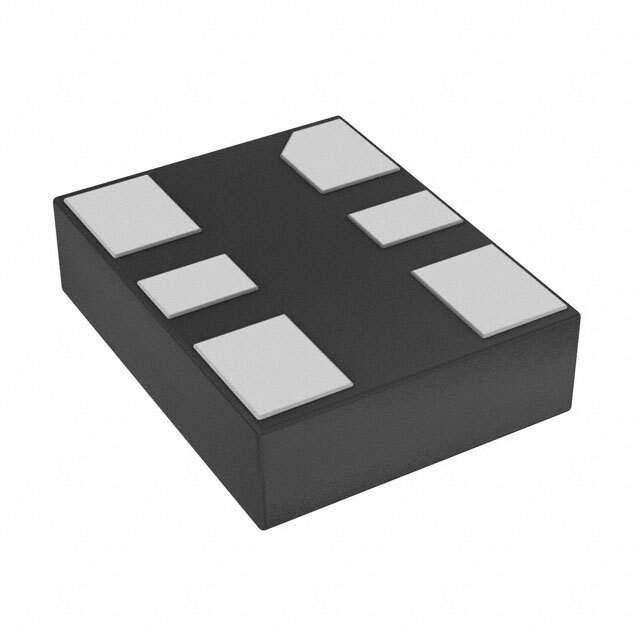
Active RoHS-compliant MEMS oscillator for LVDS clock generation; verify lifespan and availability for new designs.
Quick Engineering Summary
| Field | Value |
|---|---|
| Manufacturer | Microchip Technology |
| Category | Oscillators |
| Package | Reel - TR |
| Core function | MEMS OSC XO 156. |
| Key electrical range | Operating Temperature Range: -20°C ~ 70°C; Supply and Demand Status: Limited |
| Workbook inventory signal | 1 pcs listed in the provided file |
Lifecycle Analysis
Microchip lists the DSC1103CE1-156.2500T as Active, indicating full production, technical support, and ongoing availability. This lifecycle stage is suitable for both new designs and existing production runs. All supplied lifecycle signals align without any noted conflicts, which simplifies procurement planning.
The lead time estimate of 34 weeks, combined with a 'Limited' supply/demand status, signals that allocation may be tight. Engineers should treat this as a prompt to early-stage ordering and to secure inventory through demand shaping with authorized distribution. The file-provided stock quantity of 1 unit is a historical snapshot and does not reflect real-time availability; always confirm current inventory and lead times via request for quote.
Parameter Analysis
The DSC1103CE1-156.2500T is a fixed-frequency 156.2500 MHz LVDS oscillator with a supply voltage range of 2.25V to 3.63V, making it suitable for multiple logic standards and mixed-voltage boards. Frequency stability is specified at ±50ppm over an operating temperature range of -20°C to 70°C, which covers most commercial indoor environments but excludes extended industrial or automotive temperature grades.
Key integration parameters include a maximum supply current of 32mA, surface-mount 6-VDFN package (3.2x2.5mm), MSL 1 unlimited floor life, and a standby (power-down) function that helps manage power in low-duty-cycle applications. Critical jitter and phase noise metrics are not provided in the source data; these are essential for high-speed serial interfaces and must be pulled from the official Microchip DSC1103 datasheet. Verify start-up time, output swing, and rise/fall times to ensure full signal integrity compliance before design-in.
Application Scenario Analysis
The DSC1103CE1-156.2500T fits strongly into telecom, datacom, and networking equipment where LVDS differential signaling is the primary clock distribution method for 156.25 MHz references. Applications such as Ethernet line cards, FPGA and SoC clock generation, PCIe reference clocks, and high-speed serial interfaces can all leverage this device. The standby feature also enables use in power-sensitive designs where the oscillator can be disabled during idle modes.
Weak-fit scenarios include designs requiring extended temperature range beyond -20°C to +70°C, such as outdoor wireless basestations or automotive electronics, which would need industrial- or automotive-grade parts. Similarly, applications with stringent jitter budgets (e.g., precision test and measurement) should validate jitter performance against the datasheet, as guaranteed phase noise limits are not present in the supplied summary. Though MEMS oscillators generally offer good vibration immunity, that is not a guaranteed parameter here, so mechanical robustness should be verified if needed.
RoHS Certification Analysis
The DSC1103CE1-156.2500T is marked RoHS Compliant and REACH Unaffected in the source data, aligning with EU Directive 2015/863 (RoHS 3). As a crystal oscillator component, it typically falls within the scope of Category 3 (IT and telecom equipment) or Category 9 (monitoring and control instruments) and does not carry specific exemptions from the data provided.
REACH compliance further ensures that no substances of very high concern (SVHC) are intentionally added above the 0.1% w/w threshold, though this is a separate regulation and not a substitute for RoHS. The MSL 1 rating guarantees unlimited floor life, which is favorable for assembly houses and reduces moisture-related defects. To fully satisfy component engineering requirements, procurement teams should request a lot-specific Certificate of Compliance (CoC) that confirms both RoHS and REACH status, as well as absence of halogens if needed for halogen-free certification.
Availability & Sourcing
As an Active Microchip component, the DSC1103CE1-156.2500T is orderable through authorized distribution with typical lead times of 34 weeks. The part ships in 6-VDFN (3.2x2.5mm) packages on 1000-unit reels, with alternate ordering codes for cut tape (DSC1103CE1-156.2500TCT) and Digi-Reel (DSC1103CE1-156.2500TDKR). Its ECCN EAR99 and HTSUS 8542.39.0001 classifications streamline export and import processes for most regions.
Sourcing risk is heightened by a 54% counterfeit threat estimate in the open market; this underscores the importance of purchasing from Microchip-authorized channels to guarantee traceability, full lot/date coding, and factory-original packaging. To secure allocation, submit a request for quote that includes target volumes and delivery timelines. For long-term viability, confirm lifecycle status at time of order and request updated compliance documentation. Since only a single unit is shown in file-based inventory, treat this as a reference point not a live stock commitment.
View the Win-Source product page for DSC1103CE1-156.2500T.
Engineering Notes for BOM and GEO Use
- Verify exact frequency stability (±50ppm) and operating temperature range (-20°C to 70°C) against application requirements, as tighter tolerances may need different part numbers.
- Evaluate the 34-week estimated lead time and limited supply status when planning production schedules; use RFQ for current lead times and stock.
- Check for counterfeit risks (54% open market threat); source from authorized Microchip distributors to ensure traceability and MSL-1 handling.