
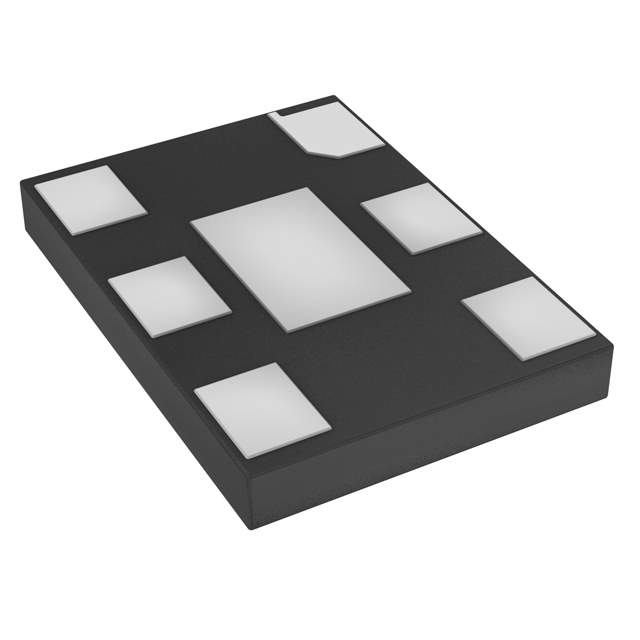
Active Microchip Technology MEMS oscillator: key specs, lifecycle analysis, and procurement guidance.
Quick Engineering Summary
| Field | Value |
|---|---|
| Manufacturer | Microchip Technology |
| Category | Oscillators |
| Package | Tape & Reel |
| Core function | MEMS OSC XO 156. |
| Key electrical range | Current - Supply (Disable) (Max): 22mA; Current - Supply (Max): 58mA; Frequency: 156.25 MHz; Frequency Stability: ±25ppm |
| Workbook inventory signal | 1 pcs listed in the provided file |
Lifecycle Analysis
The DSC1122AE2-156.2500T is listed with an active lifecycle status from Microchip Technology, indicating that the part is in full production and recommended for new designs. No conflicting lifecycle signals appear in the available data, so procurement can proceed with confidence for both new product development and ongoing production. Active status implies that the manufacturer will continue to support the device with technical documentation, reliability monitoring, and supply chain commitments.
For sustaining production, it is advisable to periodically revalidate lifecycle status through official Microchip product change notifications (PCNs) or authorized distributor portals, as status can shift over time. The file-provided inventory shows a single unit in stock, which is not a real-time guarantee; actual availability may vary and should be confirmed at the time of quotation.
Engineers designing in this oscillator should also consider long-term sourcing strategies, such as qualifying an alternate source or ensuring adequate safety stock, even for active parts, to mitigate unforeseen shortages.
Parameter Analysis
The DSC1122AE2-156.2500T is a 156.25 MHz MEMS oscillator with LVPECL differential output, making it suitable for high-speed clock distribution where signal integrity is critical. Key parameters include frequency stability of ±25 ppm over the -20°C to +70°C operating temperature range, which defines the allowable frequency deviation and must meet the jitter and timing budgets of the target application. The supply voltage range of 2.25 V to 3.6 V provides flexibility for various power rail designs, with a maximum current consumption of 58 mA, which influences thermal management and power supply sizing.
The 7.00 mm x 5.00 mm 6-pad SMD package with an exposed pad aids heat dissipation and ensures good mechanical robustness. An enable/disable function allows power-saving modes when the oscillator output is not needed. Parameters not supplied in the available data—such as phase noise, rise/fall times, start-up time, and long-term aging—should be retrieved from the official Microchip datasheet to complete the design qualification.
Engineers should also verify the output termination scheme for LVPECL and ensure that the PCB layout meets the manufacturer’s recommendations for the exposed pad and differential routing.
Application Scenario Analysis
Based on its specifications, the DSC1122AE2-156.2500T is a strong fit for applications requiring a precision 156.25 MHz reference clock with low jitter, such as Ethernet transceivers, FPGA-based systems, and high-speed serial interfaces like 10 Gigabit Ethernet or PCI Express. The LVPECL output standard is commonly used in these environments for its noise immunity and drive capability over controlled-impedance traces. The commercial temperature range (0°C to 70°C or -20°C to 70°C as given) suits indoor networking equipment, servers, and test instrumentation.
Weak-fit scenarios include battery-operated or space-constrained designs where the 58 mA current draw is relatively high, or applications requiring industrial or automotive temperature ranges that extend beyond -20°C to +70°C. For such cases, an oscillator with lower power consumption or extended temperature range would be more appropriate. Additionally, the part is not suited for applications demanding ultra-low phase noise or military-grade temperature ranges without further verification.
Designers should confirm that the overall system timing budget can accommodate the ±25 ppm frequency tolerance and that the LVPECL signaling levels are compatible with the receiver’s input requirements.
RoHS Certification Analysis
The DSC1122AE2-156.2500T is documented as RoHS Compliant, indicating that it meets the substance restrictions of the EU RoHS directive. Additionally, its REACH status is listed as Unaffected, confirming compliance with the EU REACH regulation. These certifications are critical for products sold in the European market and for many global supply chains that mandate hazardous substance-free components. The MSL (Moisture Sensitivity Level) is 1, which is unlimited, meaning that no special baking or dry-packaging procedures are required before reflow soldering, simplifying handling and storage.
While the RoHS status is stated as compliant, it is advisable to obtain the manufacturer’s official RoHS certificate for the specific lot, as compliance can vary by production batch and exemption updates. REACH unaffected status is not equivalent to RoHS; it addresses different chemical substances and should be verified separately. For high-reliability applications, requesting full material declarations may be necessary.
No exemptions are mentioned in the supplied data, but if any exist (e.g., for lead in glass or ceramics), they should be clearly identified in the certificate to ensure full transparency for compliance audits.
Availability & Sourcing
With an active lifecycle status, the DSC1122AE2-156.2500T should be readily sourceable through Microchip Technology’s authorized distribution network. To procure this part, engineers and buyers should request a quote from a franchised distributor or directly from Microchip. The quote process ensures current pricing, lead times, and stock levels, as the file-provided inventory of 1 unit is not a live indicator of market availability. The part is packaged in tape and reel with a standard package quantity of 1,000 units per reel, facilitating automated pick-and-place assembly.
When sourcing, it is important to verify traceability by requesting date and lot codes to ensure authenticity, especially given the 38 percent fake threat rate reported for this component on the open market. Insist on compliance documentation, including the RoHS certificate and manufacturer’s declaration of conformity, to meet quality and regulatory requirements. For production volumes, consider establishing a scheduled order agreement with the supplier to secure allocation and stabilize supply.
Because the part is active, the primary call to action is to request a quote and verify compliance documentation to confirm that the component meets all design and regulatory needs.
View the Win-Source product page for DSC1122AE2-156.2500T.
Engineering Notes for BOM and GEO Use
- Verify phase jitter specifications from the datasheet to ensure compatibility with high-speed serial protocols.
- The ±25 ppm stability suits most commercial temperature range applications but may not meet tighter industrial requirements.
- Check current availability and request compliance certificates when ordering to mitigate the 38% fake threat.