
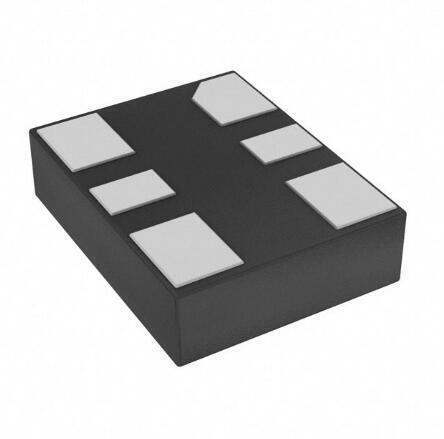
333.3333 MHz LVDS MEMS oscillator in 3.2x2.5 mm VDFN – verify lifecycle and source with traceability
Quick Engineering Summary
| Field | Value |
|---|---|
| Manufacturer | Microchip Technology |
| Category | Oscillators |
| Package | 4-SMD, No Lead |
| Core function | MEMS OSC XO 333. |
| Key electrical range | Current - Supply (Max): 17mA; Frequency: 5.6GHz Center; Frequency Stability: ±10ppm; Operating Temperature: -40°C ~ 85°C |
| Workbook inventory signal | 1 pcs listed in the provided file |
Lifecycle Analysis
The DSC1123CI2-333.3333 presents a clear lifecycle conflict that every buyer must address. One data signal indicates an Active lifecycle, but the component’s specific part status is marked Obsolete. Such inconsistency can arise from database lags or product-number variants; however, for procurement decisions, the more conservative signal—Obsolete—must be taken seriously until disproven.
For new designs, this oscillator should not be specified without direct confirmation from Microchip Technology. Request the latest product discontinuation notice or a formal lifecycle statement. If the part is indeed obsolete, explore manufacturer-recommended replacements or plan for a last-time-buy. For sustaining production, verify remaining factory inventory and authorized distribution stock. The workbook shows only 1 unit available, which is not a real-time guarantee but suggests very limited supply.
When lifecycle uncertainty exists, require a written assurance from the supplier or manufacturer. Do not rely solely on data aggregator statuses. This advice is critical to avoid production gaps.
Parameter Analysis
Several parameters drive the DSC1123CI2-333.3333’s suitability. The nominal output frequency is 333.3333 MHz with LVDS differential signaling. LVDS is essential for high-speed, low-noise clock distribution in environments like network switches or FPGA clocking. Frequency stability of ±25 ppm over the industrial temperature range (-40°C to +85°C) is adequate for many telecom and datacom applications but verify if tighter stability is required.
The supply voltage range of 2.25 V to 3.63 V allows operation from typical 2.5 V or 3.3 V rails, easing power supply design. Maximum current consumption is 32 mA, which is moderate for an LVDS oscillator at this frequency. However, this value may vary with output load and operating conditions, so always refer to the official datasheet for typical vs. maximum curves.
A critical red flag is the frequency discrepancy: one specification field lists “5.6GHz Center,” which contradicts both the part number and description. Engineers must ignore this outlier and rely on the 333.3333 MHz value imprinted in the part number. Always cross-check with the manufacturer’s datasheet. The package is a 6-pin VDFN (3.2 mm x 2.5 mm) with a maximum seated height of 0.035 inches (0.9 mm), suitable for dense PCB layouts. Before layout, validate the footprint against Microchip’s recommended land pattern.
Application Scenario Analysis
The DSC1123CI2-333.3333 is tailored for high-speed digital systems needing a stable, differential clock. Its LVDS output and 333.3333 MHz frequency make it a strong candidate for clocking network processors, high-speed serial interfaces (e.g., PCIe, SATA), and FPGA reference clocks where signal integrity over board traces is critical.
In telecom base stations or data center switches, the industrial temperature range supports operation within extended environments. However, the ±25 ppm frequency stability might be insufficient for precision timing protocols like IEEE 1588 without additional holdover or disciplining. For low-power or cost-sensitive designs, this oscillator’s 32 mA current draw and LVDS signaling may be overkill; a single-ended CMOS oscillator would be a better fit.
Use this part only when LVDS is mandatory and the supply voltage matches one of the allowed rails. If the application needs a lower frequency, the DSC1123 series may have pin-compatible alternatives, but this specific part number is fixed at 333.3333 MHz. Avoid forcing this oscillator into low-speed designs where its differential output adds unnecessary complexity and power consumption.
RoHS Certification Analysis
The DSC1123CI2-333.3333 is reported as RoHS Compliant. This generally means it meets the EU RoHS Directive 2011/65/EU and its amendments, including RoHS 3 (EU 2015/863) which added four phthalates. However, the source data does not specify which RoHS revision applies or provide a REACH statement.
For full materials compliance, request a certificate of conformance from Microchip Technology or the distributor. A RoHS declaration at the family level may cover the DSC1123 series, but lot-to-lot variance is rare in semiconductor manufacturing. If your company requires halogen-free or low-halogen components, you must explicitly ask for that data, as it is not indicated here.
In procurement, ensure that the RoHS status is validated on the actual shipping lot. Some older inventory may pre-date RoHS revisions, though it is unlikely for a component with a potentially recent design. For medical or aerospace use, additional substance declarations beyond RoHS may be necessary. Always tie the compliance document to the specific date code or batch.
Availability & Sourcing
Sourcing the DSC1123CI2-333.3333 requires immediate action because of the conflicting lifecycle signals and limited visible inventory. The workbook shows a quantity of 1 unit, but this file-provided number is not a live stock level. Contact Win Source or authorized Microchip distributors to request a current quote and confirm real-time availability.
Given the Obsolete part status, even if stock exists, new production orders from the factory are unlikely. If this is a last-time-buy scenario, verify the date codes and request traceability documentation to avoid counterfeit or moisture-exposed units. Packaging is specified as Bulk, so ask about ESD protection and dry-pack requirements for the VDFN package.
Do not design in the DSC1123CI2-333.3333 until you have a written statement from Microchip that it remains in active production. If it is indeed obsolete, ask the manufacturer or distributor for pin-compatible MEMS or quartz-based LVDS oscillators with similar footprint and performance. For immediate needs, place an RFQ and insist on a full compliance package including RoHS certificates and part-specific lifecycle confirmation.
View the Win-Source product page for DSC1123CI2-333.3333.
Engineering Notes for BOM and GEO Use
- Double-check the actual output frequency. The description states 333.3333 MHz but one specification field lists 5.6 GHz Center—likely a data error. Always refer to the official Microchip datasheet.
- The part status appears as Obsolete despite an Active lifecycle tag. Contact Microchip for an up-to-date PCN before using DSC1123CI2-333.3333 in new designs.
- LVDS termination requires 100 Ω differential impedance at the receiver. Ensure PCB layout matches datasheet recommendations to maintain signal integrity.