
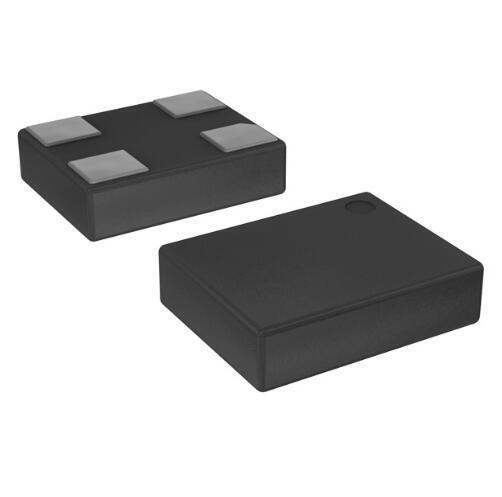
End-of-Life MEMS oscillator requires careful sourcing and migration planning.
Quick Engineering Summary
| Field | Value |
|---|---|
| Manufacturer | Microchip Technology |
| Category | Oscillators |
| Package | 4-SMD, No Lead |
| Core function | MEMS OSC XO 50. |
| Key electrical range | Current - Supply (Max): 17mA; Frequency: 5kHz; Frequency Stability: ±20ppm @ 25°C; Operating Temperature: -40°C ~ 85°C |
| Workbook inventory signal | 1 pcs listed in the provided file |
Lifecycle Analysis
The DSC6101JI2A-050.0000 from Microchip Technology is confirmed as End-of-Life (EOL) with part status marked Obsolete. All lifecycle signals—Excel lifecycle parameter, Lifecycle Status field, and Part Status—consistently indicate that this MEMS oscillator is no longer manufactured. For new designs, this part carries high procurement risk and should not be specified. Engineers must select an alternative active oscillator that meets the same frequency, stability, and automotive qualification requirements.
For existing products that still rely on the DSC6101JI2A-050.0000, immediate action is necessary to secure any remaining buffer stock. The file-provided inventory shows one unit, but this is not a real-time guarantee. Buyers should contact Win Source or authorized distributors to confirm current availability, request last-time-buy (LTB) dates, and obtain the manufacturer’s EOL notice. Without a confirmed LTB window, production continuity is at risk.
Planned migration to a substitute part should be prioritized. While the data does not list direct replacements, engineers can look for MEMS or quartz oscillators with similar footprint (2.5x2.0mm VLGA), 50 MHz CMOS output, and AEC-Q100 rating. Thorough qualification including phase noise, start-up time, and aging characteristics is recommended before switching.
Parameter Analysis
The DSC6101JI2A-050.0000 is described as a MEMS oscillator with a nominal frequency of 50.0000 MHz, yet the specification list in the source data shows a 5 kHz frequency value. This discrepancy must be resolved by consulting the official Microchip datasheet. The most credible parameters from the combined data are a 50 MHz CMOS output, a supply voltage range of 1.71V to 3.63V, and a typical supply current of 3mA rather than the 17mA maximum listed elsewhere. Frequency stability is provided as ±25ppm (or ±20ppm at 25°C, depending on source), which is adequate for many industrial and automotive applications.
The part is housed in a 4-VLGA (2.5mm x 2.0mm) surface-mount package, compatible with standard SMD reflow processes. Operating temperature range spans -40°C to +85°C, making it suitable for underhood automotive and industrial environments. The AEC-Q100 qualification noted in the extended parameters adds confidence for automotive designs, though this should be confirmed with the manufacturer’s test documentation.
Several important parameters are missing from the source data, such as output load drive capability, rise/fall times, phase jitter, standby current, and start-up time. For high-speed digital clocks, phase noise performance is critical. Engineers should request the full datasheet to verify these values and ensure they meet system timing margins. Additionally, the Enable/Disable function mentioned may have specific logic thresholds that must align with the driving circuitry.
Application Scenario Analysis
As an automotive-qualified (AEC-Q100) MEMS oscillator, the DSC6101JI2A-050.0000 was originally targeted at demanding embedded systems where reliable clock sources are essential. Strong-fit applications include automotive infotainment, ADAS sensor modules, body electronics, and industrial controllers that require a stable 50 MHz reference over a wide temperature range. Its small 2.5x2.0mm footprint suits space-constrained PCB designs in IoT gateways or camera systems.
Weak-fit scenarios arise due to the part’s fixed frequency and non-programmable function. Designs needing field-adjustable or multiple clock frequencies would be better served by programmable oscillators. Additionally, the EOL status makes it unsuitable for any new project, as future supply cannot be guaranteed. For legacy products still in production, it may be an exact form/fit/function match, but the high risk demands an accelerated migration plan.
Although the part includes an enable/disable pin for power savings, its typical current draw of 3mA is relatively low, so it can be used in battery-powered devices if the voltage range matches. However, without confirmation of start-up time and standby current, low-power performance cannot be assured. Engineers should weigh these factors against available active alternatives.
RoHS Certification Analysis
The DSC6101JI2A-050.0000 is marked as RoHS Compliant in the source data. This indicates that the part should meet EU Directive 2011/65/EU and its amendments, restricting hazardous substances such as lead, mercury, and cadmium. However, the provided information does not specify the exact RoHS standard (e.g., RoHS 3) or list any exemptions. For automotive parts, compliance to the latest EU 2015/863 (RoHS 3) is typically expected, but verification at the lot level is recommended.
No data is given for REACH, halogen-free, or Moisture Sensitivity Level (MSL). While REACH compliance is separate from RoHS, many procurement specifications require both. If the final application demands halogen-free construction or a specific MSL for reflow profile planning, these details must be obtained from Microchip’s material declaration or certificate of compliance. Given the EOL status, securing such documentation may be more challenging, as manufacturer support for legacy parts often declines.
Buyers should include compliance documentation as a condition of purchase. A Certificate of RoHS Compliance dated for the specific lot ensures that the supplied units meet the required environmental standards. Because this is a stock-limited part, verify that the supplier can provide traceability to a compliant batch before committing to production quantities.
Availability & Sourcing
The DSC6101JI2A-050.0000 is an End-of-Life (EOL) Microchip MEMS oscillator with very limited availability. The file-provided inventory indicates a quantity of just one unit, which is not a guaranteed real-time stock level. This part should only be sourced for legacy system maintenance, not for new production runs. Given the high risk, buyers should immediately request a quote through Win Source or other authorized channels to confirm actual on-hand inventory, date/lot codes, and traceability.
When procuring EOL components, traceability and authenticity are paramount. Ask the supplier for the original manufacturer’s part markings, date codes, and any available compliance documentation (RoHS, REACH) for the specific lot. Packaging details—bulk, in this case—may affect handling; ensure the supplier provides proper ESD protection. Because the part is no longer produced, there is no lead time for factory orders, so all supply is limited to distributor or broker stock.
For engineering teams, the sourcing strategy should include parallel qualification of a replacement. While this guide does not provide direct cross-references, active oscillators from Microchip or other vendors in a 4-VLGA package with 50 MHz CMOS output and AEC-Q100 rating can be evaluated. Contact Microchip’s technical support for migration suggestions and review the official EOL notice for any last-time-buy programs. Always verify lifecycle status with the manufacturer before committing to a new production design using this part.
View the Win-Source product page for DSC6101JI2A-050.0000.
Engineering Notes for BOM and GEO Use
- Verify actual frequency and voltage range from the manufacturer datasheet before design-in; provided specs show conflicting values.
- As an end-of-life part, secure inventory immediately for sustaining production and start qualification of a replacement.
- RoHS compliance status is lot-dependent; request a certificate of compliance with each order to ensure conformity.