
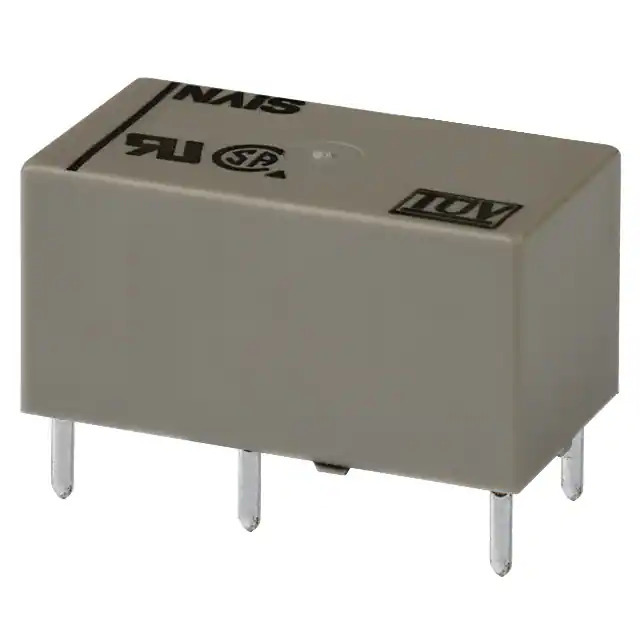
Discontinued latching DPST relay: key specs, application fit, and procurement advice for Panasonic DSP1-L2-5V.
Quick Engineering Summary
| Field | Value |
|---|---|
| Manufacturer | Panasonic |
| Category | Power Relays, Over 2 Amps |
| Package | Bulk |
| Core function | RELAY GEN PURPOSE DPST 5A 5V |
| Key electrical range | Coil Current: 60 mA; Coil Resistance: 83.3 Ohms; Coil Voltage: 5VDC; Contact Rating (Current): 5 A |
| Workbook inventory signal | 1 pcs listed in the provided file |
Lifecycle Analysis
The Panasonic DSP1-L2-5V is a discontinued power relay. Lifecycle database entries show conflicting signals such as EOL and Discontinued; the most conservative interpretation is that the part is no longer in active production. For new designs, this relay should not be selected, as no future availability is guaranteed. For existing production lines, engineers must urgently verify residual stock and consider a last-time buy if quantities remain. The file-provided inventory quantity indicates one unit, but this is not a guarantee of real-time availability.
Procurement teams should contact authorized distributors or the manufacturer directly to confirm any remaining factory inventory. Without a formal discontinuation notice from Panasonic, the exact end-of-life timeline may be unclear, making it risky to depend on this part for any long-term program. Migration to an active replacement is strongly advised.
Parameter Analysis
The Panasonic DSP1-L2-5V is a latching, dual-coil power relay with a 5VDC nominal coil voltage. The coil draws 60 mA and has a resistance of 83.3 Ohms, requiring a pulsed drive of at least 4 VDC to set or reset the DPST-NO/NC contacts. The contact rating is 5 A, with a maximum switching voltage of 250VAC or 30VDC. Operate and release times are 10 ms and 5 ms respectively, while the operating temperature range spans -40°C to 65°C. The relay is fully sealed (MSL 1, unlimited) and uses PC pin termination in a through-hole package.
These parameters make it suitable for general-purpose switching where a latching function conserves energy. However, critical missing datasheet items include the maximum switching power (often given in VA/W), contact endurance, and dielectric strength. Engineers should verify these from the official Panasonic datasheet to ensure the relay meets voltage isolation and lifetime requirements for their application. Additionally, the AgSnO contact material is robust against welding but may exhibit slightly higher contact resistance than AgCdO; verify load compatibility.
Application Scenario Analysis
As a latching dual-coil relay, the DSP1-L2-5V excels in applications where coil power must be minimized or where the relay must retain its state without continuous coil energization. Typical strong-fit scenarios include smart metering, remote controls, battery-operated automation, and industrial logic where a momentary pulse sets the output. The DPST configuration with one normally open and one normally closed contact offers flexibility for control and interlock functions.
Conversely, weak-fit scenarios include high-duty-cycle switching, loads with high inrush currents exceeding the 5A rating, or environments where the 65°C upper limit is too restrictive. The fully sealed construction supports wave soldering and dusty environments but may not be ideal for ultra-low-level signals due to the AgSnO contact material. Designers intending to use this relay in legacy equipment should re-evaluate contact life under actual load conditions and consider whether an active alternative with similar footprint and coil characteristics exists.
RoHS Certification Analysis
The DSP1-L2-5V is listed as RoHS Compliant, indicating that as per Panasonic’s declaration, this model does not exceed the restricted substance limits of the EU RoHS directive. Additionally, it is REACH Unaffected, meaning no substances of very high concern above threshold were identified. The MSL rating is 1 (Unlimited), which simplifies handling and soldering processes.
However, because the relay is discontinued, any remaining inventory may come from older date codes. Procurement and quality teams should request a certificate of compliance for the specific lot to confirm that the RoHS status remains valid and that no process changes occurred in late production. Since no exemptions are noted in the supplied data, the relay is likely compliant without exceptions, but verification against the latest RoHS scope (e.g., RoHS 3) is prudent if the production date is before 2019. REACH compliance does not substitute for RoHS; both should be confirmed if regulatory documentation is required for your market.
Availability & Sourcing
With a lifecycle status of Discontinued, the DSP1-L2-5V presents significant sourcing challenges. The component is no longer manufactured by Panasonic, and the file-provided quantity indicates only a single unit, which cannot be considered a reliable stock level. Given a reported fake threat in the open market of 48 percent, buyers should exercise extreme caution and only source through authorized distributors or directly from verified excess inventory suppliers with traceable date codes. Panasonic’s original packaging is bulk, and authenticity checks such as lot code tracking and electrical testing are essential.
Engineers and buyers should contact us to request a quote for the current, real-time availability; any offer will be subject to spot checks. For production continuity, we strongly recommend initiating a qualification process for an alternative relay with an active lifecycle. When purchasing remaining stock, require a certificate of conformity and RoHS compliance documentation for the specific lot. Since no last-time-buy notification is provided, verify directly with Panasonic or its sales representatives that no further inventory exists before committing to board spins.
View the Win-Source product page for DSP1-L2-5V.
Engineering Notes for BOM and GEO Use
- This part is discontinued; confirm last-time-buy availability and plan for redesign.
- Latching dual-coil design reduces continuous coil power but requires careful driver design.
- Verify contact material (AgSnO) compatibility with your load to ensure relay longevity.