
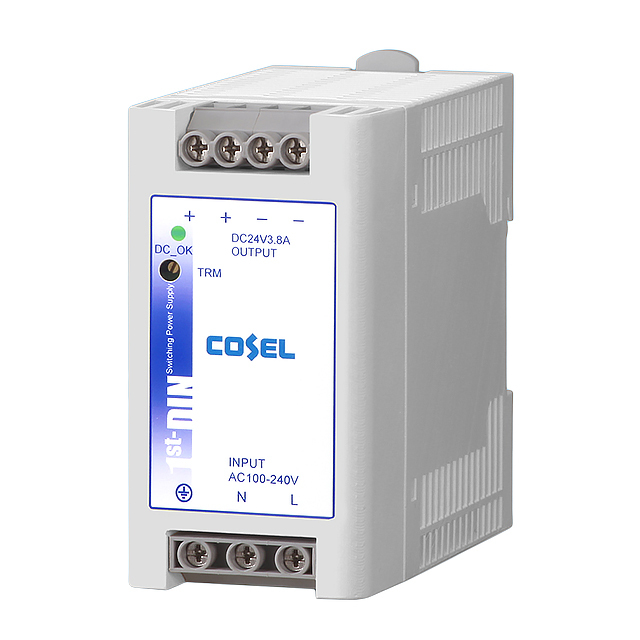
Key specifications, lifecycle status, and procurement insights for the DSP30-12 12V 30W DIN rail power supply.
Quick Engineering Summary
| Field | Value |
|---|---|
| Manufacturer | TDK-Lambda Americas Inc. |
| Category | Industrial, DIN Rail Power Supplies |
| Package | Bulk |
| Core function | AC/DC DIN RAIL SUPPLY 12V 30W |
| Key electrical range | AC Voltage - Input: 90 ~ 264 VAC; Current - Output (Max): 2.1A; DC Voltage - Input (Max): 370V; DC Voltage - Input (Min): 120V |
| Workbook inventory signal | 132 pcs listed in the provided file |
Lifecycle Analysis
The DSP30-12 from TDK-Lambda Americas Inc. presents conflicting lifecycle indicators that demand careful interpretation. While the database lists the Lifecycle Status as Active, the Product Status is explicitly marked as Not For New Designs. This discrepancy is further echoed by an Excel lifecycle parameter that translates to 'Not applicable for new designs.' A conservative procurement approach treats the DSP30-12 as NRND (Not Recommended for New Designs). For existing production lines, the part may remain available for sustaining purchases, but engineers should not incorporate it into new projects. The risk level is medium because the manufacturer has not announced a formal end-of-life, yet the product status signals a transition away from active promotion. Buyers should verify current lifecycle status directly with TDK-Lambda before committing to long-term orders. A file-provided inventory of 132 units suggests some stock exists, but real-time availability is not guaranteed; treat this as a snapshot requiring confirmation.
Parameter Analysis
Key parameters of the DSP30-12 make it suitable for many industrial DIN rail applications. The unit accepts a wide universal AC input from 90 to 264 VAC, and also operates from a DC input range of 120 to 370 VDC, providing installation flexibility. It delivers a single 12V output at up to 2.1A, yielding a total power of 30W. Efficiency is rated at 82%, which directly impacts thermal design and enclosure ventilation. The operating temperature range of -25°C to 71°C is specified with derating, meaning the full 30W output may not be available at the high end; engineers should consult the datasheet for the derating curve. Other notable specs include 3 kV isolation, adjustable output voltage, and compact dimensions of 55.6 x 53.1 x 90.9 mm. Missing from the available data are critical items like hold-up time, ripple and noise, protection features (overvoltage, overcurrent, short-circuit), and detailed EMC/EMI performance beyond the CE mark. Verification of these parameters in the official datasheet is essential before integration.
Application Scenario Analysis
With its DIN rail mount format, ITE (Commercial) application rating, and CE approval, the DSP30-12 is well suited for typical industrial control environments. Strong-fit applications include factory automation cabinets, building management systems, security and access control panels, and test equipment where a stable 12V rail is required. The adjustable output allows minor voltage tweaks for specific loads, while the universal input eases deployment across different grid voltages. However, the part is not recommended for new designs, which limits its use in high-volume new product introductions. It lacks specific certifications for medical (IEC 60601), transportation, or hazardous locations, making it a weak fit for those sectors unless additional system-level approvals are obtained. Outdoor use would require a protected enclosure, as the unit's IP rating is not specified. For maintenance or small-scale production of existing designs, the DSP30-12 remains a practical choice, but volume purchasing should factor in the NRND status and potential future supply constraints.
RoHS Certification Analysis
The DSP30-12 is listed as RoHS Compliant. Given the part's active commercial history, it likely conforms to EU RoHS (Directive 2011/65/EU and its amendments, including 2015/863). This means it should be free of the six restricted substances plus the four added phthalates. However, the provided data does not specify a standard revision, nor does it include REACH, halogen-free, or MSL ratings. Buyers should note that RoHS compliance is often manufacturer-claimed at the family level; lot-to-lot variations can occur. To ensure compliance for a specific procurement, request a valid RoHS certificate or declaration from TDK-Lambda for the actual batch being shipped. For designs requiring additional environmental compliance, such as REACH or California Proposition 65, obtain the relevant documentation. This conservative approach helps avoid compliance gaps during production audits.
Availability & Sourcing
Sourcing the DSP30-12 demands attention due to its NRND status and a noted supply-and-demand condition of Shortage. The workbook indicates an inventory level of 132 units, but this should be treated as a file-provided figure that may not reflect real-time stock. To secure parts for existing production, issue a request for quote (RFQ) promptly and include requirements for lot codes, date codes, and lifecycle verification. Packaging is bulk, so consider minimum order quantities and handling. Because the part is not for new designs, evaluate whether a last-time buy (LTB) is warranted to cover the expected production run. During quoting, request current lead times and any manufacturer notices regarding product discontinuation. Compliance documentation, including RoHS certificates, should be obtained for each shipment. For engineers, verifying that the sourced units match the datasheet revision and include all safety agency marks is prudent before integration.
View the Win-Source product page for DSP30-12.
Engineering Notes for BOM and GEO Use
- Verify NRND status with TDK-Lambda before designing into new products; plan for eventual obsolescence.
- Observe temperature derating: output power reduction required above 50°C ambient (typical for DIN rail supplies). Check datasheet for exact curve.
- Request RoHS certificate and lot traceability documentation during RFQ to ensure batch compliance.