
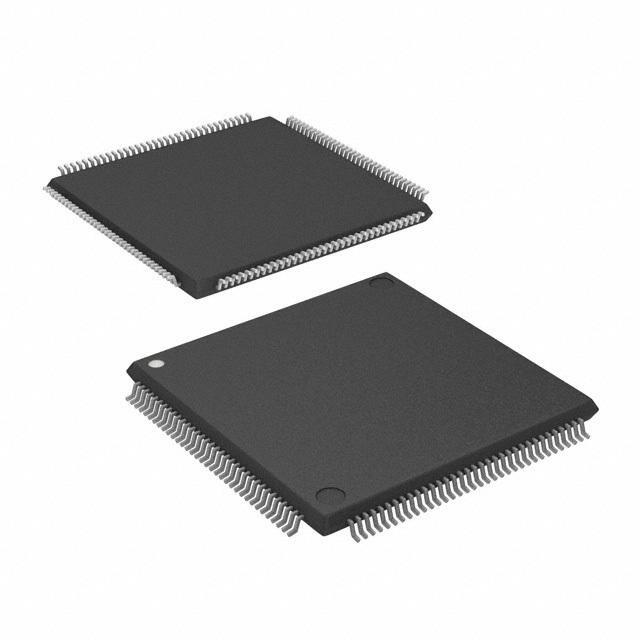
EOL 24-bit fixed-point DSP with 100MHz clock, 144-LQFP package. Verify lifecycle and source carefully.
Quick Engineering Summary
| Field | Value |
|---|---|
| Manufacturer | Freescale Semiconductor - NXP |
| Category | Embedded - DSP (Digital Signal Processors) |
| Package | 144-LQFP (20x20) |
| Core function | IC DSP 24BIT 100MHZ 144-LQFP |
| Key electrical range | Supply and Demand Status: Limited; Temperature Range - Operating: -40°C to 100°C (TJ); Voltage - Core: 3.30V; Voltage - I/O: 3.30V |
| Workbook inventory signal | 60 pcs listed in the provided file |
Lifecycle Analysis
The DSP56303AG100 is classified as End-of-Life (EOL) by NXP, with all provided lifecycle signals indicating it is Not For New Designs. An estimated EOL date of 2019 suggests that last-time-buy opportunities may have passed, making new procurement increasingly difficult. For sustaining production of legacy systems, engineers should immediately verify the official EOL notice and last-time-buy schedule with NXP to avoid supply disruption.
The file-provided inventory shows a quantity of 60 units, but this figure is not a real-time guarantee and should be validated with a formal quote. Given the high counterfeit risk of 64% in the open market, sourcing from authorized or trusted channels is critical. For new designs, a migration to an active NXP DSP or alternative architecture is strongly recommended.
Without active support and limited availability, the DSP56303AG100 poses a high procurement risk. Design teams should plan for a redesign if this part is essential to current production.
Parameter Analysis
The DSP56303AG100 is a 24-bit fixed-point digital signal processor operating at a 100MHz clock rate, built on a 144-LQFP (20x20) surface-mount package. Its core and I/O voltages are both 3.30V, simplifying power supply design with a single rail. The on-chip RAM is 24kB, complemented by 576 bytes of ROM, which constrains firmware size and may require external memory for complex algorithms.
Key parameters such as the 100MHz clock and fixed-point architecture define the computational throughput for real-time signal processing tasks like audio filtering, motor control, and telecom line-card operations. The industrial temperature range of -40°C to 100°C (junction) allows deployment in harsh environments. The 144-LQFP package demands careful PCB layout for thermal and signal integrity.
Missing specifications that require datasheet verification include peripheral interfaces (e.g., host interface, SSI, SCI), DMA channels, and timer modules. The available memory is modest, so designers should confirm that on-chip resources meet application needs before committing to a legacy design.
Application Scenario Analysis
The DSP56303AG100 targets cost-sensitive embedded signal processing applications where moderate performance and 24-bit fixed-point precision are sufficient. Typical strong-fit scenarios include industrial motor drives, power inverters, basic audio processing, and voice-band telecom systems. Its 100MHz clock and fixed-point core handle control loops, filtering, and FFT operations common in these domains.
Due to limited on-chip memory (24kB RAM, 576B ROM), the part is less suitable for applications demanding large data buffers or complex algorithm execution. High-end audio effects, video processing, or advanced analytics exceed its computational and memory capacity. The industrial temperature range supports use in factory automation and outdoor equipment, but the EOL status restricts it to sustaining existing products rather than new deployments.
Engineers should treat the DSP56303AG100 as a legacy solution for field-proven designs. Migration to a newer DSP with higher memory and active lifecycle is advised for any performance expansion or reliability improvement.
RoHS Certification Analysis
The DSP56303AG100 is listed as RoHS Compliant, which indicates conformance to the EU Restriction of Hazardous Substances directive. However, the specific RoHS standard (e.g., RoHS 3 / EU 2015/863) is not explicitly stated in the supplied data, so buyers should request documentation to confirm the exact compliance level. The part is also noted as Not Halogen Free, meaning it may contain bromine- or chlorine-based flame retardants, which could be a concern for applications requiring low-halogen materials.
While RoHS compliance is a minimum requirement for many markets, lot-level verification is advisable when sourcing from non-franchised distributors, especially given the EOL status and high counterfeit threat. Additional substance declarations such as REACH are not provided; however, REACH does not substitute for RoHS, so purchasers must assess both separately if needed. Moisture sensitivity level (MSL) is not specified; proper storage as per the tray packaging and dry conditions should be maintained.
Availability & Sourcing
Availability of the DSP56303AG100 is limited, consistent with its EOL status. The file-provided stock shows 60 units in tray packaging, but this quantity is not guaranteed in real time. A formal request for quote (RFQ) is necessary to confirm current inventory, pricing, and lead time. The part is classified with a high 64% fake threat in the open market, so sourcing from authorized NXP distributors or vetted independent suppliers with traceability documentation is imperative.
Buyers should insist on verifying date/lot codes and request copies of the manufacturer's EOL notice and RoHS certificate. Proper storage conditions—dry storage cabinet with humidity protection—must be maintained to prevent moisture damage to the 144-LQFP package. Given that the part is Not For New Designs, procurement should be limited to aftermarket support for existing products.
Because the last-time-buy date has likely passed, securing inventory may require spot-market purchases that carry higher risk. Engineers should evaluate a redesign to an active DSP from NXP or an alternative vendor to mitigate long-term supply chain vulnerability.
View the Win-Source product page for DSP56303AG100.
Engineering Notes for BOM and GEO Use
- Confirm EOL status and last-time-buy dates with NXP before committing to new production designs.
- Verify RoHS compliance at the lot level when sourcing from independent distributors due to high counterfeit risk (64% fake threat).
- Evaluate code compatibility and peripheral set if migrating to a newer DSP family, as on-chip RAM is limited to 24kB and ROM to 576B.