
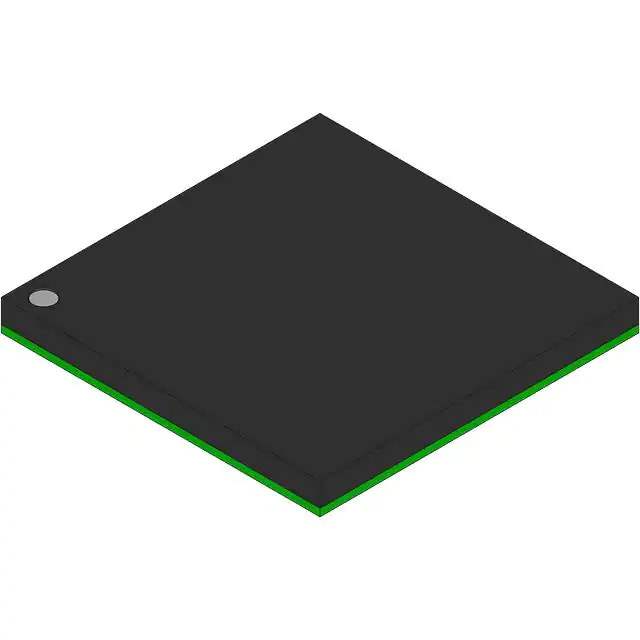
EOL fixed-point DSP with conflicting lifecycle signals – file-based inventory 1,960 pcs as of capture.
Quick Engineering Summary
| Field | Value |
|---|---|
| Manufacturer | Freescale Semiconductor - NXP |
| Category | Embedded - DSP (Digital Signal Processors) |
| Package | Bulk |
| Core function | IC DSP 24BIT 200MHZ 196MAPBGA |
| Key electrical range | Temperature Range - Operating: -40°C ~ 100°C; Voltage - Core: 1.60V; Voltage - I/O: 3.30V |
| Workbook inventory signal | 1960 pcs listed in the provided file |
Lifecycle Analysis
The DSP56321VF200 from Freescale Semiconductor (now NXP) is listed as End-of-Life (EOL) in lifecycle status records, with additional Excel data corroborating EOL. However, a conflicting "Active" entry exists under Product Status, which can mislead procurement teams. Conservative interpretation dictates treating this part as EOL for all new designs and production planning. The risk level is high: legacy parts may become unavailable without notice, and last-time buy windows may have expired. Engineers and buyers should immediately contact NXP or authorized distributors to confirm the official obsolescence schedule, last-time buy date, and any recommended migration path to a newer DSP or MCU. Continuing production with this component requires secure, traceable inventory from authorized sources to avoid counterfeit or recycled devices. The file-provided inventory quantity of 1,960 pieces is a snapshot and not a real-time availability commitment, so validation before purchase is essential.
Parameter Analysis
The DSP56321VF200 is a fixed-point DSP from the DSP563xx series, operating at 200 MHz. Key parameters include a 24-bit core, 576 kB of on-chip RAM, and 576 bytes of ROM for boot routines. It supports multiple interfaces: Host Interface, SSI (Synchronous Serial Interface), and SCI (Serial Communication Interface), making it suitable for systems requiring serial data exchange. The device operates from a 1.6 V core supply and 3.3 V I/O, with a junction temperature range of -40°C to 100°C. It is housed in a 196-MAPBGA (15x15 mm) surface-mount package with MSL Level 3 (168 hours floor life). These parameters directly affect board design: core voltage regulation must be precise, and proper thermal management is needed for the BGA package. Critically, the data provided lacks power consumption figures, MIPS performance metrics, detailed timing specifications, and pinout descriptions. Engineers must consult the full NXP datasheet to verify signal integrity requirements, decoupling, and layout guidelines before integrating this EOL component into any design, especially for high-reliability applications.
Application Scenario Analysis
This fixed-point DSP was designed for embedded signal processing applications commonly found in telecommunications, audio processing, industrial control, and motor control systems. Its host interface and serial communication ports make it well-suited for legacy telecom infrastructure, such as line cards, echo cancellation, and voice codecs. In industrial automation, it could handle sensor data processing and closed-loop control where deterministic DSP performance is required. However, the EOL status and 24-bit fixed-point architecture limit its relevance for new high-performance designs; modern alternatives often use floating-point DSPs or ARM-based processors with richer ecosystems. This part is a weak fit for applications demanding high MIPS, large memory, or advanced connectivity like Ethernet or USB. For existing systems already designed around the DSP56321VF200, it can serve as a sustaining component, but design teams should evaluate migration paths to newer NXP DSPs or ARM Cortex-M/A series processors to ensure long-term availability and support.
RoHS Certification Analysis
The DSP56321VF200 is marked as RoHS Compliant in the source data, but the specific directive (e.g., EU 2015/863) is not explicitly stated. Typically, this implies compliance with the EU RoHS directive, restricting lead, mercury, cadmium, and other hazardous substances. No exemptions are listed, suggesting standard compliance. The REACH status is reported as Vendor Undefined, meaning the supplier has not provided confirmation under the EU REACH regulation; it is not a substitute for RoHS certification. Buyers should request full material declarations and RoHS certificates for the specific lot or date code during procurement to ensure compliance continuity, especially since this is an EOL component potentially sourced from older stock. The moisture sensitivity level (MSL) is 3, mandating proper dry-pack handling and a floor life of 168 hours after opening, with re-baking if exposed beyond limits. For EOL parts, verifying compliance at the batch level is critical to avoid non-conformance in regulated industries.
Availability & Sourcing
Given the EOL lifecycle and 58% fake threat in the open market, sourcing DSP56321VF200 demands rigorous supply-chain due diligence. The file-provided quantity of 1,960 pieces from Win Source is not guaranteed real-time stock; availability can fluctuate. Engineers and buyers must request a quote to confirm current QTY, date/lot codes, and packaging authenticity. Insist on traceable chain-of-custody documentation and full RoHS/REACH compliance certificates. Since this is an EOL part, last-time buy opportunities may be closed, so secure inventory only from authorized NXP distributors or verified excess suppliers. For maintenance and repair of existing systems, evaluate if a form-fit-function replacement exists; otherwise, stockpile authenticated inventory. Given the counterfeit risk, third-party testing (e.g., decapsulation, x-ray) may be warranted for high-criticality applications. Manufacturers often recommend migrating to newer DSPs; consult NXP’s product longevity program for alternatives.
View the Win-Source product page for DSP56321VF200.
Engineering Notes for BOM and GEO Use
- Confirm EOL timeline with NXP; avoid new designs and plan migration immediately.
- Verify core and I/O voltage sequencing requirements from the original datasheet to prevent latch-up.
- Authenticate all procurement lots against counterfeits (58% open-market risk); demand traceability and test reports.