
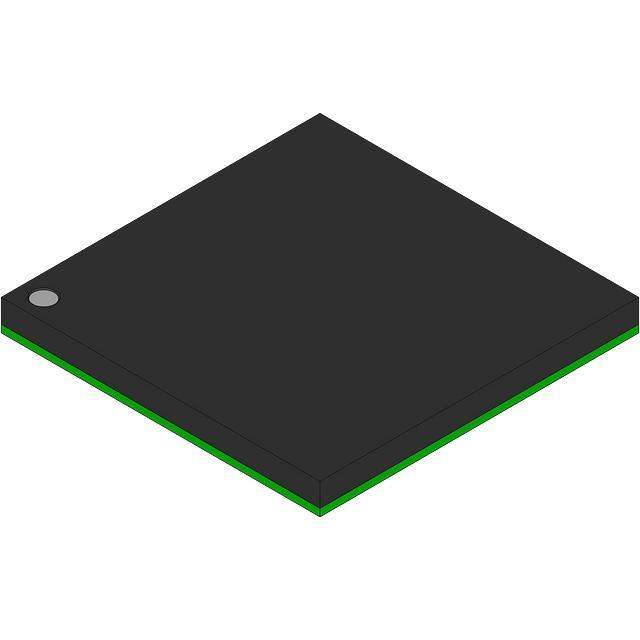
EOL fixed-point DSP with 576kB RAM, 196-MAPBGA package, and 240MHz clock rate. Sourcing and compliance considerations.
Quick Engineering Summary
| Field | Value |
|---|---|
| Manufacturer | Freescale Semiconductor - NXP |
| Category | Embedded - DSP (Digital Signal Processors) |
| Package | 196-MAPBGA (15x15) |
| Core function | IC DSP 24BIT 240MHZ 196MAPBGA |
| Key electrical range | Supply and Demand Status: Limited; Temperature Range - Operating: -40°C to 100°C (TJ); Voltage - Core: 1.60V; Voltage - I/O: 3.30V |
| Workbook inventory signal | 1 pcs listed in the provided file |
Lifecycle Analysis
DSP56321VF240 is classified as End-of-Life (EOL) by Freescale Semiconductor (now NXP), meaning the manufacturer has ceased production and no additional units will be fabricated. All available lifecycle signals align: the primary lifecycle status is EOL, and it is marked 'Not For New Designs.' For procurement, this translates to a high-risk status; new product development should not use this part. Engineers maintaining existing systems must plan for end-of-life procurement to cover anticipated production runs and field service needs.
File-provided inventory data indicates only a single unit currently in stock, which should not be considered guaranteed real-time availability. The product is supplied in tray packaging and requires dry storage. Given the EOL designation, any remaining stock should be secured promptly while verifying date codes and storage conditions to ensure long-term reliability.
Parameter Analysis
The DSP56321VF240 is a 24-bit fixed-point digital signal processor operating at a clock rate of 240 MHz. It features a large on-chip RAM of 576 kB, a small non-volatile ROM (576 B), a 1.6 V core voltage, and 3.3 V I/O. The device is housed in a 196‑MAPBGA package with a 15×15 mm body, and it uses surface‑mount technology. The operating junction temperature range is ‑40°C to +100°C.
These parameters define the performance envelope: the 24‑bit fixed-point architecture suits precision integer math, and the 240 MHz clock suggests high throughput for DSP tasks like filtering and control loops. However, engineers should verify additional specifications not included here—such as exact MIPS rating, peripheral interfaces (host, SSI, SCI), power dissipation, JTAG support, and detailed timing—from the official datasheet before integration. The 55% counterfeit risk underscores the need for thorough parameter confirmation on received parts, as deviations may indicate non‑authentic components.
Application Scenario Analysis
This device is a member of Freescale’s DSP563xx family, typically employed in embedded systems requiring real‑time digital signal processing. Its fixed‑point 24‑bit architecture is well‑suited for audio processing, industrial motor control, telecom echo cancellation, and medical instrumentation where deterministic integer math is preferred. The 240 MHz speed and large on‑chip RAM enable complex algorithm execution without external memory bottlenecks.
However, because the DSP56321VF240 is EOL, it is not appropriate for new designs. It remains a candidate for sustaining existing products where a form‑fit‑function replacement is necessary and a hardware redesign is not feasible. For new projects, buyers should evaluate more current NXP DSP offerings or alternatives from other vendors that are in active production. Using this EOL part in a new design would carry significant supply chain risk.
RoHS Certification Analysis
The RoHS compliance of DSP56321VF240 is ambiguous: the provided compliance summary indicates RoHS Compliant, while a separate specification entry lists RoHS Non‑Compliant. No specific RoHS standard version (e.g., EU 2015/863) is cited. REACH status is not mentioned. This conflict requires direct verification with NXP’s official product documentation or a Product Change Notification (PCN).
For procurement, request a Certificate of Conformance from the supplier that explicitly states the RoHS exemption status, if any. If the part is indeed non‑compliant, its use in European Union markets would be restricted unless exempted. Engineers must ensure that the final BOM version meets regional environmental regulations. In cases where RoHS compliance is mandatory, alternative parts that are definitively compliant should be sourced.
Availability & Sourcing
Sourcing DSP56321VF240 requires caution due to its EOL status, limited stock, and a reported open‑market counterfeit risk of 55%. File data shows a single unit in stock, but real‑time availability must be confirmed via RFQ. The component is supplied in tray packaging and stored in dry, humidity‑controlled environments.
Buyers should only purchase through authorized NXP distributors or reputable independent sources that perform in‑house screening for authenticity. Always request date and lot codes, environmental compliance certificates, and supply chain traceability. As the part is EOL, secure sufficient inventory for your product’s lifecycle while simultaneously initiating a migration to an active‑production replacement. Verify the manufacturer’s last‑time‑buy notices to avoid missing any window for procurement.
View the Win-Source product page for DSP56321VF240.
Engineering Notes for BOM and GEO Use
- Verify that the 240MHz clock and 24-bit fixed-point architecture meet your algorithm's performance and precision requirements under worst-case conditions.
- Given EOL status and 55% counterfeit risk, only source from authenticated suppliers and request full traceability documentation.
- Plan a migration strategy to an active NXP DSP or equivalent to avoid long-term supply disruption.