
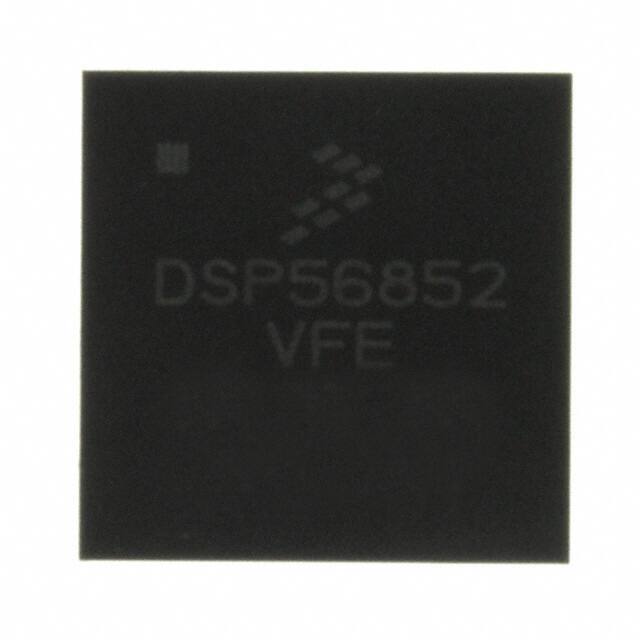
Detailed engineering specs, lifecycle analysis, and global sourcing insights for the DSP56852VFE 16-bit microcontroller.
Quick Engineering Summary
| Field | Value |
|---|---|
| Manufacturer | NXP / Nexperia |
| Category | Embedded - Microcontrollers |
| Package | 81-MAPBGA (8x8) |
| Core function | IC MCU 16BIT 12KB SRAM 81MAPBGA |
| Key electrical range | Operating Temperature Range: -40°C ~ 85°C (TA); Supply and Demand Status: Balance; Supply Voltage: 1.8V ~ 3.3V |
| Workbook inventory signal | 1 pcs listed in the provided file |
Lifecycle Analysis
The DSP56852VFE presents conflicting lifecycle data. While the 'Lifecycle Status' parameter is listed as Active, the 'Part Status' field explicitly shows Obsolete. For procurement purposes, this part should be treated as discontinued. The conflict may arise from outdated manufacturer information or aggregation errors, but the presence of an obsolete status is a strong indicator that the device is no longer in production.
New designs should avoid the DSP56852VFE entirely. For existing products, immediate steps should include validating the official lifecycle status with NXP, checking for any last-time-buy notices, and beginning a migration to a replacement microcontroller. The file-provided inventory quantity of one unit is a snapshot and does not reflect real-time availability. Sustaining production will require careful sourcing of remaining stock, often through authorized distributors or specialized brokers with traceability guarantees.
Parameter Analysis
The DSP56852VFE is built around a 56800E 16-bit core operating at up to 120MHz. One key differentiator is the use of SRAM for program memory (12KB), unlike most MCUs that employ flash. This suggests the part may rely on external bootloading or execution from an external memory bus (EBI/EMI), which is supported on this device. The internal oscillator and supply voltage range of 1.8V to 3.3V offer flexibility in power management, but the limited 11 I/O lines constrain the number of external interfaces that can be directly driven.
Critical missing parameters that require datasheet verification include the size of on‑chip data RAM (Excel data suggests 4K x 16, but not confirmed), the availability of an ADC or DAC, and the exact number and type of timers/PWM channels. The peripheral set listed (POR, WDT) is minimal; the part number likely supports other standard MCU features that are undocumented in the current data. Engineers should obtain the full official datasheet to characterize all functional blocks and ensure they meet application requirements.
Application Scenario Analysis
Given its DSP-oriented 56800E core and high clock speed, the DSP56852VFE is best suited for computationally intensive control loops such as sensorless motor control, digital power conversion, or simple audio processing. The external memory interface allows expansion of code and data storage, partially offsetting the small internal SRAM. Applications that can leverage a bootloader from an external flash or a host processor over SPI/SCI are a strong fit.
However, the limited number of I/Os (11) makes this part less suitable for applications requiring extensive user interfaces, many analog inputs, or parallel communication to multiple peripherals. The lack of on‑chip flash and the uncertainty around integrated analog peripherals further narrow the sweet spot. Weak‑fit scenarios include products needing standalone operation without external memory or those that demand a wide set of integrated communication modules. For such cases, a more modern ARM‑based MCU with ample flash and I/O is likely a better choice.
RoHS Certification Analysis
The DSP56852VFE is documented as RoHS Compliant, meaning it meets the substance restrictions of the EU RoHS directive. Additionally, it is marked as REACH Unaffected, indicating no SVHC concerns per the current candidate list. The moisture sensitivity level is MSL 3 with a 168‑hour floor life, which mandates controlled storage and baking before reflow if the exposure time is exceeded.
While this general compliance is useful for qualification, it is essential to obtain lot‑specific certificates of conformance when purchasing. Family‑level declarations may not cover all batch variances, particularly for an older part whose production may have occurred under different material sets. There are no listed RoHS exemptions, but this should be confirmed through direct manufacturer documentation, especially if the device is intended for exemptions‑dependent applications such as medical or military equipment.
Availability & Sourcing
Sourcing the DSP56852VFE requires a careful approach due to its obsolete status and a high 65% counterfeit threat rating observed in the open market. The file‑provided quantity of one unit is not a guarantee of stock; current availability must be verified through an RFQ to authorized distributors or vetted independent sources. Traceability to the original manufacturer, date/lot codes, and compliance certificates are mandatory to mitigate the risk of non‑conforming or substandard parts.
Given the discontinued lifecycle, buyers should not rely on just‑in‑time procurement. Instead, secure any available inventory for sustaining production and immediately evaluate a migration path to a recommended alternative from NXP. All transactions should include terms for visual inspection and, if volume permits, third‑party authenticity testing. For quote requests, specify the tray packaging and confirm that the parts are handled per MSL 3 requirements to preserve solderability.
View the Win-Source product page for DSP56852VFE.
Engineering Notes for BOM and GEO Use
- Confirm lifecycle directly with NXP; conflicting obsolete status requires immediate migration planning for new designs.
- Verify all peripheral specifications (timers, ADC, PWM) from official datasheet before PCB layout.
- Package is MAPBGA with 0.8mm pitch; ensure assembly capability for this fine-pitch BGA.