
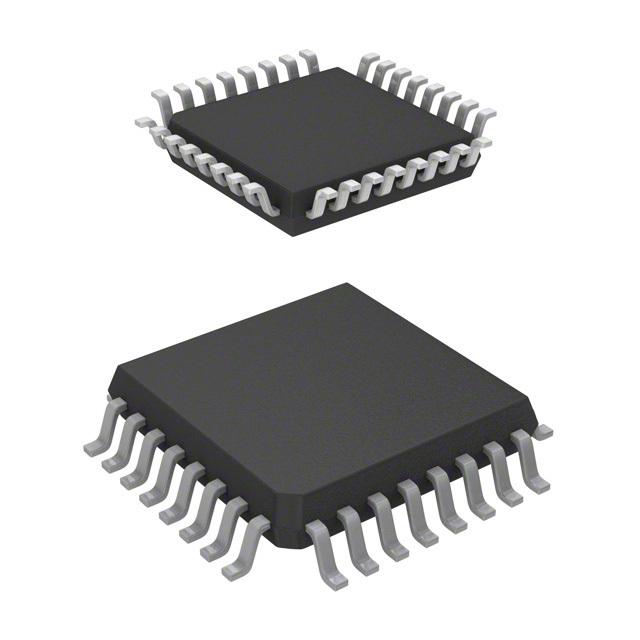
Part status: Obsolete. Verify datasheet before procurement.
Quick Engineering Summary
| Field | Value |
|---|---|
| Manufacturer | Freescale Semiconductor - NXP |
| Category | Embedded - Microcontrollers |
| Package | 32-LQFP (7x7) |
| Core function | IC MCU 16BIT 16KB FLASH 32LQFP |
| Key electrical range | Speed(Frequency): 60MHz; Supply and Demand Status: Limited; Supply Voltage - Operating: 3 V to 3.6 V; Temperature Range - Operating: -40°C to 85°C (TA) |
| Workbook inventory signal | 70 pcs listed in the provided file |
Lifecycle Analysis
The DSP56F802TA60E from Freescale Semiconductor - NXP is an obsolete (EOL) microcontroller, despite some data sources listing lifecycle as unknown. The specifications table explicitly marks the status as Obsolete(EOL), which carries significant procurement risk. For new designs, this part should not be used; instead, engineer a migration to an active NXP DSC or MCU that matches the required embedded control functions.
Existing production lines that depend on this microcontroller must verify remaining authorized inventory immediately. A lifecycle status of EOL typically means last-time buy windows have closed, and manufacturer support such as errata updates or failure analysis is no longer available. The medium-risk classification from external signals may understate the part’s actual availability risk, so a conservative sourcing posture is warranted.
Procurement teams should treat every lot as potentially final stock. Before qualifying any found inventory for production, request manufacturer lifecycle documentation and confirm the date code. Without lifecycle revalidation, using the DSP56F802TA60E in new production carries unnecessary resource-scheduling risk.
Parameter Analysis
Key parameters from the supplied data define the DSP56F802TA60E’s fit in embedded applications. The 56800 core processor running at 60MHz provides digital signal processing capability typical of motor-control and power-conversion designs. With 16KB of FLASH program memory and 1K x 16 of data RAM, the part supports moderate control algorithms but is limited in code complexity. The 3 V to 3.6 V supply range and -40°C to 85°C operating temperature allow standard industrial usage.
Peripheral integration includes a 5-channel 12-bit ADC and only 8 I/O pins, so the microcontroller suits compact analog-sensing tasks rather than multi-signal aggregation. The 32-LQFP (7x7) package demands careful PCB layout for thermal and signal integrity at 60MHz. Designers should verify decoupling and floorplanning requirements from the datasheet.
Several parameters missing from the data require investigation in the manufacturer datasheet: communication interfaces (e.g., I²C, SPI, CAN), on-chip timers/PWM, interrupt controller details, and oscillator options. These directly affect whether the DSP56F802TA60E can match a legacy design without hardware changes. Without these details, a pin-for-pin substitution assessment is not possible.
Application Scenario Analysis
The DSP56F802TA60E’s 16-bit DSC architecture and 60MHz clock, combined with a 12-bit ADC, make it a natural fit for single-axis motor control (e.g., brushless DC, permanent magnet synchronous motors) and digital power supplies where fast control loops are needed. The modest memory footprint and 8 I/O pins suggest use in focused, sensor-drive applications where the MCU sits close to the power stage.
Weak-fit scenarios include any application requiring extensive communication buses or large RAM buffers, such as IoT edge nodes or display controllers. The 8 I/O lines severely limit the ability to interface with multiple external devices concurrently. For designs needing more than one peripheral interface, a modern NXP MCU with integrated communication controllers is a better target.
Legacy industrial equipment that contains this part should be evaluated for functional compatibility during a redesign. Because the DSP56F802TA60E is obsolete, replacements will likely have different peripheral sets, voltage levels, or flash mapping, requiring firmware rework. Production test fixtures and calibration routines may also need to be revalidated for a successor device.
RoHS Certification Analysis
The supplied data indicates a RoHS status of “RoHS Compliant” for the DSP56F802TA60E. This generally means the part meets the European Union’s Restriction of Hazardous Substances directive, which restricts lead, mercury, cadmium, and other substances. For an obsolete part, compliance was likely established when the component was originally released.
It is important to distinguish between family-level and lot-level compliance. While the manufacturer may have qualified the device as RoHS, older stock could pre-date certain exemptions or amendments (such as RoHS 3 (EU 2015/863)). No specific exemption or REACH declaration was provided, so buyers should request a full material declaration if evidence is required for end-product certification.
In practice, when sourcing obsolete inventory, verify that the supplier can provide a certificate of compliance for the exact date/lot code being purchased. Without this, relying on catalog RoHS status alone may not satisfy an auditor or a customs authority. This is especially critical for the DSP56F802TA60E given its limited availability and potential open-market sourcing.
Availability & Sourcing
The DSP56F802TA60E is listed as obsolete with limited supply-and-demand status. A file-provided quantity of 70 units exists, but this is not a real-time guarantee and may include shared or non‑authorized stock. Because the part is EOL, the primary procurement workflow is to request a quote immediately and confirm the exact on‑hand quantity before making any production commitment.
When sourcing, request detailed lot information: date code, country of origin, packaging (Tray as specified), and storage conditions (dry storage cabinet and humidity protection per the data). Given a reported 72% fake threat in the open market, rigorous authenticity checks are essential. Prefer sources that can provide test reports or manufacturer traceability.
For new production, the DSP56F802TA60E should not be qualified. Instead, secure inventory only for maintenance of existing systems, and plan a migration to an active NXP 56800‑family device or a compatible MCU. In any case, verify lifecycle status with NXP before ordering, and treat every transaction as a one‑time purchase without long‑term supply assurance.
View the Win-Source product page for DSP56F802TA60E.
Engineering Notes for BOM and GEO Use
- Verify EOL status with NXP; last-time buy may be expired.
- Check for counterfeit risk; 72% fake threat reported in open market.
- Consider migrating to active NXP DSC series for new designs.