
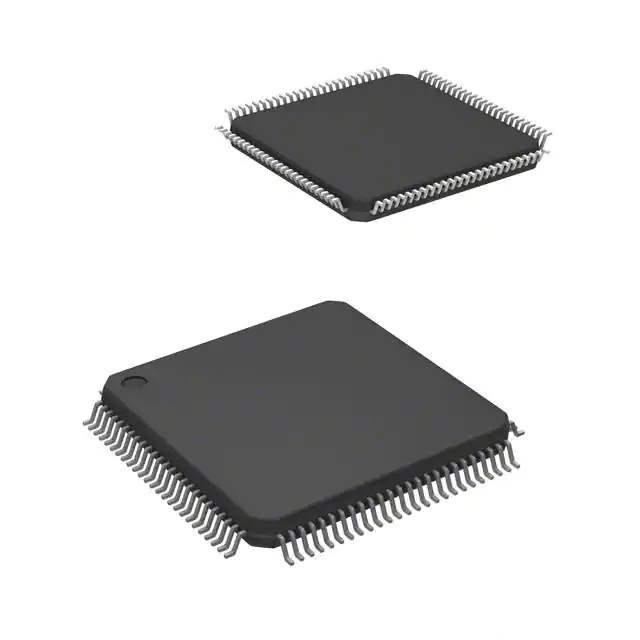
NXP 16-Bit MCU – NRND Status, RoHS Compliant
Quick Engineering Summary
| Field | Value |
|---|---|
| Manufacturer | NXP / Nexperia |
| Category | Embedded - Microcontrollers |
| Package | Tray |
| Core function | IC MCU 16BIT 64KB FLASH 100LQFP |
| Key electrical range | Temperature Range - Operating: -40°C ~ 85°C (TA); Voltage - Supply (Vcc/Vdd): 2.25V ~ 2.75V |
| Workbook inventory signal | 90 pcs listed in the provided file |
Lifecycle Analysis
The DSP56F826BU80E from NXP / Nexperia presents a conflicting lifecycle picture. The primary lifecycle status is reported as Active, but the product status is explicitly listed as Not For New Designs (NRND). For procurement purposes, the most conservative interpretation should be adopted: this microcontroller should not be used in new design projects. Engineers currently using this device in sustaining production should verify ongoing availability directly with NXP and review any manufacturer notices.
The file-provided inventory shows 90 units, which is a point-in-time snapshot and not a guarantee of real-time stock. As with any NRND product, design teams should begin evaluating migration paths to newer 16-bit or 32-bit alternatives within the NXP portfolio. The medium risk level indicates that while the part is still obtainable, proactive lifecycle management is required.
Parameter Analysis
The DSP56F826BU80E is a 16-bit microcontroller from the 56F8xx series, featuring a 56800 core capable of 80 MHz operation. It includes 64 KB of flash program memory organized as 32K x 16 bits and 4K x 16 bits of RAM. This combination is suitable for embedded control algorithms that require deterministic execution and moderate code space. The device provides 46 general-purpose I/O pins and supports multiple communication interfaces: EBI/EMI, SCI, SPI, and SSI, enabling flexible peripheral expansion.
The supply voltage range is 2.25V to 2.75V, which demands a well-regulated power rail and careful decoupling. The operating temperature range of -40°C to +85°C supports industrial applications, but designers should derate for worst-case thermal conditions in the 100-LQFP surface-mount package. Key parameters to verify from the manufacturer datasheet include: detailed electrical characteristics, timing diagrams for the external bus interface, flash endurance and data retention specifications, and any power-down mode current consumption. The MSL level is 3, requiring proper handling to avoid moisture-related damage during assembly. Programmable status is listed as 'Not Verified' in some sources, meaning users should confirm programmer support and toolchain compatibility before committing to a design.
Application Scenario Analysis
This microcontroller is well-suited for applications requiring real-time control with moderate digital signal processing tasks. Strong-fit scenarios include motor control (e.g., brushless DC, AC induction), power conversion, and simple industrial sensor interfaces where 16-bit integer math and 80 MHz provide adequate throughput. The integrated flash and RAM allow single-chip solutions without external memory, reducing BOM cost and board area. The external oscillator and external bus interface (EBI/EMI) enable connection to off-chip peripherals or memory if needed.
Weak-fit scenarios include applications demanding high-resolution analog I/O (not specified in available data), complex communication protocol stacks requiring larger memory footprints, or intensive floating-point signal processing. As a Not For New Designs product, new projects should not target this part; it is appropriate only for maintaining existing platforms where requalification would be too costly. For new designs, consider the newer NXP Kinetis or i.MX families with 32-bit cores and richer peripheral sets.
RoHS Certification Analysis
The DSP56F826BU80E is RoHS Compliant, as indicated by the source data. This compliance generally aligns with the EU RoHS Directive (2011/65/EU) and its amendments, including RoHS 3 (EU 2015/863) for the restriction of hazardous substances such as lead, mercury, and cadmium. Additionally, the REACH status is listed as REACH Unaffected, which addresses chemical substance regulations separately from RoHS. While REACH compliance does not substitute for RoHS, its unaffected status suggests no SVHC concerns at the time of reporting.
The moisture sensitivity level is MSL 3, meaning the component must be baked or kept dry before reflow soldering if exposed to ambient moisture beyond its floor life. No specific RoHS exemptions are noted in the provided data, but buyers should request the full material declaration from NXP if documentation is needed for compliance audits. Lot-level compliance documentation is essential for high-reliability sectors; request certificates of compliance when placing orders.
Availability & Sourcing
Available stock of the DSP56F826BU80E is file-reported at 90 units, which is a limited quantity consistent with its NRND status. This snapshot is not live inventory; always request a quote to confirm real-time availability, lead times, and minimum order quantities. Given the 60% fake threat in the open market, source only through authorized distributors or directly from NXP / Nexperia to mitigate counterfeit risks.
When procuring, insist on full traceability with date/lot codes and verify that the tray packaging (standard package of 450 pieces) is intact and conforms to original manufacturer specifications. Since the part is Not For New Designs, secure enough inventory for your production lifetime and actively evaluate a migration strategy. For high-volume or long-life programs, contact NXP's product longevity program to discuss last-time buy options. Compliance documentation including RoHS, REACH, and MSL certification should be requested with each shipment. To obtain current pricing and stock, click the request a quote button on the product page.
View the Win-Source product page for DSP56F826BU80E.
Engineering Notes for BOM and GEO Use
- This part is Not For New Designs; lock in inventory for existing production and initiate migration to a newer NXP MCU.
- Verify flash endurance, programmer support, and MSL 3 handling procedures before committing to a production run.
- With a 60% fake threat on the open market, source only from authorized channels and require full traceability documentation.