
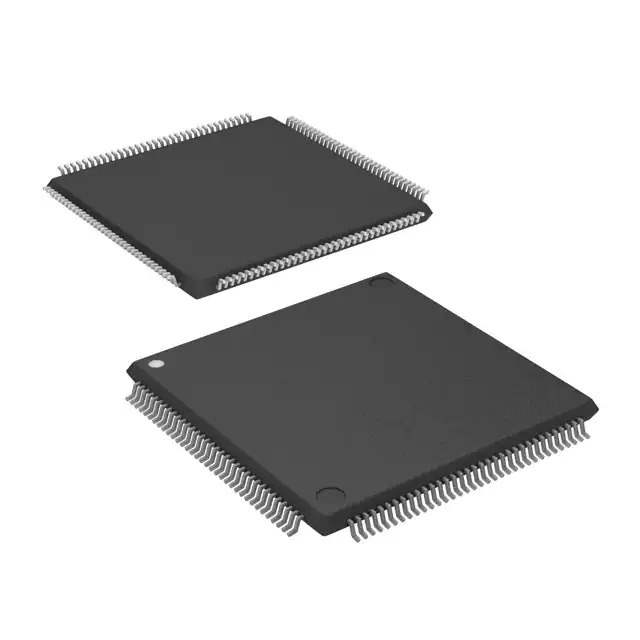
NRND audio processor; verify manufacturer status for new designs; 144-LQFP package; 200MHz clock; 744kB RAM
Quick Engineering Summary
| Field | Value |
|---|---|
| Manufacturer | NXP / Nexperia |
| Category | Embedded - DSP (Digital Signal Processors) |
| Package | Tray |
| Core function | AUDIO PROCESSOR SYMPH 144-LQFP |
| Key electrical range | Temperature Range - Operating: 0°C ~ 70°C (TA); Voltage - Core: 1.00V; Voltage - I/O: 3.30V |
| Workbook inventory signal | 39 pcs listed in the provided file |
Lifecycle Analysis
The DSPB56720AG from NXP presents a complex lifecycle status. Supplier data indicates both Active and Not For New Designs designations, creating a conflict that must be resolved conservatively. For this part, the safest interpretation is NRND (Not Recommended for New Design). Engineers should treat the DSPB56720AG as unsuitable for new product development and restrict its use to sustaining existing production only.
Before committing to any purchase, directly verify the latest status with NXP or an authorized distributor. File-provided inventory shows limited quantities, which is consistent with a part approaching end-of-maturity. Relying on spot-market stock for ongoing production carries significant supply risk. A formal migration plan to an alternative NXP audio processor or a next-generation DSP should be initiated for projects with long lifecycles.
Parameter Analysis
The DSPB56720AG operates at a clock rate of 200 MHz and includes 744 kB of on-chip RAM, both critical for real-time audio algorithms such as filtering, mixing, and effects processing. Its interface set—host interface, I2C, SAI, and SPI—provides flexible connectivity to codecs, microcontrollers, and external memory. The core voltage of 1.00 V and I/O voltage of 3.30 V require careful power sequencing and decoupling; designers should verify recommended ramp orders and tolerances from the manufacturer datasheet.
Package details are equally important. The 144-LQFP with a 20x20 mm body and 0.5 mm pitch requires standard SMT assembly but proper pad design and stencil optimization are necessary for high-yield soldering. The specified operating temperature range of 0°C to 70°C restricts the DSPB56720AG to commercial-grade environments, ruling out industrial extended-temperature applications. Missing from available data are key electrical specs such as power dissipation, core and I/O current consumption, and ESD ratings—all must be obtained from the official datasheet before finalizing a design.
Application Scenario Analysis
The DSPB56720AG targets audio processing applications where its dedicated DSP architecture and Symphony family heritage offer efficient, low-latency signal handling. Strong-fit scenarios include multi-channel home theater receivers, automotive infotainment systems (cabin temperature range), professional audio mixers, and digital speaker processors. In these applications, the combination of 200 MHz performance, ample on-chip RAM, and multiple digital audio interfaces (SAI, I2C) allows complex audio pipelines without external memory bottlenecks.
Weak-fit scenarios arise when requirements exceed the part’s commercial temperature range (e.g., outdoor or harsh industrial environments) or when the system demands integrated analog peripherals not present in this device. Additionally, because the DSPB56720AG has a Not For New Designs status, it is not advisable for new designs or high-volume programs with long-term availability needs. For simple audio tasks where a general-purpose microcontroller suffices, this DSP would be over-specified, making it a poor choice from a cost and supply perspective.
RoHS Certification Analysis
The DSPB56720AG is listed as RoHS Compliant, indicating that it meets EU RoHS substance restrictions under Directive 2011/65/EU and its amendments, including RoHS 3 (EU 2015/863). However, the supporting compliance documentation (e.g., certificate of compliance, full material declaration) is not provided in the current data set and should be requested from the supplier for lot-level verification.
REACH status is reported as unaffected, meaning the part does not contain Substances of Very High Concern (SVHC) above the threshold; this is a separate regulation and does not replace RoHS conformance. Additionally, the Moisture Sensitivity Level (MSL) is rated 3, with a 168-hour floor life after opening the moisture barrier bag. Assembly sites must follow J-STD-020 baking and handling procedures to avoid popcorning or delamination during reflow. Confirm with NXP whether any RoHS exemptions apply to the specific lot, especially for lead finishes inside the package.
Availability & Sourcing
The DSPB56720AG carries an NRND lifecycle status, which directly impacts sourcing strategy. Current file data indicates inventory of 39 units, but this figure is not a real-time stock guarantee and should be confirmed through a quote request. For sustaining production, secure enough units to cover forecasted demand and consider a last-time buy if NXP signals impending discontinuation.
Sourcing from the open market exposes buyers to a notable counterfeit threat: the part has a 44% fake risk indicator, making traceability essential. Insist on date/lot code verification, original packaging, and full compliance documentation (RoHS, REACH, MSL, and Certificate of Conformance). The standard packaging is a tray with 300 pieces per box; partial tray quantities may be available. Always review manufacturer PCNs (Product Change Notifications) and request a formal lifecycle confirmation before ordering. For new designs, evaluate NXP’s current audio DSP portfolio as a migration path from the DSPB56720AG.
View the Win-Source product page for DSPB56720AG.
Engineering Notes for BOM and GEO Use
- Confirm lifecycle directly with NXP before using in new production; conflicting signals exist (Active vs Not For New Designs).
- Plan for MSL 3 handling per J-STD-020 to avoid moisture-related reflow damage, including a 168-hour floor life.
- High open-market counterfeit risk (44% fake threat rate); source only from authorized distributors or trusted partners with traceability.