
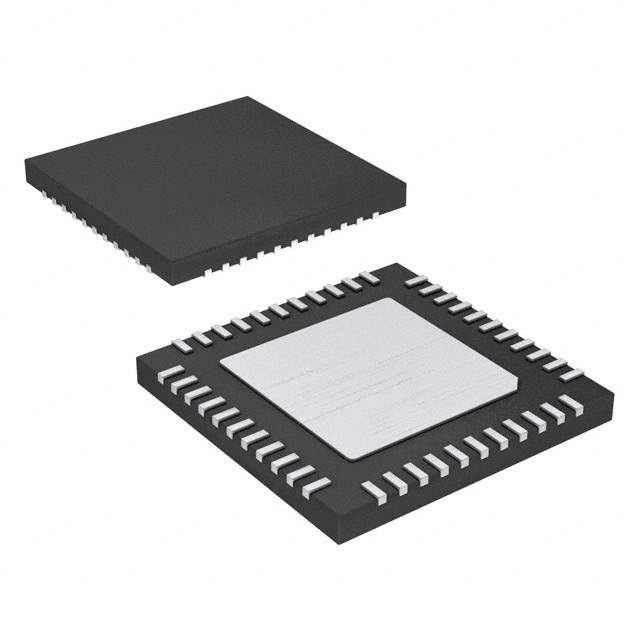
Microchip Technology 16‑bit dsPIC MCU with 24KB Flash, 20 MIPS, 44‑QFN
Quick Engineering Summary
| Field | Value |
|---|---|
| Manufacturer | Microchip Technology |
| Category | Embedded - Microcontrollers |
| Package | 44-QFN (8x8) |
| Core function | IC MCU 16BIT 24KB FLASH 44QFN |
| Key electrical range | Operating Temperature Range: -40°C ~ 125°C (TA); Supply and Demand Status: Limited; Supply Voltage: 2.5 V ~ 5.5 V |
| Workbook inventory signal | 1 pcs listed in the provided file |
Lifecycle Analysis
The DSPIC30F3013-20E/ML from Microchip Technology is listed as active, indicating the manufacturer continues to produce and support the part for new designs. However, an estimated end-of-life date of 2026 appears in the data, which introduces a planning consideration for applications with multi-year production cycles. While the immediate risk remains low, design teams should treat this as a signal to monitor Microchip's product change notifications and internal roadmap. For products expected to stay in production beyond 2026, it is prudent to either secure lifetime buys or evaluate migration paths to newer dsPIC33 families that offer greater longevity.
The source data shows a single unit in file-based inventory and a supply-and-demand status of limited. This does not reflect real-time availability but suggests that market supplies may be constrained. Engineers and buyers should confirm stock levels and lead times directly through authorized distribution before relying on this part for production. Lifecycle status should be verified directly with Microchip or a franchised distributor at the time of quotation, as statuses can change.
Parameter Analysis
The DSPIC30F3013-20E/ML is a 16-bit dsPIC digital signal controller based on Microchip’s dsPIC30F core, delivering 20 MIPS performance. Key parameters include 24KB of FLASH program memory (organized as 8K x 24-bit words), 2KB of RAM, and 1KB of EEPROM. The wide operating voltage range of 2.5 V to 5.5 V supports both 3.3 V and 5 V system designs, and the extended temperature range of -40°C to 125°C qualifies it for industrial and automotive environments. On-chip peripherals include I2C, SPI, and UART/USART serial interfaces, a 10-channel 12-bit ADC, and multiple PWM outputs, along with brown-out reset, power-on reset, and a watchdog timer.
For integration and layout, the 44-pin QFN package (8x8 mm) with exposed pad aids thermal dissipation but requires careful PCB design for soldering and inspection. The internal oscillator simplifies clocking, reducing external component count. Engineers should verify from the datasheet critical parameters not provided here, such as flash endurance cycles, ADC sampling rate and accuracy, output drive strength, and any errata that could affect operation. Additionally, the estimated 45% counterfeit risk in the open market makes it essential to source from authorized channels to ensure genuine parts with full traceability.
Application Scenario Analysis
The DSPIC30F3013-20E/ML fits well in embedded control applications that require moderate digital signal processing capability combined with standard microcontroller features. Typical strong-fit scenarios include motor control (sensor or sensorless BLDC, PMSM) where the integrated PWM, fast ADC, and DSP engine can execute control loops efficiently. Industrial automation, such as smart sensors, valve controllers, and actuator drivers, can leverage the wide temperature range and communication interfaces. The dsPIC core’s ability to handle multiply-accumulate and fractional arithmetic makes it suitable for closed-loop control and power conversion systems like power supplies, inverters, and LED lighting ballasts.
In contrast, weak-fit scenarios arise when applications need larger memory footprints, high-speed connectivity like CAN FD or Ethernet, or advanced security features. The 24KB flash and 2KB RAM are modest by modern standards, limiting complex protocol stacks or large lookup tables. Designs that demand ultra-low power consumption may also find newer Microchip parts more optimized. The part can serve as a cost-effective option for legacy designs or where the existing toolchain and code base are already established, but for new designs with extended lifespan requirements, the projected 2026 EOL should be weighed against the availability of more recent alternatives.
RoHS Certification Analysis
The DSPIC30F3013-20E/ML is documented as RoHS compliant, indicating that it meets the European Union's Restriction of Hazardous Substances directive. The material composition avoids lead, mercury, cadmium, hexavalent chromium, and specific flame retardants, making the part suitable for sale and use in EU markets and many other jurisdictions that enforce similar environmental regulations. In addition, the part is flagged as halogen free, which addresses the voluntary reduction of bromine and chlorine in the device’s resin and package materials, a requirement increasingly requested in eco-conscious and high-reliability sectors.
It is important to note that while the part number is registered as RoHS compliant, compliance can vary by assembly lot and date code, particularly for a mature product introduced in 2004. Buyers should request a Certificate of Compliance or equivalent documentation with each shipment. The absence of REACH information in the source data means that REACH SVHC compliance should be confirmed separately if required. For applications subject to strict environmental auditing, verifying compliance directly with Microchip or through an authorized distributor is recommended before production qualification.
Availability & Sourcing
Sourcing the DSPIC30F3013-20E/ML requires attention to both immediate availability and long-term supply continuity. The file-provided inventory shows a single unit, which is not a real-time guarantee, and the supply-and-demand status is ‘limited’. Engineers and buyers should request a quote through the platform to obtain current stock levels, lead times, and pricing from verified suppliers. Packaging is specified as tube, which is typical for small-to-medium volume assembly; for higher volumes, tape-and-reel options may need to be confirmed.
Given the 45% counterfeit risk in the open market, procurement teams must insist on full traceability—including manufacturer markings, date codes, lot codes, and original packaging—and consider third-party testing for high-value production runs. The part’s active lifecycle supports new designs, but the projected EOL in 2026 means that sustaining-production orders should be planned with buffer stock or a migration strategy. Always verify lifecycle status directly with Microchip or an authorized distributor at the time of quotation. For RoHS and halogen-free compliance, request documentation with each lot to ensure ongoing conformance. Use the RFQ function to engage suppliers and secure this microcontroller with visibility into lead times and authenticity.
View the Win-Source product page for DSPIC30F3013-20E/ML.
Engineering Notes for BOM and GEO Use
- Verify flash endurance and data retention specifications from the official datasheet to ensure design reliability.
- Plan for the part's estimated end-of-life in 2026; consider alternative or newer Microchip dsPIC33 families for long-life projects.
- Given a 45% fake threat in the open market, purchase only from authorized sources and perform incoming inspection.