
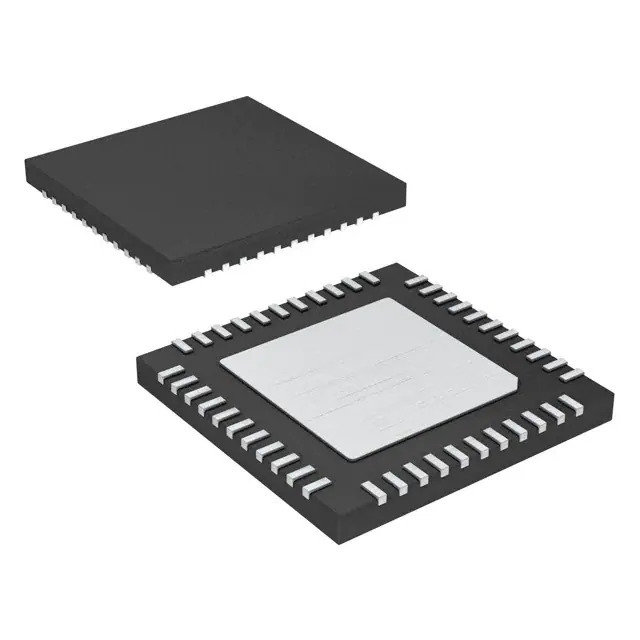
Engineer's sourcing guide: key parameters, compliance, and procurement insights for the DSPIC30F4013-20I/ML microcontroller from Microchip Technology.
Quick Engineering Summary
| Field | Value |
|---|---|
| Manufacturer | Microchip Technology |
| Category | Embedded - Microcontrollers |
| Package | Tube |
| Core function | IC MCU 16BIT 48KB FLASH 44QFN |
| Key electrical range | Temperature Range - Operating: -40°C ~ 85°C (TA); Voltage - Supply (Vcc/Vdd): 2.5V ~ 5.5V |
| Workbook inventory signal | 1234 pcs listed in the provided file |
Lifecycle Analysis
The DSPIC30F4013-20I/ML is currently in Active lifecycle status according to Microchip Technology. All available signals point to full production and support, making it a low-risk choice for new designs and volume manufacturing.
Engineers can confidently incorporate this microcontroller into long-lifecycle products, as Microchip typically provides extended support for dsPIC devices. However, as with any active part, teams should periodically review the manufacturer's product page for any announcements regarding NRND or EOL notices, especially if the product line evolves.
The file-provided inventory quantity of 1,234 units suggests availability, but this is not a real-time guarantee. For critical production, always confirm current stock and lead times directly with authorized distributors or the manufacturer.
Parameter Analysis
Key parameters define the integration fit of the DSPIC30F4013-20I/ML. The 16-bit dsPIC core operates at 20 MIPS, offering DSP acceleration for math-intensive tasks. Program memory is 48KB Flash (organized as 16K x 24-bit words), complemented by 2K x 8 RAM and 1K x 8 EEPROM—sufficient for modest control algorithms and data logging.
Connectivity options include CANbus, I²C, SPI, and UART/USART, making it versatile for industrial networks. A 13-channel 12-bit ADC supports sensor interfacing, while peripherals like AC'97 and I²S enable audio applications. The supply voltage range of 2.5V to 5.5V eases power supply design and tolerates noisy industrial rails. Operating temperature span of -40°C to 85°C suits many industrial environments.
For PCB integration, the 44-VQFN exposed pad package requires careful thermal design. MSL level 1 simplifies handling. Missing from the provided data are specific timing parameters, brown-out threshold levels, and current consumption figures—engineers should consult the full datasheet to validate these for their design margins.
Application Scenario Analysis
The DSPIC30F4013-20I/ML is well-suited for embedded control applications requiring DSP capability. Its strong peripheral set, including CANbus and PWM, positions it for motor control, power inverters, and automotive subsystems. The I²S and AC'97 interfaces make it viable for audio processing or voice communication modules.
Industrial automation is a natural fit, given the communication protocols and robust temperature range. The 12-bit ADC and brown-out detect support reliable sensor data acquisition in harsh environments. Consumer appliances like advanced washing machines or smart HVAC systems can also leverage its processing power and connectivity.
Conversely, this part may be over-specified for simple GPIO-driven tasks or extremely cost-sensitive products. For battery-powered designs, the typical power consumption is not listed, so a careful evaluation against the supply voltage range and sleep modes is needed. It is not intended for high-performance computing where 32-bit architectures or higher clock speeds are mandatory.
RoHS Certification Analysis
The DSPIC30F4013-20I/ML is marked RoHS Compliant according to the supplied data, and REACH Unaffected. This indicates its compliance with the EU Directive 2011/65/EU, including its amendments up to RoHS 3 (2015/863), which restricts lead, mercury, cadmium, and other hazardous substances.
The Active lifecycle status of the part ensures ongoing compliance by Microchip. No specific exemptions are noted, but customers may request a full materials declaration for lot-level verification. The MSL Level 1 rating further supports its use in standard SMT assembly processes without special baking requirements, assuming reflow profiles align with the exposed pad package.
Designers should confirm that the actual production batches maintain RoHS status, particularly when sourcing from non-authorized channels due to the noted 39% fake threat. Requesting a certificate of conformance with each shipment is advisable.
Availability & Sourcing
Sourcing the DSPIC30F4013-20I/ML requires attention to the 39% fake threat prevalence in the open market. This high risk underscores the importance of using authorized Microchip distributors or vendors with rigorous anti-counterfeit protocols. The file-provided quantity of 1,234 units is a snapshot and not a live inventory count—buyers should always request a current quote.
Given the Active lifecycle status, standard procurement practices apply: request a quote, verify package (Tube, 44-QFN), and confirm MSL Level 1 for storage. For production orders, specify date/lot code traceability and request compliance documentation (RoHS, REACH, and CoC). The part's ECCN 3A991A2 and HTSUS 8542.31.0001 assist in export/import classification.
As the part is fully supported for new designs, the primary sourcing strategy is to secure volume from trusted channels and validate authenticity through visual inspection or third-party testing. For initial prototypes, samples from the manufacturer can mitigate counterfeit risks.
View the Win-Source product page for DSPIC30F4013-20I/ML.
Engineering Notes for BOM and GEO Use
- The 39% fake threat rate demands strict authentication steps; always source from authorized distributors to avoid counterfeits and ensure compliance.
- MSL Level 1 and tube packaging simplify handling, but the exposed pad 44-QFN requires careful thermal PCB design and reflow profiling.
- Active lifecycle and broad supply voltage (2.5–5.5V) make this a solid choice for new industrial designs, but verify errata for communication module issues before finalizing schematics.