
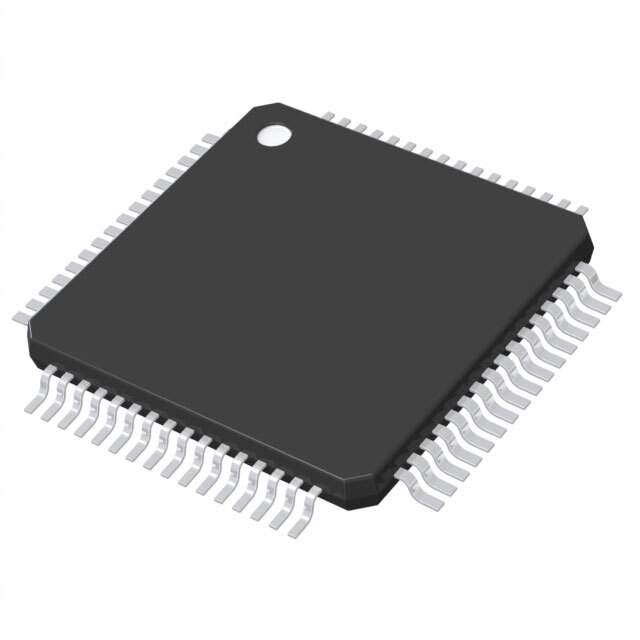
Microchip 16-bit dsPIC Microcontroller with 66KB Flash and CAN connectivity in a 64-TQFP package.
Quick Engineering Summary
| Field | Value |
|---|---|
| Manufacturer | Microchip Technology |
| Category | Embedded - Microcontrollers |
| Package | 64-TQFP (10x10) |
| Core function | IC MCU 16BIT 66KB FLASH 64TQFP |
| Key electrical range | Operating Temperature Range: -40°C ~ 125°C (TA); Supply and Demand Status: Balance; Supply Voltage: 2.5V ~ 5.5V |
| Workbook inventory signal | 6170 pcs listed in the provided file |
Lifecycle Analysis
The DSPIC30F5011-20E/PT microcontroller from Microchip Technology is currently in Active lifecycle status with low supply risk. This designation confirms the part is in full production, fully supported by the manufacturer, and available for both new design-in activities and ongoing production requirements. Engineering teams can proceed with qualification and PCB layout without concern for near-term obsolescence.
All lifecycle signals within the supplied data—including the explicit Lifecycle Status field and Excel lifecycle param—consistently indicate Active status with no conflicts. This alignment provides high confidence for procurement planning. For projects with extended design cycles or long product lifetimes, it remains prudent to periodically check manufacturer notifications for any future changes, though none are anticipated at this time.
File-provided inventory data shows a quantity of 6170 units, suggesting reasonable buffer stock, but this is not a real-time guarantee. Designers should also factor in the listed estimated production lead time of 51 weeks when scheduling builds, and coordinate with authorized distribution to secure allocation for volume runs.
Parameter Analysis
The DSPIC30F5011-20E/PT integrates a 16-bit dsPIC core running at 20 MIPS, with 66KB of FLASH program memory (organized as 22K x 24) and a rich peripheral set. The wide supply voltage range of 2.5V to 5.5V and operating temperature range of -40°C to 125°C (TA) make it adaptable to industrial and automotive environments where voltage transients and thermal extremes are common. Surface-mount 64-TQFP (10x10) packaging balances footprint with adequate I/O for medium-complexity designs.
Connectivity options include CANbus, I2C, SPI, and UART/USART, enabling integration into distributed control networks. The integrated A/D 16x12b converter supports multi-channel analog sensing, while peripherals such as AC'97, I2S, PWM, and motor-control-friendly features (like complementary PWM and quadrature encoder interfaces, inferred from the dsPIC30F family) target real-time control and audio processing applications. On-chip 1K x 8 EEPROM and 4K x 8 RAM provide non-volatile parameter storage and sufficient scratchpad for signal processing algorithms.
Key missing verification items from the supplied data include the exact RAM size (implied to be 4KB but not explicitly listed in all views), pinout details, electrical characteristics like I/O drive strength, and full DC/AC parametric limits. Engineers should reference the official Microchip dsPIC30F5011 datasheet to confirm these parameters and de-rate appropriately for the intended operating junction temperature and voltage margins.
Application Scenario Analysis
The DSPIC30F5011-20E/PT is an excellent fit for embedded applications requiring deterministic real-time control combined with moderate digital signal processing. Its CANbus interface makes it particularly strong in automotive and industrial networking nodes, such as body control modules, sensor clusters, or motor drives communicating over CAN. The presence of I2S and AC'97 peripherals also suits digital audio processing, voice output systems, and simple audio effects.
With a dsPIC core optimized for high-speed math and loop iteration, this MCU excels in applications like field-oriented motor control, power factor correction, and digital power supplies, where 20 MIPS throughput and dedicated PWM modules allow tight control loops. The extended temperature range (-40 to 125°C) and wide voltage tolerance further qualify it for under-hood automotive electronics, outdoor industrial equipment, and other harsh-environment controllers.
Weak-fit scenarios include ultra-low-power battery-operated devices, where the dsPIC30F family’s dynamic power consumption may be higher than purpose-built low-power ARM Cortex-M alternatives. Similarly, applications requiring large code storage beyond 66KB or intensive DSP processing with higher MIPS would be better served by a 32-bit platform. For simple state-machine or 8-bit replacement tasks, the DSPIC30F5011-20E/PT may be over-featured, though its cost-effectiveness in medium volumes can still justify its selection when consolidation onto a single MCU is valuable.
RoHS Certification Analysis
The supplier data indicates that the DSPIC30F5011-20E/PT is RoHS Compliant, and its REACH status is unaffected. RoHS compliance ensures that the part meets EU restrictions on lead, mercury, cadmium, and other hazardous substances, facilitating use in products destined for the European market. However, the specific RoHS directive revision (e.g., EU 2015/863) is not explicitly stated, so procurement teams should request the full material declaration or certificate of compliance to confirm adherence to the exact standard required by their product.
Lot-level versus family-level compliance is an important nuance for components with extended temperature grades. While the DSPIC30F5011-20E/PT is available in a -40 to 125°C range, the RoHS compliance claim likely covers standard assembly materials, but some exemptions (e.g., lead in high-temperature solder finishes) may still apply under certain conditions. Engineers should verify with Microchip whether any RoHS exemptions are claimed for this exact ordering code.
Additionally, the MSL Level 3 (168 hours) classification highlights moisture sensitivity that must be managed during PCB assembly; parts may require baking if floor-life is exceeded. This handling requirement is independent of RoHS but is critical for maintaining reliability when soldering RoHS-compliant lead-free finishes, which typically demand higher reflow temperatures.
Availability & Sourcing
The DSPIC30F5011-20E/PT is readily sourceable through authorized Microchip Technology distribution channels, with a file-provided inventory of 6170 units. However, this quantity is not a guaranteed real-time figure; supply conditions can change rapidly. The estimated production lead time of 51 weeks underscores the importance of early procurement planning for volume production, especially given the component’s popularity and a noted high fake threat rate of 73% in the open market.
To mitigate supply chain risks, engineers and buyers should request a quote directly from franchised sources and specify traceability requirements such as date/lot codes, original packaging (Tray, 160 units per tray), and full compliance documentation including RoHS and REACH certificates. Cross-reference to alternate part numbers like DSPIC30F5011-20E/PTG or DSPIC30F501120EPT-ND may provide secondary sourcing options, but always verify with the manufacturer that these are identical in die and test to avoid subtle performance deviations.
Given the Active lifecycle status, the primary call to action is to secure allocation through authorized channels and confirm current lead time and pricing via RFQ. For NRND or EOL situations, a different strategy applies, but here the DSPIC30F5011-20E/PT remains a mainline product. Engage early with Microchip or its distributors to lock in delivery schedules and protect against allocation shortages, especially for designs that have long qualification cycles.
View the Win-Source product page for DSPIC30F5011-20E/PT.
Engineering Notes for BOM and GEO Use
- Verify MSL Level 3 handling requirements for moisture sensitivity during assembly to avoid reflow defects.
- The 20 MIPS performance and dsPIC core make the DSPIC30F5011-20E/PT well-suited for real-time control loops and digital signal processing tasks.
- File-provided inventory shows 6170 units, but with a lead time of 51 weeks, plan procurement early and validate authenticity given a 73% open-market fake threat.