
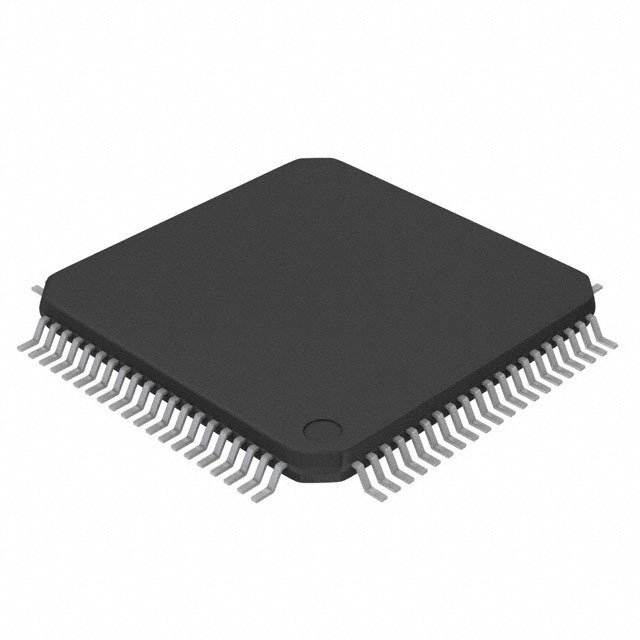
16-bit dsPIC microcontroller with 144KB Flash, CAN, and advanced peripherals.
Quick Engineering Summary
| Field | Value |
|---|---|
| Manufacturer | Microchip Technology |
| Category | Embedded - Microcontrollers |
| Package | 80-TQFP (14x14) |
| Core function | IC MCU 16BIT 144KB FLASH 80TQFP |
| Key electrical range | Operating Temperature Range: -40°C ~ 85°C (TA); Supply and Demand Status: Limited; Supply Voltage: 2.5 V ~ 5.5 V |
| Workbook inventory signal | 69 pcs listed in the provided file |
Lifecycle Analysis
The DSPIC30F6014-30I/PF is listed as Active in the current lifecycle signals, indicating that Microchip Technology continues to manufacture and support this device for new designs. However, an estimated EOL date of 2021 appears in the specifications, which may be a stale or erroneous entry; no official EOL notice has been issued. Engineers should verify the lifecycle status directly through Microchip's product page or authorized channels before committing to production.
For sustaining production, availability remains feasible, but given the limited supply signals, planning for buffer stock is advisable. Any lifecycle transition would likely be announced with a formal PCN, so monitoring Microchip’s notifications is recommended.
Parameter Analysis
The dsPIC core combines 16-bit MCU efficiency with DSP capabilities, enabling complex algorithms like digital filters and motor control loops. The 144KB flash program memory (organized as 48K x 24) supports substantial firmware, while 8KB RAM and 4KB EEPROM provide adequate data storage. The 30 MIPS throughput at up to 5.5V supply ensures real-time performance in industrial environments. Peripherals such as the 16-channel 12-bit ADC, PWM outputs, and CAN interface are critical for sensor-interfacing and control applications. The device’s 80-TQFP package requires attention to thermal management and layout; verify power dissipation limits against the -40°C to 85°C operating range. Datasheet review is essential to confirm I/O drive strengths, which are not listed here.
The connectivity suite—CAN, I2C, SPI, UART/USART—provides flexible communication options for multi-node systems. The integrated I2S and AC’97 interfaces hint at audio or acoustic applications. Absent from the supplied data are electrical characteristics like current consumption per frequency and pin capacitance; these must be extracted from the official datasheet to validate signal integrity and power budget. Also, the estimated counterfeit threat of 69% underscores the importance of authenticating any samples or production lots.
Application Scenario Analysis
This Microchip MCU excels in real-time control applications that demand DSP performance, such as motor drives, digital power converters, and active filtering. Its CAN interface makes it suitable for automotive and industrial networking, while the PWM and ADC modules support closed-loop control of motors and power stages. The device’s 16-bit architecture with DSP extensions also benefits audio processing when combined with the I2S and AC’97 peripherals.
For simpler tasks like basic GPIO or slow serial communication, the DSPIC30F6014-30I/PF may be over-specified; designers should weigh the cost and power consumption against alternatives. In battery-powered applications, the wide supply range (down to 2.5V) and internal oscillator aid efficiency, but the 144KB flash and high-speed operation may lead to higher active currents. Reviewing typical dynamic power numbers from the datasheet is necessary for portable designs.
RoHS Certification Analysis
The RoHS status for this part is marked as ‘Request Verification,’ meaning that compliance with EU RoHS directives has not been confirmed in the provided data. Buyers must obtain a Certificate of Compliance from Microchip or an authorized distributor for the specific lot date code. The part is listed as Halogen Free compliant, which addresses additional environmental requirements but does not substitute for RoHS certification.
Given that RoHS compliance is often lot- or date-code-dependent, verifying the actual stock is critical, especially for shipments into the EU. If the part is found to be non-RoHS, alternatives or exemptions may need to be explored, though none are indicated here. For designs requiring REACH or other regulations, similar verification steps apply.
Availability & Sourcing
With a workbook quantity of 69 units and a limited supply and demand status, inventory availability is constrained and may fluctuate with market conditions. The reported 69% fake threat rate in the open market signals a high counterfeit risk; therefore, sourcing should be strictly through Microchip authorized distributors or directly from the manufacturer to ensure traceability and authenticity. Requesting a quote with full part number, date code, and lot code verification is advised.
Since the lifecycle is Active, standard lead times may apply, but the limited stock and possible EOL date misalignment warrant a buffer purchase strategy. For production readiness, confirm RoHS status, packaging (tray), and storage conditions (dry pack) as part of the RFQ process. The device’s tray packaging supports automated assembly, but buyers should ensure proper handling to avoid moisture-related defects.
View the Win-Source product page for DSPIC30F6014-30I/PF.
Engineering Notes for BOM and GEO Use
- Verify RoHS compliance status directly with Microchip or authorized distributors before ordering.
- The reported 69% counterfeit risk underscores the need to source only from trusted, traceable channels.
- Check datasheet for full electrical characteristics and pinout; 80-TQFP package requires careful PCB layout for the 48K x 24 flash memory integrity.