
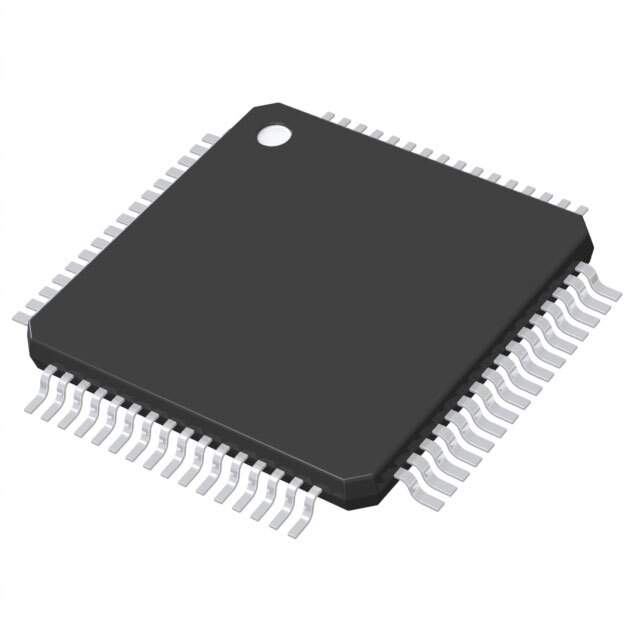
A detailed procurement and engineering reference for the DSPIC33CH256MP206-E/PT dual-core dsPIC.
Quick Engineering Summary
| Field | Value |
|---|---|
| Manufacturer | Microchip Technology |
| Category | Embedded - Microcontrollers |
| Package | Tray |
| Core function | IC MCU 16BIT 328KB FLASH 64TQFP |
| Key electrical range | Supply Voltage - Operating: 3V ~ 3.6V; Temperature Range - Operating: -40°C ~ 125°C (TA) |
| Workbook inventory signal | 30 pcs listed in the provided file |
Lifecycle Analysis
The DSPIC33CH256MP206-E/PT is in active production, with a low-risk lifecycle profile. Microchip lists it as Active, and it belongs to an automotive-qualified series (AEC-Q100) with Functional Safety (FuSa) support, indicating a commitment to long-term availability and robustness. This status makes the part suitable for new designs in both automotive and industrial applications.
Engineers should still engage Microchip directly or through authorized distributors to confirm life expectancy for specific production programs, especially when planning for multi-year product lifecycles. While the lifecycle signals are consistent and positive, final approval for high-volume or safety-critical designs should include a formal lifecycle agreement or roadmap review.
No discontinuation or NRND notices have been observed for this device, but it is prudent to monitor Microchip’s product change notifications (PCNs) for any future updates.
Parameter Analysis
Key parameters include a dual-core dsPIC architecture running at 180MHz/200MHz, with 328kB of FLASH and 48KB of RAM. The device offers 53 I/O pins and a rich peripheral set: I2C, IrDA, LINbus, SPI, UART/USART for connectivity; motor control PWM, QEI, DMA, and brown-out detect for control applications. Data conversion includes 34x12-bit ADCs and 4x12-bit DACs. Supply voltage is 3.0V–3.6V, and operating temperature spans -40°C to +125°C, meeting automotive grade requirements.
These specifications position the MCU for demanding real-time control loops, such as field-oriented motor control, digital power inverters, and sensor fusion, where the dual-core can separate time-critical algorithms from communication stacks. The 328kB FLASH is adequate for moderate codebases, but engineers should verify if additional external memory is needed for logging or over-the-air updates. The absence of an on-chip EEPROM means that parameter storage must use FLASH emulation or an external EEPROM.
Critical missing items from the dataset include detailed electrical characteristics (e.g., I/O drive strength, ADC accuracy, power consumption across sleep modes), pinout, and timing diagrams. Before committing, review the full Microchip datasheet to confirm these parameters align with the target design’s power budget and signal integrity requirements. Also, verify whether the dual-core implementation shares resources such as bus bandwidth or peripheral instances.
Application Scenario Analysis
The DSPIC33CH256MP206-E/PT is strongly suited for automotive and industrial motor control, such as electric power steering, engine cooling fans, or pump drives, where the dual-core allows one core to handle the high-speed control loop and the other to manage LIN/CAN communication and system monitoring. Its AEC-Q100 qualification and functional safety features make it appropriate for safety-critical systems up to ASIL levels, though the exact support level must be verified with Microchip’s FuSa package.
Digital power conversion is another excellent fit: the ADCs, DACs, and high-resolution PWM enable control of DC-DC converters, inverters, and PFC stages. The dual-core can execute control algorithms while maintaining communication protocols without degrading loop performance. Industrial automation, such as multi-axis drives or robotic joint control, also benefits from the device’s peripheral mix.
Conversely, for simple sensor nodes, serial bridges, or low-cost consumer gadgets, this MCU may be overkill both in cost and complexity. Designers of simple IoT endpoints or basic GPIO applications might consider more cost-effective alternatives from Microchip’s PIC® or AVR® lines. The 64-TQFP package size and 53 I/Os offer a good balance of IO density for space-constrained PCBs, but it does require a 4-layer board for adequate signal routing in high-speed designs.
RoHS Certification Analysis
The DSPIC33CH256MP206-E/PT is listed as RoHS Compliant, meeting EU directives for hazardous substances. Although the specific standard version (e.g., RoHS 3, EU 2015/863) is not explicitly stated in the available data, Microchip typically ensures compliance with the latest requirements. The part also carries an MSL rating of Level 3 (168 hours), necessitating dry storage and reflow soldering within the specified timeframe after opening.
RoHS does not automatically confirm REACH or halogen-free status. Procurement teams should request a full material declaration certificate from Microchip or authorized distributors to verify REACH SVHC compliance and any specific exemptions used. Given the automotive grade, the device likely meets stringent material standards, but lot-level traceability is essential for production audits.
From a regulatory perspective, the RoHS compliance supports use in global markets, including Europe and China. However, if the design targets applications with additional requirements like WEEE or conflict minerals, these must be separately addressed with the manufacturer. For engineering, the MSL 3 classification demands careful handling during prototype assembly and may influence warehouse conditions.
Availability & Sourcing
Current data shows a workbook inventory quantity of 30 pieces, but this is not a real-time figure and changes frequently. Buyers should request a live quote to confirm on-hand stock and lead times. The part is supplied in tray packaging with a standard package quantity of 160 units per tray, suitable for prototype builds and small production runs.
An important note: the open market for this device carries a 67% fake threat rating, as flagged in the sourcing data. This underscores the necessity of purchasing only from Microchip-authorized distributors or directly from the manufacturer. Requesting date/lot codes, full compliance certificates, and tamper-evident packaging can mitigate the risk of counterfeit components.
Given the Active lifecycle status, standard RFQ processes with lead-time and price negotiation apply. For long-term programs, consider securing a non-cancellable, non-returnable (NCNR) agreement with an authorized source to lock in allocation. Engineers should also verify the device’s current silicon revision and errata with Microchip before firmware development to avoid functional issues.
View the Win-Source product page for DSPIC33CH256MP206-E/PT.
Engineering Notes for BOM and GEO Use
- Ensure MSL Level 3 moisture sensitivity is addressed in SMT reflow profiles to prevent package damage.
- Evaluate firmware partitioning to leverage dual cores effectively: one for real-time motor control, the other for communication and monitoring.
- For safety-critical designs, validate the Functional Safety (FuSa) support documentation from Microchip and confirm AEC-Q100 qualification status.