
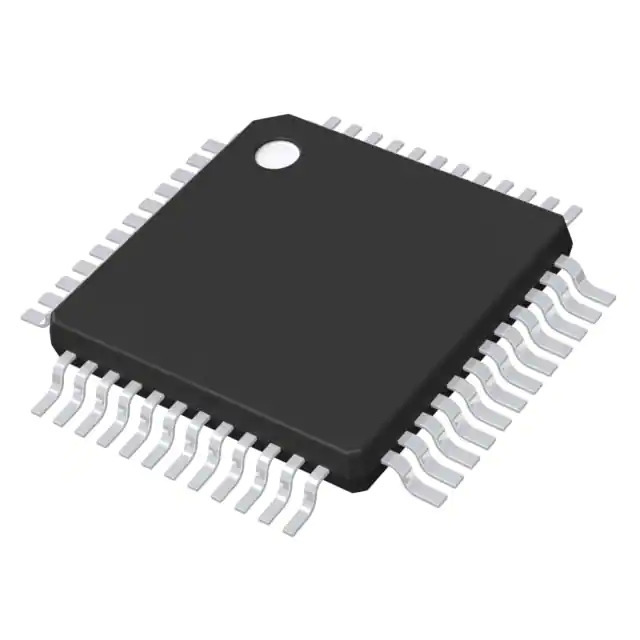
16-Bit Dual-Core dsPIC MCU with 328KB FLASH in 48-TQFP
Quick Engineering Summary
| Field | Value |
|---|---|
| Manufacturer | Microchip Technology |
| Category | Embedded - Microcontrollers |
| Package | Tray |
| Core function | IC MCU 16BIT 328KB FLASH 48TQFP |
| Key electrical range | Temperature Range - Operating: -40°C ~ 85°C (TA); Voltage - Supply (Vcc/Vdd): 3V ~ 3.6V |
| Workbook inventory signal | 1 pcs listed in the provided file |
Lifecycle Analysis
The DSPIC33CH256MP505-I/PT is currently active in Microchip’s portfolio, as confirmed by all lifecycle signals from the manufacturer and distribution data. Active status means the part is in full production, supported for new designs, and generally has stable lead times. For engineers, this is the most favorable lifecycle stage, allowing confident integration into new PCB designs without immediate risk of obsolescence.
However, even with an active status, it is prudent to validate the manufacturer’s product longevity program, especially for applications with long qualification cycles or extended production life. Microchip often provides longevity commitments for its dsPIC families. Procurement teams should also monitor any PCN (Product Change Notifications) that could affect form, fit, or function. The provided inventory file notes a single unit, which should not be interpreted as current stock; actual availability must be checked through authorized distribution.
Risk is assessed as low given the strong alignment of lifecycle signals, but continuous monitoring and a second-source strategy (if possible) are always recommended for supply chain resilience.
Parameter Analysis
The DSPIC33CH256MP505-I/PT features a 16-bit dual-core dsPIC processor with primary core speeds reaching 200MHz and secondary core at 180MHz. This asymmetric multi-core design allows segregation of real-time control loops (e.g., motor commutation) from communication stacks (e.g., CAN or LIN) on separate cores, reducing latency and simplifying firmware architecture. The 328KB FLASH and 48KB RAM provide ample space for complex algorithms and communication protocols.
An impressive analog integration includes 31 channels of 12-bit ADC and four 12-bit DAC channels, enabling direct sensor and actuator interfacing without external components. The motor control PWM and QEI peripherals are hardware-optimized for high-speed field-oriented control (FOC) and position feedback, making this device a natural fit for motor drives. Connectivity options (CANbus, I2C, IrDA, LINbus, SPI, UART/USART) cover most industrial and automotive communication needs.
Critical parameters to verify from the official datasheet include: package thermal resistance for worst-case power dissipation at 200MHz, internal oscillator accuracy over temperature, current consumption at various operating modes, and specific EEPROM emulation capabilities (note EEPROM size is marked as ‘-’). The MSL Level 3 designation requires baking and dry pack handling if the reflow cycle exceeds the 168-hour floor life. Designers should also confirm that the 3V–3.6V supply range aligns with their power rail tolerances and that the -40°C to +85°C operating range meets environmental requirements.
Application Scenario Analysis
The DSPIC33CH256MP505-I/PT is strongly suited for real-time embedded control applications where its dual-core architecture and specialized peripherals offer distinct advantages. Motor control systems—such as sensorless FOC for permanent magnet synchronous motors (PMSM), brushless DC (BLDC) drives, and stepper controllers—benefit from the high-resolution PWM, QEI, and fast ADC. The ability to offload communication tasks (CAN/LIN) to the secondary core enables responsive control in automotive and industrial automation nodes.
Industrial automation equipment, including PLCs, distributed I/O modules, and intelligent actuators, can leverage the part’s CANbus and LIN for fieldbus connectivity, while the rich analog front end simplifies analog signal conditioning. The Functional Safety (FuSa) series designation suggests it may target safety‑critical systems like appliance motor controls or sensor redundancy applications, though the exact SIL/ASIL level must be verified with Microchip.
Less ideal scenarios include ultra-low-power battery-operated devices where the dual-core, high‑speed operation may exceed energy budgets; devices requiring 5V I/O tolerance; and applications that need large external memory buses, as this package does not expose parallel memory interfaces. For such cases, alternative Microchip dsPIC or SAM families with low‑power features or EMIF might be more appropriate.
RoHS Certification Analysis
The part is labeled RoHS Compliant and REACH Unaffected, indicating that it meets EU directives restricting hazardous substances. While the specific RoHS directive version is not provided, current production typically adheres to RoHS 3 (2015/863) which includes additional phthalates restrictions. For formal certification, a Compliance Certificate should be obtained from Microchip’s environmental compliance portal.
REACH Unaffected status confirms that the product does not contain Substances of Very High Concern (SVHCs) above 0.1% weight by weight, which is a regulatory requirement for market access in Europe. However, REACH compliance does not automatically guarantee RoHS conformity, as RoHS has its own list of restricted substances. In this case, both declarations align, but for high‑reliability sectors (medical, automotive), full material declarations are advisable.
The MSL Level 3 rating is directly relevant to Pb‑free reflow soldering processes that are standard under RoHS compliance. Peak reflow temperatures for lead‑free solder typically reach 260°C, and the 168‑hour floor life after opening dry pack necessitates strict handling procedures. Assembly teams should plan for dry storage or baking prior to placement to avoid popcorn failures, especially with the thin 48‑TQFP package.
Availability & Sourcing
As an active Microchip product, the DSPIC33CH256MP505-I/PT is expected to be available through authorized distributors with standard lead times. The file-provided inventory quantity of 1 is not a real‑time reflection of market stock; procurement teams should request a quote for current availability and pricing. Because the part comes in tray packaging, it is typically supplied in full‑tray multiples, which may simplify ordering for medium‑volume production.
When sourcing, it is critical to use authorized channels to mitigate counterfeit risk: the open market fake threat is noted at 40%, underscoring the need for traceability back to Microchip. Requesting date/lot codes, certificates of conformance, and RoHS/REACH documentation from the supplier is recommended. For new designs, a sample order with full compliance documentation can help qualify the part before committing to volume purchases.
Lifecycle‑related actions: since the part is active, standard RFQ and P.O. placement processes apply. For sustaining production, establish a reorder point and safety stock based on lead‑time variability. If the part were to ever transition to NRND or EOL, a last‑time‑buy would be essential, but currently no such signals exist. Engineers and buyers should monitor Microchip’s PCN service for any changes that might affect sourcing strategy.
View the Win-Source product page for DSPIC33CH256MP505-I/PT.
Engineering Notes for BOM and GEO Use
- Verify MSL Level 3 and handle per J-STD-033 reflow recommendations to avoid moisture-induced delamination.
- The dual-core architecture running at up to 200MHz is optimized for real-time control loops requiring parallel sensor processing and time-critical motor or power algorithms.
- Confirm absence of on-chip EEPROM from full datasheet and plan for external non-volatile storage if parameter storage is needed.